The Fan is a short piece of music composed in NotateMe, "performed" in Sibelius and used as a soundtrack for a video of the ceiling fan in our sunroom taken in September 2009. Like my previous video, Baby Elephant Seal Walk, the music was completely finished before I sought out any visuals. I didn't select a title until I knew what the visuals were.
Astronomical scenes, flickering as if in an old movie.
Lunar landscape, vaguely changing focus.
Circumnavigating an unseen sun.
It must mean something.
Figure out what, exactly, by yourself.
Good luck with that.
Showing posts with label video. Show all posts
Showing posts with label video. Show all posts
Saturday, November 30, 2013

Saturday, February 23, 2013
A Woman Is Not A Drum
Can you use the human body as a percussion instrument? Sure - hit it and it will make a little sound. The body is just a big sack of meat and fluid plus a couple air chambers for resonance. Anyone (not just tenors as Anna Russell quipped) can have "resonance where their brains ought to be."
When it comes to slapping people it matters who you hit and how. The act of hitting another person, especially if you're hitting a woman, can lead to unintended results. You could end up looking like a jerk.
Chapter One: Hitting Yourself
Our story starts with hambone. That's where the performer slaps his own body, a musical style associated with black slaves in the Old South who, the story goes, were not allowed instruments lest they use them to secretly plan rebellion. (Their masters must have feared talking drums).
Here's a video introduction to hambone:
Here's another hambone video, this one from the famous American cultural institution Hee Haw. Here one-handed hambone is combined with an even more esoteric human-body percussion, rhythmic hand squeezing. (The marvelous vocals are called eefin.)
Chapter Two: Hitting Other People
Now watch this video:
Three formally dressed, but shoeless, musical sadists slap a resonant masochist. All in good fun, no doubt.
Although stylistically far removed from hambone, this video also shows the human body being used as a percussion instrument. With obvious differences...
Most importantly, these three performers are not hitting themselves. They are wailing on a fat man. Let's call him Drum Man. We know this is not their first take because Drum Man's drum head (i.e. his skin) is already quite red. And Drum Man starts the clip with a big sigh.
We can see his face the whole time. This gives us clues to his personality. Our hero seems to be taking his beat down with a sense of equanimity. Or maybe it's just detachment. "Okay," I imagine him saying "Let's get this over with."
Maybe he's got something to prove. "Do your worst," he might say, "I can take whatever you can give. I'm a real man." It's like watching the losing fighter being pummeled in a boxing match.
Drum Man's eyes are fixed on the camera, on us viewers. Maybe he's defying us. Is he saying "Who you lookin' at? You lookin' at me?"
Secondly, the players are getting a variety of musical sounds out of their "drum". Hitting his belly, his arms, his back and later his (facial) cheeks create different tones. There's enough timbral variety and humor to sustain interest for a quick minute.
I wonder if this video was made as a television commercial. I can't find the term "Equipo Elite Mundial" online. A sporting goods company perhaps?
Try imagining variations to this video:
Chapter Three: Duke Ellington's A Drum Is A Woman
Duke Ellington and Billy Strayhorn's A Drum Is A Woman is a large scale work from the late fifties - a suite of pieces that tell a story. You could think of it as an oratorio or even a short opera. It was used as a soundtrack for a television show and released as an album.
When I was in my twenties I first heard two songs from A Drum Is A Woman played as musical interludes in certain episodes of the BBC's Goon Show, originally broadcast in the fifties. The singer was Ray Ellington, an English son of a Black American entertainer and a Russian Jew. Ellington was his stage name. He was not related to Duke.
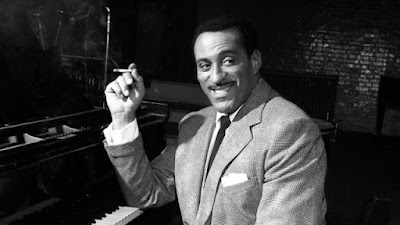
These two songs, You Better Know It and What Else Can You Do With A Drum, stood out because they contain references to hitting women. This struck me as strange content for a pop song. At the time I had no idea who had written them or why. (Another tune Ray Ellington sang, Bloodshot Eyes by Wynonie Harris, fell into the same category.)
Here are recordings of these tunes, clipped from Goon Show airchecks, plus some of the lyrics.
Ray Ellington sings You Better Know It from Duke Ellington's A Drum Is A Woman
Madame Zajj is the main character ("zajj" = "jazz", get it?). She is created out of a drum. She changes back into a drum. She is the drum and the drum is her. I guess, really, she is the rhythm itself, the rhythm which drives men wild.
Her love interest in this story is named Caribee Joe.
Duke's narration is sly and well modulated. His prose often turns flowery and surreal.
Duke makes his essential analogy at the top. Here are the very first lines of A Drum Is A Woman:
We should already have known that.
Chapter Four: Jorge Perez Gonzalez's Bottom Percussion
If Duke Ellington's A Drum Is A Woman is a delicate dance metaphorically combining love of music with love of women, then Jorge Perez Gonzalez's recent video Bottom Percussion PATAX shows just how low the art of metaphor has fallen.
Perez lines up four pairs of hairless naked be-thonged butt cheeks, arranges them so that's all we can see and then he spanks them with his hands, synching with a (prerecorded) instrumental track. He occasionally hits a suspended cymbal.
He tells us that this is music. I think he needs to be told that it isn't civilized to beat women. Or anyone. After all, it's not the Fifties any more.
Previously JPG's most watched video had about 30,000 hits in ten months. Bottom Percussion got hit over seven million times in just two weeks. Since Bottom Percussion is no more interesting musically than those other tracks (actually less interesting), it's not hard to figure that this popularity results from the particular "instrument" he uses and how he plays it.
People (meaning, in this case, mostly males, according to YouTube statistics) must want to see musicians hit women. With such a large viewership, Perez has almost certainly opened up a new You Tube revenue stream for himself. Sequels and copycats can't be far behind.
In an attempt to excuse himself from well-deserved accusations of musical misogyny, after two weeks Perez revealed that only two of the butts were female. The others were not female, they just appeared to be. He released another video showing these four people standing up afterwards with blurred faces. I guess the Butt Cheek People don't want their identities known. Maybe they are afraid that their mothers would find out.
At least Drum Man looked us straight in the eyes. And he only got hit above the waist.
When struck, the Butt Cheek People all make pretty much the same sound. Perez seems to carefully choose which cheek he will hit. But maybe he's just hitting randomly. There seems little musical point for changing cheeks. It's easy to imagine him thinking "I enjoy spanking one butt. Four butts will be four times more fun."
If Perez had chosen a wide variety of body sizes to beat on presumably there would be aural distinctions between them. A butt of a morbidly obese person might serve as the "bass butt". A little girl or boy butt might serve as the "soprano butt" (that's a disgusting thought because Perez ought to know that it isn't civilized to hit children. He could use a petite adult instead).
Maybe Perez only knows beautiful, hairless, tight-assed people with insufficient bodily resonance. I think it's more likely that he just likes to hit on butts.
Because Perez has posed his instruments so the camera can only see one section of their bodies and because he chose to portray them as identical and interchangeable, he can be validly accused of sexual objectification. Male or female, he has turned people into things. Thank goodness he only used his hands to hit them.
Watching videos of spanking turns some people on sexually. Some like to spank, others like being spanked. As long as the relationship is consensual there's no problem. Bottom Percussion really should be labelled as soft porn. Keeping music and porn as two separate categories would be the civilized thing to do.
Seven million hits can't all be wrong, can they? Everyone is free to draw the line between music and porn where they see fit. There are more than ten likes for every dislike.
You might want to compare Bottom Percussion with this definitely NSFW video which shows a man "performing" on a young girl's behind. Like Bottom Percussion you can't see the spankee's face. Unlike Bottom Percussion there is no pretense of musicality. It really is soft porn.
Others have called for Bottom Percussion to be removed from You Tube. That's never gonna happen.
Instead, I hope that Jorge Perez Gonzalez does many more videos and lives an extra long life - long enough to someday understand what is so objectionable about this performance. He has sunk to great depths without even knowing he's in a hole. Getting out of his hole is going to require an awful lot of time and effort.
Who knows - this video might make his career, lead him to fame and fortune, the way Kim Kardashian's sex tape benefitted her.
To "honor" Jorge Perez Gonzalez's musical travesty and maybe give hs career a little extra boost I've decided to dust off the long dormant Mixed Meters awards program called The Dockers. After all, this is awards season; the Oscars are this weekend.
The envelope please.
And the Docker For Setting A New All Time Artistic Low By Pretending That A Soft Porn Video Is Really Music goes to ... Jorge Perez Gonzalez for his video Bottom Percussion. Take a bow, Jorge.
Chapter Five: Jayne Cortez's If The Drum Is A Woman
I was happy to discover other, more civilized opinions which employ the metaphor of women and drums.
Jayne Cortez, who passed away recently, was a poet. She performed her work with a band called The Firespitters. Beyond her own successful career, she came of a high jazz pedigree as the mother of Denardo Coleman. She was once married to Ornette.
Her poem If the Drum Is A Woman speaks to the issue of domestic violence against women. The poem uses Duke's woman/drum metaphor. This seems like an appropriate way to conclude this post.
Here's a video of Jayne Cortez reciting If the Drum Is A Woman with accompaniment by The Firespitters. Appropriately they play a lot of drums in the background. Read the whole poem here. I include a short excerpt below.
It has been almost three years since I awarded the last Docker. This is a link to all the awards.
Mixed Meters has never discussed spanking before. But the subject of penises has come up a few times. Some of those posts even have musical connections.
Want more eefin? Check out this eefin post from WFMU.
Butt Tags: Duke Ellington. . . Ray Ellington. . . hambone. . . body percussion. . . spanking video
When it comes to slapping people it matters who you hit and how. The act of hitting another person, especially if you're hitting a woman, can lead to unintended results. You could end up looking like a jerk.
Chapter One: Hitting Yourself
Our story starts with hambone. That's where the performer slaps his own body, a musical style associated with black slaves in the Old South who, the story goes, were not allowed instruments lest they use them to secretly plan rebellion. (Their masters must have feared talking drums).
Here's a video introduction to hambone:
Here's another hambone video, this one from the famous American cultural institution Hee Haw. Here one-handed hambone is combined with an even more esoteric human-body percussion, rhythmic hand squeezing. (The marvelous vocals are called eefin.)
Chapter Two: Hitting Other People
Now watch this video:
Three formally dressed, but shoeless, musical sadists slap a resonant masochist. All in good fun, no doubt.
Although stylistically far removed from hambone, this video also shows the human body being used as a percussion instrument. With obvious differences...
Most importantly, these three performers are not hitting themselves. They are wailing on a fat man. Let's call him Drum Man. We know this is not their first take because Drum Man's drum head (i.e. his skin) is already quite red. And Drum Man starts the clip with a big sigh.
We can see his face the whole time. This gives us clues to his personality. Our hero seems to be taking his beat down with a sense of equanimity. Or maybe it's just detachment. "Okay," I imagine him saying "Let's get this over with."
Maybe he's got something to prove. "Do your worst," he might say, "I can take whatever you can give. I'm a real man." It's like watching the losing fighter being pummeled in a boxing match.
Drum Man's eyes are fixed on the camera, on us viewers. Maybe he's defying us. Is he saying "Who you lookin' at? You lookin' at me?"
Secondly, the players are getting a variety of musical sounds out of their "drum". Hitting his belly, his arms, his back and later his (facial) cheeks create different tones. There's enough timbral variety and humor to sustain interest for a quick minute.
I wonder if this video was made as a television commercial. I can't find the term "Equipo Elite Mundial" online. A sporting goods company perhaps?
Try imagining variations to this video:
- Instead of three male percussionists, how about three sexy women hitting Drum Man?
- Imagine the three sexy female drummers hitting a large, nearly naked woman who, like Drum Man, was just standing there, taking the hits with a blank expression on her face.
- Imagine these three male percussionists hitting the large woman instead of Drum Man.
- Finally, what if these guys were hitting on an extremely sexy woman? But only musically, of course. This post IS about music.
Chapter Three: Duke Ellington's A Drum Is A Woman
Duke Ellington and Billy Strayhorn's A Drum Is A Woman is a large scale work from the late fifties - a suite of pieces that tell a story. You could think of it as an oratorio or even a short opera. It was used as a soundtrack for a television show and released as an album.
When I was in my twenties I first heard two songs from A Drum Is A Woman played as musical interludes in certain episodes of the BBC's Goon Show, originally broadcast in the fifties. The singer was Ray Ellington, an English son of a Black American entertainer and a Russian Jew. Ellington was his stage name. He was not related to Duke.

These two songs, You Better Know It and What Else Can You Do With A Drum, stood out because they contain references to hitting women. This struck me as strange content for a pop song. At the time I had no idea who had written them or why. (Another tune Ray Ellington sang, Bloodshot Eyes by Wynonie Harris, fell into the same category.)
Here are recordings of these tunes, clipped from Goon Show airchecks, plus some of the lyrics.
Ray Ellington sings You Better Know It from Duke Ellington's A Drum Is A Woman
Zajj, darling. We're in love, it appears.Ray Ellington sings What Else Can You Do With A Drum from Duke Ellington's A Drum Is A Woman.
And I surely want to thank you.
But if you get ideas
I'll surely have to spank you.
There was a man who lived in Barbados
He saw a pretty woman one day
He took her home and when they got there
She turned into a drum.
It isn't civilized to beat womenSeveral tracks from Duke's original recordings of A Drum Is A Woman are available on YouTube:
No matter what they do or they say
But will somebody tell me
What else can you do with a drum?
- Part I: A Drum Is A Woman
- Caribee Joe/Congo Square
- Madame Zajj/Ballet of the Flying Saucers
- Part V - Caribee Joe - Part 2
Madame Zajj is the main character ("zajj" = "jazz", get it?). She is created out of a drum. She changes back into a drum. She is the drum and the drum is her. I guess, really, she is the rhythm itself, the rhythm which drives men wild.
Her love interest in this story is named Caribee Joe.
Once there was a boy named Caribee Joe.Zajj appears in scene after scene. She dances seductively at Mardi Gras. She's a snappy dresser. She drives a big car (one with 88 cylinders that goes 440 miles per hour - but she gets a ticket for stopping at a green light). Later she makes an entrance from inside one of those flying saucers.
Spoke with the animals in their jungle slang.
His heartbeat was like bongos
And he sang every song they sang.
One day he found an elaborately fabricated drum
And when he touched it, it actually spoke to him, saying,
"I am not a drum, I am a woman.
Know me as Madame Zajj, African chantress.
I can make you rich and famous.
Together we can travel
and make beautiful rhythm for the world."
But Joe was in love with the jungle, the virgin jungle,
God-made and untouched,
and with the jungle he had to stay.
The drum beat up a storm, screeching,
"I am the one and only Madame Zajj.
But there are many Joes,
and one Joe can make rhythm as well as another."
So she hopped a trade wind
And away she went to Barbados
in search of another Joe.
Duke's narration is sly and well modulated. His prose often turns flowery and surreal.
And we know it is about time now for the Mississippi RiverZajj turns out to be too much woman - or too much rhythm - for Joe. After travelling to New York, where he learns about be-bop in the jazz clubs, he seems happy to return to his jungle. There he teaches other drums to tell this story.
To look like a puddle of pecan blue pudding,
Pistachio and indigo, and the sun and the neon-rose lollipop
Is being drawn up over the horizon into a fizzy bunch of grape colored clouds.
Ahhh Hah! Madame Zajj.A Drum Is A Woman is really a story in which love of musical rhythm is metaphorically compared to the love for a woman. An allegory. Madame Zajj represents the essential rhythmic feel of jazz.
She's from way back, as far back as way back goes.
She's been way out, as far out as far out goes.
Enjoyed triumph on triumph, as the fanciest and the most famous.
Wealth and good looks. She has everything but Joe.
She draws on all the resources of sorcery,
Trying to steal Joe from the jungle.
Joe too has had a fair amount of success giving drums lessons.
And in the evening he sits by the fire
With his fabulous collection of drums around him.
And Joe likes to tell them about his trip to New York
And Madame Zajj's dream.
When Joe gets sleepy he takes his favorite
New shiny drum on his knee and says
"Now you tell me a story."
And the new drum clears her throat and starts to recite
"Once there was a boy named Caribee Joe.
One day he found an elaborately fabricated drum.
And when he touched it, it actually spoke to him,
Saying 'I am not a drum. I am a woman'."
Duke makes his essential analogy at the top. Here are the very first lines of A Drum Is A Woman:
A drum is a womanMetaphor or not, regardless of the quality of his music, we suspect that Ellington understood that he might be misunderstood - even back in the Fifties. I suppose that's why he feels the need to tell us "it isn't civilized to beat women".
Who won't stay out of your blood.
A drum is a woman
It's beat is like the quickening of a heart in love.
We should already have known that.
Chapter Four: Jorge Perez Gonzalez's Bottom Percussion
If Duke Ellington's A Drum Is A Woman is a delicate dance metaphorically combining love of music with love of women, then Jorge Perez Gonzalez's recent video Bottom Percussion PATAX shows just how low the art of metaphor has fallen.
Perez lines up four pairs of hairless naked be-thonged butt cheeks, arranges them so that's all we can see and then he spanks them with his hands, synching with a (prerecorded) instrumental track. He occasionally hits a suspended cymbal.
He tells us that this is music. I think he needs to be told that it isn't civilized to beat women. Or anyone. After all, it's not the Fifties any more.
Previously JPG's most watched video had about 30,000 hits in ten months. Bottom Percussion got hit over seven million times in just two weeks. Since Bottom Percussion is no more interesting musically than those other tracks (actually less interesting), it's not hard to figure that this popularity results from the particular "instrument" he uses and how he plays it.
People (meaning, in this case, mostly males, according to YouTube statistics) must want to see musicians hit women. With such a large viewership, Perez has almost certainly opened up a new You Tube revenue stream for himself. Sequels and copycats can't be far behind.
In an attempt to excuse himself from well-deserved accusations of musical misogyny, after two weeks Perez revealed that only two of the butts were female. The others were not female, they just appeared to be. He released another video showing these four people standing up afterwards with blurred faces. I guess the Butt Cheek People don't want their identities known. Maybe they are afraid that their mothers would find out.
At least Drum Man looked us straight in the eyes. And he only got hit above the waist.
When struck, the Butt Cheek People all make pretty much the same sound. Perez seems to carefully choose which cheek he will hit. But maybe he's just hitting randomly. There seems little musical point for changing cheeks. It's easy to imagine him thinking "I enjoy spanking one butt. Four butts will be four times more fun."
If Perez had chosen a wide variety of body sizes to beat on presumably there would be aural distinctions between them. A butt of a morbidly obese person might serve as the "bass butt". A little girl or boy butt might serve as the "soprano butt" (that's a disgusting thought because Perez ought to know that it isn't civilized to hit children. He could use a petite adult instead).
Maybe Perez only knows beautiful, hairless, tight-assed people with insufficient bodily resonance. I think it's more likely that he just likes to hit on butts.
Because Perez has posed his instruments so the camera can only see one section of their bodies and because he chose to portray them as identical and interchangeable, he can be validly accused of sexual objectification. Male or female, he has turned people into things. Thank goodness he only used his hands to hit them.
Watching videos of spanking turns some people on sexually. Some like to spank, others like being spanked. As long as the relationship is consensual there's no problem. Bottom Percussion really should be labelled as soft porn. Keeping music and porn as two separate categories would be the civilized thing to do.
Seven million hits can't all be wrong, can they? Everyone is free to draw the line between music and porn where they see fit. There are more than ten likes for every dislike.
You might want to compare Bottom Percussion with this definitely NSFW video which shows a man "performing" on a young girl's behind. Like Bottom Percussion you can't see the spankee's face. Unlike Bottom Percussion there is no pretense of musicality. It really is soft porn.
Others have called for Bottom Percussion to be removed from You Tube. That's never gonna happen.
Instead, I hope that Jorge Perez Gonzalez does many more videos and lives an extra long life - long enough to someday understand what is so objectionable about this performance. He has sunk to great depths without even knowing he's in a hole. Getting out of his hole is going to require an awful lot of time and effort.
Who knows - this video might make his career, lead him to fame and fortune, the way Kim Kardashian's sex tape benefitted her.
To "honor" Jorge Perez Gonzalez's musical travesty and maybe give hs career a little extra boost I've decided to dust off the long dormant Mixed Meters awards program called The Dockers. After all, this is awards season; the Oscars are this weekend.
The envelope please.
And the Docker For Setting A New All Time Artistic Low By Pretending That A Soft Porn Video Is Really Music goes to ... Jorge Perez Gonzalez for his video Bottom Percussion. Take a bow, Jorge.
Chapter Five: Jayne Cortez's If The Drum Is A Woman
I was happy to discover other, more civilized opinions which employ the metaphor of women and drums.
Jayne Cortez, who passed away recently, was a poet. She performed her work with a band called The Firespitters. Beyond her own successful career, she came of a high jazz pedigree as the mother of Denardo Coleman. She was once married to Ornette.
Her poem If the Drum Is A Woman speaks to the issue of domestic violence against women. The poem uses Duke's woman/drum metaphor. This seems like an appropriate way to conclude this post.
Here's a video of Jayne Cortez reciting If the Drum Is A Woman with accompaniment by The Firespitters. Appropriately they play a lot of drums in the background. Read the whole poem here. I include a short excerpt below.
If the drum is a woman
then understand your drum
your drum is not docile
your drum is not invisible
your drum is not inferior to you
your drum is a woman
so don't reject your drum
don't try to dominate your drum
It has been almost three years since I awarded the last Docker. This is a link to all the awards.
Mixed Meters has never discussed spanking before. But the subject of penises has come up a few times. Some of those posts even have musical connections.
Want more eefin? Check out this eefin post from WFMU.
Butt Tags: Duke Ellington. . . Ray Ellington. . . hambone. . . body percussion. . . spanking video
Monday, May 28, 2012
Conlon Nancarrow Documentary
You couldn't call my relationship to the music of Conlon Nancarrow "love/hate". It's more "like/dislike".
On the one hand his Studies have a jazzy, powerful, propulsive energy filled with spellbinding rhythms and spectacular gestures. That's the "like" part. But the sound of those extra-bright player pianos wears on me. I lose interest pretty quickly.
The importance of Nancarrow, to me at least, is that he pioneered the notion of the loner composer. He was the first to write music for a specialized musical device which gave him complete control over all aspects of his music. That device played the completed finished pieces. No performers were involved.

As technology has improved over the decades, especially with digital instruments, being a loner composer has become more and more common. These days a relatively modest investment in computers and software is all it takes to start making music far beyond the capabilities of any performer, real or imaginary. This is the way I compose and I'm very happy doing it.
I suppose some people are still scandalized by these developments. If you're such a person, remember that this method of composition is never going to eliminate composers who write for live performers. It does, I think, force them to write music for the real strengths of performers. These strengths include the abilities to interpret and improvise.
Also, this is also not going to eliminate live concerts. That's because aspects of live performance, notably something which might be called the 'spiritual' component, that ineffable communication between performer and listener, can't be approached by digitally created performances.
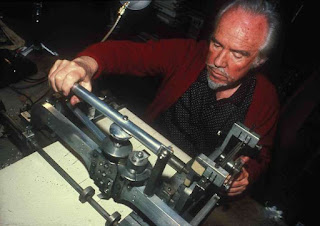
Conlon Nancarrow's music and methods were not precursors to the sequencers, samplers and electronica of today. I'm not aware of anyone still writing music for player piano. But he was the first to demonstrate that a composer can have a different relationship to listeners, not by imagining music and then giving it to instrumentalists and singers to perform, but by actually making the music directly using specialized tools in a studio,an analog of the way painters or sculptors do their work. When finished, the results are shared immediately with an audience.
With this in mind, you can see why I might be interested in a new video documentary about the life and music of Conlon Nancarrow. This video, which at the moment seems to be called only "Conlon Nancarrow Documentary", is available on Vimeo. It was produced at the University of Arkansas, the state where Nancarrow grew up. (The video is in high definition - if you, like me, have trouble getting it to stream, you can download the file in either large or small size for better playback. I burned mine to a DVD.)
Produced by James Greeson and Dale Carpenter, this documentary starts with Nancarrows childhood years, covers his politics and involvement in the Abraham Lincoln Brigade during the Spanish Civil War, his move to Mexico City in the 1940s and then his subsequent discovery and late-in-life fame. There's a section about the composer Trimpin who is hailed as a kind of successor to Nancarrow. There are talking heads aplenty and a couple performances of early piano works, ones Nancarrow intended for flesh and blood pianists.
The most interesting part, however, which inspired me to write this post, is that this video allows you to actually watch the player pianos playing Nancarrow's piano rolls. Not just the roll rolling past the tracker, but the actual internal workings of the piano itself - levers flexing, gears turning and wheels whirling. This is something I've never seen before and I found it particularly riveting.

During Nancarrow's years of fame his music was performed in concert all over the world - but almost always by tape recordings, not with actual player pianos. I saw such a concert in Los Angeles - mid-eighties, I guess. It was at the Japan-America Theater. The composer was present and he engaged in a question and answer session with the audience, moderated by composer William Kraft.
In this documentary, at one point, a talking head refers to Nancarrow as "shy". That's a good description of how he answered the audience's questions. He gave us virtually no information, preferring to quietly avoid questions. It became kind of funny.
Earlier in the concert there had been a presentation about his life and work. One picture showed a shelf of books about theories of time - a subject one would imagine to be of considerable interest to a composer who wrote music in multiple tempi. Nancarrow's extensive library is shown and discussed in this new documentary as well. As someone who long ago had been influenced by my own readings about time, I decided to ask him if he found any particular books on the subject influential. No, he replied quietly, he couldn't think of any.
Here's an interview with Nancarrow in which he is considerably more informative.
This documentary is, apparently, nearly finished. Here's an additional sequence of talking heads, apparently cut from the video, talking about Conlon's relationship to food: eating fried worms, drinking tequila, eating one fruit while looking at another, his kitchen where he cooked paella or ground curry powder.
Abraham Lincoln Brigade Tags: Conlon Nancarrow. . . video documentary. . . composer biography
On the one hand his Studies have a jazzy, powerful, propulsive energy filled with spellbinding rhythms and spectacular gestures. That's the "like" part. But the sound of those extra-bright player pianos wears on me. I lose interest pretty quickly.
The importance of Nancarrow, to me at least, is that he pioneered the notion of the loner composer. He was the first to write music for a specialized musical device which gave him complete control over all aspects of his music. That device played the completed finished pieces. No performers were involved.

As technology has improved over the decades, especially with digital instruments, being a loner composer has become more and more common. These days a relatively modest investment in computers and software is all it takes to start making music far beyond the capabilities of any performer, real or imaginary. This is the way I compose and I'm very happy doing it.
I suppose some people are still scandalized by these developments. If you're such a person, remember that this method of composition is never going to eliminate composers who write for live performers. It does, I think, force them to write music for the real strengths of performers. These strengths include the abilities to interpret and improvise.
Also, this is also not going to eliminate live concerts. That's because aspects of live performance, notably something which might be called the 'spiritual' component, that ineffable communication between performer and listener, can't be approached by digitally created performances.

Conlon Nancarrow's music and methods were not precursors to the sequencers, samplers and electronica of today. I'm not aware of anyone still writing music for player piano. But he was the first to demonstrate that a composer can have a different relationship to listeners, not by imagining music and then giving it to instrumentalists and singers to perform, but by actually making the music directly using specialized tools in a studio,an analog of the way painters or sculptors do their work. When finished, the results are shared immediately with an audience.
With this in mind, you can see why I might be interested in a new video documentary about the life and music of Conlon Nancarrow. This video, which at the moment seems to be called only "Conlon Nancarrow Documentary", is available on Vimeo. It was produced at the University of Arkansas, the state where Nancarrow grew up. (The video is in high definition - if you, like me, have trouble getting it to stream, you can download the file in either large or small size for better playback. I burned mine to a DVD.)
Produced by James Greeson and Dale Carpenter, this documentary starts with Nancarrows childhood years, covers his politics and involvement in the Abraham Lincoln Brigade during the Spanish Civil War, his move to Mexico City in the 1940s and then his subsequent discovery and late-in-life fame. There's a section about the composer Trimpin who is hailed as a kind of successor to Nancarrow. There are talking heads aplenty and a couple performances of early piano works, ones Nancarrow intended for flesh and blood pianists.
The most interesting part, however, which inspired me to write this post, is that this video allows you to actually watch the player pianos playing Nancarrow's piano rolls. Not just the roll rolling past the tracker, but the actual internal workings of the piano itself - levers flexing, gears turning and wheels whirling. This is something I've never seen before and I found it particularly riveting.

During Nancarrow's years of fame his music was performed in concert all over the world - but almost always by tape recordings, not with actual player pianos. I saw such a concert in Los Angeles - mid-eighties, I guess. It was at the Japan-America Theater. The composer was present and he engaged in a question and answer session with the audience, moderated by composer William Kraft.
In this documentary, at one point, a talking head refers to Nancarrow as "shy". That's a good description of how he answered the audience's questions. He gave us virtually no information, preferring to quietly avoid questions. It became kind of funny.
Earlier in the concert there had been a presentation about his life and work. One picture showed a shelf of books about theories of time - a subject one would imagine to be of considerable interest to a composer who wrote music in multiple tempi. Nancarrow's extensive library is shown and discussed in this new documentary as well. As someone who long ago had been influenced by my own readings about time, I decided to ask him if he found any particular books on the subject influential. No, he replied quietly, he couldn't think of any.
Here's an interview with Nancarrow in which he is considerably more informative.
This documentary is, apparently, nearly finished. Here's an additional sequence of talking heads, apparently cut from the video, talking about Conlon's relationship to food: eating fried worms, drinking tequila, eating one fruit while looking at another, his kitchen where he cooked paella or ground curry powder.
Abraham Lincoln Brigade Tags: Conlon Nancarrow. . . video documentary. . . composer biography
Friday, May 25, 2012
The Mister and Mockingbirds
Watch and listen to The Mister and Mockingbirds by David Ocker
282 seconds - © 2012 by David Ocker
It was May 16, 2012, a Wednesday. The sun was shining directly into our backyard. That's unusual except at this time of year as the sun journeys north to the spot at which it celebrates the solstice. The time was about 6:45 p.m. The sun was low on the horizon, moving down in the west to where, each evening, it celebrates another successful day. The sun, I guess, likes to party. And why not?
Leslie was puttering in her "victory" garden (tomatos and strawberries are very big this year) with Chowderhead following on her heels hoping she'll throw the ball or rooting in the bushes hoping to catch a small furry creature or protecting us by barking at other dogs as they walk their owners on the other side of the fence, out on the street.
I sat quietly on the patio watching the two of them. There was a slight breeze. Somewhere not far off and a little farther than that and again farther yet, a sequence of mockingbirds sang. Maybe they were trying to identify the limits of their individual tree domains. Or maybe that's something mockingbirds just do.
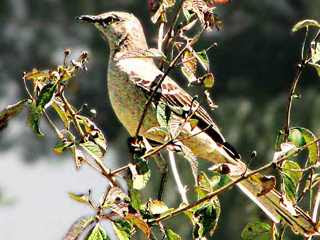
At one point, because she had decided that her hanging ferns needed water, Leslie turned on the misters.
Little hoses run under the patio roof feeding water to nozzles. These emit sprays of small droplets. More expensive misting systems produce super small droplets and might be used, say, to cool diners on fancy patios at expensive restaurants during hot weather. You can feel those drops but they're hard to see. Neither our patio nor our misters could be called fancy. The misters spray larger droplets and are intended to water the plants. Even so, if one sits the right distance from them, the spray can be very pleasant - a cooling showerette during any heatwave.
As it turned out, I was in just the right spot not only to enjoy the refreshing mist but to watch the sunlight reflect off each little drop as it fell. And there were a lot of drops. During their short lifespans these drops obey twin masters: gravitational attraction and wind currents. Maybe other masters as well, but my grasp of physics is weak. Each drop takes a slightly different course to its ultimate destination. As they fall they swirl. And they're very good at swirling.
Lit perfectly by the setting sun, the drops followed the wind as they fell to earth, forming sheets and clouds and clusters and more complex shapes and sometimes even shapeless amorphous indescribable masses of moving airborne bits of water, like a thousand monochromatic fireworks all going off at once creating a torrent of cool wet sparks in constant flux. Each one sang the sun's song as it rode the wind to its own landing point. (1)
I enjoyed watching this show. It was a near perfect moment. Simply enjoying it wasn't enough. I was struck with the notion to capture it on video.
So I pulled the aging point'n'shoot from my pocket and possessively made a video. I suppose I wanted to save the experience for later. I concentrated on the cloud of droplets. "This," I thought, "might be a good video for music." And then I added "David, please try to hold the camera steady."
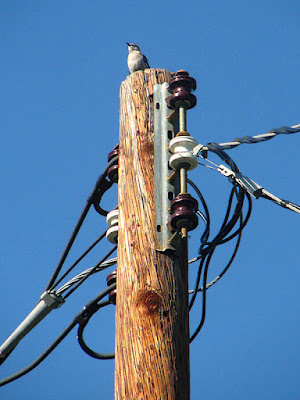
I think the music I wrote takes more inspiration from the mockingbird song than from the clouds of mist. That's okay. There's more than enough complexity in the moving image to keep your eye distracted while your ear listens. I tried to leave space in the music for the birdsong to come through. By "space" of course I mean "time". Or maybe "silence". I've been writing a lot of silence lately.
I've been fascinated with the musical possibilities of mockingbird song for a long time. I remember the first time I heard a mockingbird - it must have been 1975. I had been sent home from CalArts for something called "summer vacation". Before my long drive back to Iowa I was staying with two of my trumpet-playing buddies who were house sitting for their trumpet instructor in Hollywood. I was amazed by a bird which sang all night, spinning out a musically interesting continuously changing vocal solo - a John Coltrane bird. I figured it had been tricked into singing by the bright nighttime city lights, but apparently singing at night is something mockingbirds just do.
Anyway ... I've taken this combination of mockingbird song and clouds of water mist as the basis for a piece of music. A commemoration of a simple moment in my life, unmemorable except for the fact that I enjoyed it. Moreover, this is a good example of my desire to make art from the small things in life - the things that otherwise go unnoticed or get forgotten. Other composers can write music about the meaning of life or great love or destiny or fate or death or whatever eternal cosmic verity they care to choose. This piece, The Mister and Mockingbirds, is about where I was at on Wednesday May 16, 2012 at approximate 6:45 p.m. and what I did for about 5 minutes. And that is quite enough for one piece of music.
While we're on the subject of video...
It seems that water and birds are favorite subjects for my videos. The combination can most obviously be found in Water With Ducks and less obviously in Flap!
The Mister and Mockingbirds video benefits greatly from higher resolution. But even the 480p version on YouTube still suffers from blocky compression artefacts. It looks lots better streamed from my hard drive. Sorry about that. My grasp of video technology is weak.
And finally an announcement ... I've created a YouTube playlist devoted to my music videos. It's called David Ocker Music Videos. There are 19 of them which, according to YouTube, last a total of 54'54". Almost an hour. I described the playlist as containing...
I think the species of the mockingbird under discussion here is mimus polyglottos. A discussion of their vocal habits is here.
The title The Mister and Mockingbirds might remind you of this, but I suggest you not seek out more similarities because there aren't any.
(1) I worked hard to write this paragraph without using the phrase "danced on the wind". You're welcome.
Mocking Mist Tags: mockingbird. . . misters. . . music video . . . David Ocker
282 seconds - © 2012 by David Ocker
It was May 16, 2012, a Wednesday. The sun was shining directly into our backyard. That's unusual except at this time of year as the sun journeys north to the spot at which it celebrates the solstice. The time was about 6:45 p.m. The sun was low on the horizon, moving down in the west to where, each evening, it celebrates another successful day. The sun, I guess, likes to party. And why not?
Leslie was puttering in her "victory" garden (tomatos and strawberries are very big this year) with Chowderhead following on her heels hoping she'll throw the ball or rooting in the bushes hoping to catch a small furry creature or protecting us by barking at other dogs as they walk their owners on the other side of the fence, out on the street.
I sat quietly on the patio watching the two of them. There was a slight breeze. Somewhere not far off and a little farther than that and again farther yet, a sequence of mockingbirds sang. Maybe they were trying to identify the limits of their individual tree domains. Or maybe that's something mockingbirds just do.

At one point, because she had decided that her hanging ferns needed water, Leslie turned on the misters.
Little hoses run under the patio roof feeding water to nozzles. These emit sprays of small droplets. More expensive misting systems produce super small droplets and might be used, say, to cool diners on fancy patios at expensive restaurants during hot weather. You can feel those drops but they're hard to see. Neither our patio nor our misters could be called fancy. The misters spray larger droplets and are intended to water the plants. Even so, if one sits the right distance from them, the spray can be very pleasant - a cooling showerette during any heatwave.
As it turned out, I was in just the right spot not only to enjoy the refreshing mist but to watch the sunlight reflect off each little drop as it fell. And there were a lot of drops. During their short lifespans these drops obey twin masters: gravitational attraction and wind currents. Maybe other masters as well, but my grasp of physics is weak. Each drop takes a slightly different course to its ultimate destination. As they fall they swirl. And they're very good at swirling.
Lit perfectly by the setting sun, the drops followed the wind as they fell to earth, forming sheets and clouds and clusters and more complex shapes and sometimes even shapeless amorphous indescribable masses of moving airborne bits of water, like a thousand monochromatic fireworks all going off at once creating a torrent of cool wet sparks in constant flux. Each one sang the sun's song as it rode the wind to its own landing point. (1)
I enjoyed watching this show. It was a near perfect moment. Simply enjoying it wasn't enough. I was struck with the notion to capture it on video.
So I pulled the aging point'n'shoot from my pocket and possessively made a video. I suppose I wanted to save the experience for later. I concentrated on the cloud of droplets. "This," I thought, "might be a good video for music." And then I added "David, please try to hold the camera steady."

I think the music I wrote takes more inspiration from the mockingbird song than from the clouds of mist. That's okay. There's more than enough complexity in the moving image to keep your eye distracted while your ear listens. I tried to leave space in the music for the birdsong to come through. By "space" of course I mean "time". Or maybe "silence". I've been writing a lot of silence lately.
I've been fascinated with the musical possibilities of mockingbird song for a long time. I remember the first time I heard a mockingbird - it must have been 1975. I had been sent home from CalArts for something called "summer vacation". Before my long drive back to Iowa I was staying with two of my trumpet-playing buddies who were house sitting for their trumpet instructor in Hollywood. I was amazed by a bird which sang all night, spinning out a musically interesting continuously changing vocal solo - a John Coltrane bird. I figured it had been tricked into singing by the bright nighttime city lights, but apparently singing at night is something mockingbirds just do.
Anyway ... I've taken this combination of mockingbird song and clouds of water mist as the basis for a piece of music. A commemoration of a simple moment in my life, unmemorable except for the fact that I enjoyed it. Moreover, this is a good example of my desire to make art from the small things in life - the things that otherwise go unnoticed or get forgotten. Other composers can write music about the meaning of life or great love or destiny or fate or death or whatever eternal cosmic verity they care to choose. This piece, The Mister and Mockingbirds, is about where I was at on Wednesday May 16, 2012 at approximate 6:45 p.m. and what I did for about 5 minutes. And that is quite enough for one piece of music.
While we're on the subject of video...
It seems that water and birds are favorite subjects for my videos. The combination can most obviously be found in Water With Ducks and less obviously in Flap!
The Mister and Mockingbirds video benefits greatly from higher resolution. But even the 480p version on YouTube still suffers from blocky compression artefacts. It looks lots better streamed from my hard drive. Sorry about that. My grasp of video technology is weak.
And finally an announcement ... I've created a YouTube playlist devoted to my music videos. It's called David Ocker Music Videos. There are 19 of them which, according to YouTube, last a total of 54'54". Almost an hour. I described the playlist as containing...
Only those videos for which I have composed music, sorted (more or less) beginning with the most recent and ending with the most embarrassing. My first attempt to put music to a moving image was "Birds Who Don't Know The Words" - in 2007.Enjoy.
I think the species of the mockingbird under discussion here is mimus polyglottos. A discussion of their vocal habits is here.
The title The Mister and Mockingbirds might remind you of this, but I suggest you not seek out more similarities because there aren't any.
(1) I worked hard to write this paragraph without using the phrase "danced on the wind". You're welcome.
Mocking Mist Tags: mockingbird. . . misters. . . music video . . . David Ocker
Wednesday, May 23, 2012
A Brief History of John Baldessari
John Baldessari is a famous artist. He taught at Cal Arts while I was a student there in the seventies. Of course I never met him. Nor do I even remember seeing his works back then ... although I must have, of course. He is now respected, super successful and much honored - so the works I can't remember must have been pretty damn good.
A couple days ago I encountered an LA Times webpage entitled Tom Waits talks up artist John Baldessari in six-minute video. As I happened to have six extra minutes at that moment, I watched it. Fun stuff. Here's the YouTube link: A Brief History of John Baldessari .
Waits was apparently chosen because Baldessari likes his voice (and also possibly because the two came from the same hometown.) More than the voice, it's Waits' dry, wry delivery style that contributes so much. The video itself is a high energy assemblage: the artist as a talking head in his studio, pictures of the artist, his artworks, his stuff, places he's been and lots of moving text and graphic effects.
One quick bit of text (30 seconds in) says that Baldessari has been called "the Godfather of Conceptual Art" but with a telling, sophomoric, hysterical extra on-screen letter F which is conspicuously crossed out. Guy humor. Blink and you'll miss it.

(Go ahead, search Google for the phrase "Godfather of Conceptual Fart" to find out if anyone ever really said that about John Baldessari.)
The people who produced this video, no one I've heard of, are credited on the YouTube page.
These people are really the reason I enjoyed it so much. The bouncy pacing, witty writing and irreverant attitude combine to be lots more interesting than John Baldessari's art or Tom Waits' voice. Rossini and Bizet don't hurt either. I especially like a great new cadential chord in William Tell (at 1'50").
There's also an apparent reason for the Clint Eastwood reference: this video was produced for a LACMA gala where Baldessari and Eastwood were both feted by rich and famous people, possibly ones with short attention spans.
Later in the film we learn that "John Baldessari believes that every young artist should know three things":
Of course, maybe I did hear it. And I just can't remember now.
A recent MM post about another LACMA art project: Floating Rocks.
If you prefer your art in the streets rather than in the museums by artists who don't allow their picture to be taken, here are two MM posts: Street Art Now and Then and Banksy Speaks.
Conceptual Fart Tags: John Baldessari. . . Tom Waits. . . video biography. . . LACMA
A couple days ago I encountered an LA Times webpage entitled Tom Waits talks up artist John Baldessari in six-minute video. As I happened to have six extra minutes at that moment, I watched it. Fun stuff. Here's the YouTube link: A Brief History of John Baldessari .
Waits was apparently chosen because Baldessari likes his voice (and also possibly because the two came from the same hometown.) More than the voice, it's Waits' dry, wry delivery style that contributes so much. The video itself is a high energy assemblage: the artist as a talking head in his studio, pictures of the artist, his artworks, his stuff, places he's been and lots of moving text and graphic effects.
One quick bit of text (30 seconds in) says that Baldessari has been called "the Godfather of Conceptual Art" but with a telling, sophomoric, hysterical extra on-screen letter F which is conspicuously crossed out. Guy humor. Blink and you'll miss it.

(Go ahead, search Google for the phrase "Godfather of Conceptual Fart" to find out if anyone ever really said that about John Baldessari.)
The people who produced this video, no one I've heard of, are credited on the YouTube page.
directed by Henry Joost and Ariel Schulman (http://gosupermarche.com/)
edited by Max Joseph (http://www.maxjoseph.com/)
written by Gabriel Nussbaum (http://www.bankstreetfilms.com)
cinematography by Magdalena Gorka (http://magdalenagorka.com/) and Henry Joost
produced by Mandy Yaeger & Erin Wright
These people are really the reason I enjoyed it so much. The bouncy pacing, witty writing and irreverant attitude combine to be lots more interesting than John Baldessari's art or Tom Waits' voice. Rossini and Bizet don't hurt either. I especially like a great new cadential chord in William Tell (at 1'50").
There's also an apparent reason for the Clint Eastwood reference: this video was produced for a LACMA gala where Baldessari and Eastwood were both feted by rich and famous people, possibly ones with short attention spans.
Later in the film we learn that "John Baldessari believes that every young artist should know three things":
- Talent is cheap.
- You have to be possessed which you can't will.
- Being at the right place at the right time.
Of course, maybe I did hear it. And I just can't remember now.
A recent MM post about another LACMA art project: Floating Rocks.
If you prefer your art in the streets rather than in the museums by artists who don't allow their picture to be taken, here are two MM posts: Street Art Now and Then and Banksy Speaks.
Conceptual Fart Tags: John Baldessari. . . Tom Waits. . . video biography. . . LACMA
Wednesday, April 18, 2012
Morgenrot
Here's a little movie I ran into on the Internet. If you've ever wished someone would push a burning piano - an old upright in this case - from the top of the Empire State Building, then this video will be three and a half minutes well spent.
Lots of sepia tones. A very old feel. New York in slowest motion. I suspect that this is a work of high technology - although you might never notice the technique as you watch the piano fall.
The film is credited to Jeff Desom, the music, entitled Morgenrot, a simple waltz from the album Ferndorf, to Hauschka.
Here's another piano epic by the same duo - Bloksky - focusing more on the artist than on the instrument.
Burning Piano Tags: Hauschka. . . Jeff Desom. . . music video
Saturday, March 31, 2012
Tim Minchin
Here are videos by Tim Minchin. I had never heard of him until yesterday.
He's an Australian living in Britain. He has unkempt red hair and uses lots of eye-liner. He writes songs which he sings while playing the piano. He's a very talented guy. Also very funny. Very uninhibited when it comes to discussing sex. Prudes and Republicans will not approve.
More importantly, his music shows a strong political sense. If you believe in things like religion, alternative medicine or the paranormal, Tim Minchin is not going to amuse you.
Some of his songs are definitely NOT SAFE FOR WORK since he often deals with sexual topics. The first video at least makes the effort at a G rating. It was written especially for television broadcast in the UK. It's clean - if you ignore the double entendres.
I like self-reflexive art like this: songs about songs. Here he performs at the Proms, with full symphonic accompaniment. It's a song about singing the pitch F-sharp while playing in the key of F.
Tim does not mince words about controversial subjects. The Pope Song, for example, deals with priestly pedophilia - a hot button topic. He clothes this delicate subject with countless repetitions of the f-word Reminds me of Frank Zappa in that sense.
You could compare Minchin to Victor Borge, as a comedian pianist - only with sex. Or to Tom Lehrer, as a comedian, pianist, social commentator - only with sex added. Minchin's use of clever wordplay can be really remarkable - I'd compare that aspect of his work to someone as good as Cole Porter - just with lots of explicit sex.
In this last video, an animation of a Minchin monologue, you might sense a resemblance to Ken Nordine. You might get the impression that Tim is a really smart guy who does not suffer fools one little bit. Someone who's pretty confident that his way of understanding of the world is the proper one and isn't afraid to get into your face to tell you just how wrong you are.
There's a lot more Minchin on YouTube. What the heck - here's one more: Some People Have It Worse than Me - which contains this great existentialist line:
This just in: Tim Minchin here in Los Angeles on April 10 at Amoeba Records in darkest Hollywood. He's got a lot of work to do before he cracks the U.S. market.
I know it's a pale comparison to Minchin's songs, but you could listen to my own piece which overuses the word fuck: Frustration Etude No. 1.
Fuck Tags: Tim Minchin. . . songwriter
He's an Australian living in Britain. He has unkempt red hair and uses lots of eye-liner. He writes songs which he sings while playing the piano. He's a very talented guy. Also very funny. Very uninhibited when it comes to discussing sex. Prudes and Republicans will not approve.
More importantly, his music shows a strong political sense. If you believe in things like religion, alternative medicine or the paranormal, Tim Minchin is not going to amuse you.
Some of his songs are definitely NOT SAFE FOR WORK since he often deals with sexual topics. The first video at least makes the effort at a G rating. It was written especially for television broadcast in the UK. It's clean - if you ignore the double entendres.
I like self-reflexive art like this: songs about songs. Here he performs at the Proms, with full symphonic accompaniment. It's a song about singing the pitch F-sharp while playing in the key of F.
Tim does not mince words about controversial subjects. The Pope Song, for example, deals with priestly pedophilia - a hot button topic. He clothes this delicate subject with countless repetitions of the f-word Reminds me of Frank Zappa in that sense.
You could compare Minchin to Victor Borge, as a comedian pianist - only with sex. Or to Tom Lehrer, as a comedian, pianist, social commentator - only with sex added. Minchin's use of clever wordplay can be really remarkable - I'd compare that aspect of his work to someone as good as Cole Porter - just with lots of explicit sex.
In this last video, an animation of a Minchin monologue, you might sense a resemblance to Ken Nordine. You might get the impression that Tim is a really smart guy who does not suffer fools one little bit. Someone who's pretty confident that his way of understanding of the world is the proper one and isn't afraid to get into your face to tell you just how wrong you are.
There's a lot more Minchin on YouTube. What the heck - here's one more: Some People Have It Worse than Me - which contains this great existentialist line:
But the total non-existence
of colonic animation
Seems to me
the perfect metaphor
for the utter constipation
of my soul.
This just in: Tim Minchin here in Los Angeles on April 10 at Amoeba Records in darkest Hollywood. He's got a lot of work to do before he cracks the U.S. market.
I know it's a pale comparison to Minchin's songs, but you could listen to my own piece which overuses the word fuck: Frustration Etude No. 1.
Fuck Tags: Tim Minchin. . . songwriter
Monday, February 27, 2012
Music that Moves
Here are three videos. Each in it's own way pushes the art of music notation to the breaking point. Fun stuff.
First, a piano piece even Lang Lang could't play - unless he became a computer:
Ever heard of Ferninand Ries? Neither have I. But, judging by this, his music can be a real thrill ride:
Finally: a new form of computer-aided tablature. All you have to do in order to perform this drum solo yourself is to follow the moving lines with your own sticks. But be quick about it.
Read about this video.
Dots and Lines Tags: Music Notation. . . computer music notation
Tuesday, July 05, 2011
Selling with Vivaldi
(If you have time to watch only one of these videos, definitely watch the last one, Beer Vivaldi.)
In the museum-like world of classical music one of the most revered and oft-displayed masterworks is a set of violin concertos, The Four Seasons of Antonio Vivaldi. These pieces easily evoke meteorological images in the minds of listeners who, after all, have come to believe that music is really just like a movie - but without anything to watch.
But these pieces are among the very few which have a life as part of contemporary pop culture. They aren't as well known as the Ode to Joy or the Ride of the Valkyries. One doesn't have to look too hard to hear them in unexpected places - for example, as a soundtrack to a television commercial.
This short advertisement, running currently on television, shows a fearless stunt every-man jumping out of his luxury car onto an auto carrier, in hopes of acquiring an even better luxury car. The exciting derring-do music is the end of the first movment of Vivaldi's Winter. Perfect images for baroque music, don't you think?
Lest you think Vivaldi can only be used to sell automobiles, here's an ad for Hewlett Packard computers. The music is from Vivaldi's Summer and the guy waving his hands, creating fantastical images in mid-air, is none other than Joshua Bell, a violinist most famous perhaps for his performances in the Washington Metro. If he really could make visuals like these, live on stage just by waving his hands, Bell could probably become a really big star.
Lest you think that Vivaldi can only be used to sell autos and computers, here's another ad, with the very same Joshua Bell performing the same movement from the same Vivaldi concerto. The only difference is that in this one he is selling perfume, not that you can tell until the very end. Listen for the horrible cut in the music, just before the voice over.
Lest you think that Vivaldi's Four Seasons can only be used to sell high cost, high tech or high prestige items, here's an example of it being used for a different type of product. We see a scruffy college student amidst piles of forbidding obscure tomes, apparently translating an oriental language. In his notebook he writes "The divine truth one must find lies within." This idea provokes him first to deep thought and then to begin a quest through the stacks of the library. What he finds is ... a package of noodles. (Actually it finds him.) The remainder of the saga involves fancy kitchen prep work - the kind performed nightly by inscrutable Japanese chefs at your local Benihaha.
If you're paying attention, however, this commercial should make you want to buy an Audi. Yes, this noodling music comes from the same Vivaldi movement so perfect for jumping out of your car on a busy freeway.
These four uses of Vivaldi are all pretty standard capitalist realism - art in the service of profit. Our last example is much more interesting, vastly more creative, much more focused on Vivaldi's music - it's another performance of the same Winter movement which we've heard twice already. Alas, it is also much more forgiving of over consumption - in this case the item being promoted is beer. The image we see is a creative inebriate, an otherwise anonymous person called Pianobloke who must be a big fan of beer, creating pitches on a wide selection of beer in bottles, cans and glasses - the last of which he performs like a glass harmonica. These recorded snippets are assembled into Vivaldi using fancy video editing.
This video is chock full of visual imagery. There's no way to catch everything the first time. Go to YouTube and watch in high definition if you can. Notice that the first note is performed on a bottle of Duff, the beer of the Simpsons. After the music finishes each bottle of beer gets a cameo shot. Then our hero passes out. Congratulations, Pianobloke, a job well done. If you can turn out something like that I guess you weren't really that drunk. Why would you want us to think you were?
Other Mixed Meters pieces discussing classical music in advertising:
Advertising with Disney Hall "It would be a much better world if you were reminded of classical music each time you saw the bank's stagecoach, rather than being reminded of a bank each time you saw the concert stage."
In Which David Is Confused by The Second Coming "Does this, I wonder, sell shoes or religion?"
Who is Weiden & Kennedy Anyway "A dark story of crushing defeat as the home team loses by one point in the last second because an opponent is wearing better shoes. Life is like that, huh?"
Violin Concerto Tags: Antonio Vivaldi. . . The Four Seasons. . . television advertising. . . beer. . . capitalist realism. . . Joshua Bell
Saturday, April 24, 2010
30 Second Spots - A Newspaper In Traffic
You're probably wondering what sorts of things do I do at Mixed Meters when I'm not worried about foolish opera festivals and frightening neo-Nazis. One thing is that I take pictures of trash, things other people have thrown away and no one else, except me, ever looks at.
If I find trash which is moving I make a video of it. Sometimes I write some music to go with the video. I never know what sort of music to expect and neither should you.
To that end, here's a little video drama, complete with my musical soundtrack, entitled "(Sometimes I Feel Like) A Newspaper in Traffic".
Our hero is a sheet of newsprint, a flyer advertising loss leaders for a large grocery chain. The paper is separated from his friends and far from the safety of his metal rack. I found the paper on a busy Pasadena street directly across from a store in that large grocery chain. Crossing a street is quite an accomplishment for something with no motor abilities at all.
As the scene opens, our hero is being attacked by a series of terrible mechanized war machines from the present against which he has no defense. He must roll with every punch. But during a lull in the attacks he is able to regain some lost ground by gliding on a gust of wind. Eventually the enemy regroups and the sheet of paper is driven off. Apparently things end badly for our protagonist.
(Sometimes I Feel Like) A Newspaper In Traffic © 2010 by David Ocker 99 seconds. You can find the video directly on YouTube here. Please consider watching in hi-def. Please consider leaving a comment.
Other recent videos of mine:
Flashing (for Kraig Grady)
Water With Ducks
Flap
Squawk! (in which a peacock sings a short phrase from the Joe Liggins tune "The Honeydripper")
Rain Random
Traffic Tags: David Ocker. . . Newspaper. . . Traffic
Wednesday, March 10, 2010
30 Second Spots - Water With Ducks
According to Blogger this is Mixed Meters' 500th post. Read my first uncharacteristically short post here. It's dated September 16, 2005.
The principal reason I started Mixed Meters was to have a place to share the tiny musical compositions I was regularly creating on my laptop during visits to Starbucks. I called these things "30 Second Spots" in spite of the fact that they are never exactly thirty seconds long. You can read more about the whimsical rules of 30-second-spot writing here.
There must be a couple hundred spots so far. No one is counting. Some of them are embarrassingly bad. I tried to combine the better ones into a surrealistic CD album. What I discovered is that longer pieces were essential to balance a torrent of short pieces. Now, 18 months later, I find the album mildly embarrassing and way too long.

Lately I haven't posted much music on Mixed Meters because I haven't been able to prioritize composing time. I do have one 5 minute piece ready to post. It was to have been my holiday offering ... for last Christmas. Wait for it.
On Monday night I decided to make time for composing. I ignored several unfinished pieces and created a new 30 Second Spot instead. This spot has video.
I shot the clip last month at the Los Angeles County Arboretum. There are birds in it. Many of the videos to which I've composed music have birds in them. What's that about?
Here's a landscape picture taken at the Arboretum that same day. Click to enlarge.
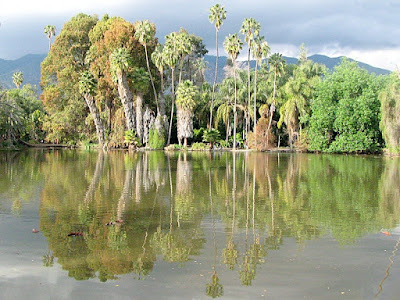
The music begins with a small melodic fragment. This was sung to me by some wind chimes as I took my daily walk on Monday. I worked it around in my head as I walked and it transformed into an infamous melody from the Dark Musical Ages. Opera queens and music theory nerds will recognize it immediately. Leslie, when she listened, had no clue that anything was quoted. However, she did accuse me of sexism in the treatment of the female duck. Everyone's a critic. Please leave your comment in the space provided.
I suggest you watch in High Definition.
Water With Ducks - © 2010 by David Ocker - 77 seconds
Here are links to other videos with my music. Some of them qualify as 30 Second Spots I suppose.
BLOBS
FLAP!
Rain Random
Squawk (This video was also taken at the LA County Arboretum)
Birds Who Don't Know the Words
The Chowder Jump (One video with three different sound tracks. The third is a combination of the first two)
You Can Pet Dinosaurs (This doesn't have any music, but it's the most popular item I've ever posted on the Internet.)
Duck Tags: 30 Second Spots. . . David Ocker. . . LA County Arboretum. . . ducks. . . water
The principal reason I started Mixed Meters was to have a place to share the tiny musical compositions I was regularly creating on my laptop during visits to Starbucks. I called these things "30 Second Spots" in spite of the fact that they are never exactly thirty seconds long. You can read more about the whimsical rules of 30-second-spot writing here.
There must be a couple hundred spots so far. No one is counting. Some of them are embarrassingly bad. I tried to combine the better ones into a surrealistic CD album. What I discovered is that longer pieces were essential to balance a torrent of short pieces. Now, 18 months later, I find the album mildly embarrassing and way too long.

Lately I haven't posted much music on Mixed Meters because I haven't been able to prioritize composing time. I do have one 5 minute piece ready to post. It was to have been my holiday offering ... for last Christmas. Wait for it.
On Monday night I decided to make time for composing. I ignored several unfinished pieces and created a new 30 Second Spot instead. This spot has video.
I shot the clip last month at the Los Angeles County Arboretum. There are birds in it. Many of the videos to which I've composed music have birds in them. What's that about?
Here's a landscape picture taken at the Arboretum that same day. Click to enlarge.

The music begins with a small melodic fragment. This was sung to me by some wind chimes as I took my daily walk on Monday. I worked it around in my head as I walked and it transformed into an infamous melody from the Dark Musical Ages. Opera queens and music theory nerds will recognize it immediately. Leslie, when she listened, had no clue that anything was quoted. However, she did accuse me of sexism in the treatment of the female duck. Everyone's a critic. Please leave your comment in the space provided.
I suggest you watch in High Definition.
Water With Ducks - © 2010 by David Ocker - 77 seconds
Here are links to other videos with my music. Some of them qualify as 30 Second Spots I suppose.
BLOBS
FLAP!
Rain Random
Squawk (This video was also taken at the LA County Arboretum)
Birds Who Don't Know the Words
The Chowder Jump (One video with three different sound tracks. The third is a combination of the first two)
You Can Pet Dinosaurs (This doesn't have any music, but it's the most popular item I've ever posted on the Internet.)
Duck Tags: 30 Second Spots. . . David Ocker. . . LA County Arboretum. . . ducks. . . water
Friday, March 05, 2010
Rubes
On the front page of RubeGoldberg.com you can read the definition of the phrase "Rube Goldberg" as defined by Webster's New World Dictionary. Yes, "Rube Goldberg" has been part of our own English language since 1931.
Farther down the page you can also read that the phrase "Rube Goldberg" is a registered trademark of Rube Goldberg Incorporated and permission to use the trademark must be secured in advance and in writing.
I guess it's now possible for corporations to own parts of the English language. The Republicans must be so proud.
Anyway, a "Rube Goldberg device" is an invention designed to do a simple task in a complex mechanical fashion. Read more about Rube at Wikipedia.
By that definition, the amazing contraption in the following music video by the group OK GO is NOT a Rube Goldberg device, since it accomplishes nothing useful. I suggest watching in high definition. Keep your eyes on the background. The video is highly entertaining. Too bad about the music.
My favorite moment is the rotating guitar which plays a bit of the song on tuned glasses. My other favorite moment is the television and the sledge hammer. Watch for the pile of TV's from the previous takes.
This Too Shall Pass reminded me of a Honda commercial from a couple years ago. That's not a R.G. device either - it accomplishes nothing useful. The video is more elegant but less fun than the OK GO video. It's not plagued by music - except a bit of drum box near the end - so you can enjoy the clinking and clanking.
I hunted around YouTube for something else Rube Goldbergish that actually accomplished some task. There's a lot out there to check out - and I didn't bother to look too hard. (This is, after all, one of those Mixed Meters posts designed for quickness not depth and I would like to go to bed soon.) But here's one that starts with an alarm clock and ends with curtains being opened. Those curtains aren't on a bedroom window but they could have been, I guess - and then some useful work would have been accomplished.
Here's another Honda commercial - more in the creepy, threatening Pulp Fiction mode.
Yet again, thanks to John Steinmetz for pointing me to Mixed Meters' better material.
Rube Tags: Rube Goldberg. . . Ok Go. . . Honda commercial
Tuesday, December 15, 2009
Crash Bang Boom
I looked for music-related old-time school instructional videos on the site http://www.avgeeks.com
I found this one. It's really annoying. Also mesmerizing. Also incredibly stupid. It's called Crash, Bang Boom. Learn about percussion instruments (and there's a rock band to watch and a chorus to listen to):
Here are the credits:
As a bonus, but only of tangential relevance, here's a more dramatic, less educational MM favorite: Music for One Apartment and Six Drummers:
(This vid doesn't load? Click here.)
The subject of Musical Instruments comes up rather often on Mixed Meters. Click here. Don't expect anything educational.
Crash Bang Boom Tags: instructional video. . . percussion
I found this one. It's really annoying. Also mesmerizing. Also incredibly stupid. It's called Crash, Bang Boom. Learn about percussion instruments (and there's a rock band to watch and a chorus to listen to):
Here are the credits:
Copyright (c) MCMLXX by Eric Productions
Produced by Eric Productions
Richard Jackson
Dale Jergenson
As a bonus, but only of tangential relevance, here's a more dramatic, less educational MM favorite: Music for One Apartment and Six Drummers:
(This vid doesn't load? Click here.)
The subject of Musical Instruments comes up rather often on Mixed Meters. Click here. Don't expect anything educational.
Crash Bang Boom Tags: instructional video. . . percussion
Tuesday, December 08, 2009
Shard by Elliott Carter - doubled
Shard is a solo guitar piece by famous high-modernist centenarian New York composer Elliott Carter who writes not-my-favorite music. To me it sounds difficult and not much else.
Here are two versions from You Tube. If played simultaneously they produce a curious phasing synchronization - a mad mad improvisation.
INSTRUCTIONS: Start the top video first. When it gets to 5 or 6 seconds start the second. You might need to let both videos load completely first. The vagaries of Internet speed may affect your personal experience.
Watch the players faces for best effect.
If you have trouble with this, you might try this link instead where the two will start automatically. Good luck.
The separate videos are here and here.
Thanks to Tom Brodhead for sending me the link to performer two. He compared the experience of listening simultaneously with the nausea of radiation therapy.
Shard Tags: Shard. . . Elliott Carter. . . solo guitar
Here are two versions from You Tube. If played simultaneously they produce a curious phasing synchronization - a mad mad improvisation.
INSTRUCTIONS: Start the top video first. When it gets to 5 or 6 seconds start the second. You might need to let both videos load completely first. The vagaries of Internet speed may affect your personal experience.
Watch the players faces for best effect.
| YouTube Doubler |
If you have trouble with this, you might try this link instead where the two will start automatically. Good luck.
The separate videos are here and here.
Thanks to Tom Brodhead for sending me the link to performer two. He compared the experience of listening simultaneously with the nausea of radiation therapy.
Shard Tags: Shard. . . Elliott Carter. . . solo guitar
Wednesday, July 29, 2009
Funny Piano (part 1)
Here are some video links with one thing in common. All involve a piano and none of them involve a cat and all are kind of funny. Well, I thought so.
In the first my favorite pianist Glenn Gould introduces the "brilliant German reductionist" composer Karlheinz Klopweisser. In this short promo Karlheinz explains the difference between German silence and French silence. Watch it here or you can download the video from UbuWeb.
Next we have another larger-than-life fictional character, Andre Previn, conducting Grieg's Piano Concerto on a 1971 English television show while he was conductor of the London Symphony.
Finally we have a clip from a 1963 Jack Parr show on which then former Vice-President Richard Nixon performs a snippet of his own Piano Concerto. (Sadly the audio is missing at the end.) Tricky Dick seems very relaxed and even cracks a joke.
Funny Piano Tags: Glenn Gould. . . Andre Previn. . . Richard Nixon
Monday, June 01, 2009
John Roasts Roger
My buddy Roger Lebow has a strange malady - every ten years, when the second digit of his age number turns to zero, he throws himself a big birthday party. Like yesterday afternoon.
My buddy John Steinmetz roasted Roger. I made a video with the point'n'shoot in my pocket. In an era of instant picture posting this is available the morning after - just like those old-fashioned newspaper things.
As always, my apologies for the sound (I was far away in a boomy room) and for the occasional camera jerk (I laughed sometimes too). If you go to the YouTube page you can annotate the video with your own comments.
Other Mixed Meters videos in a similar vein which you may enjoy: Vinny Introduces Anne and Vinny Introduces Me.
Click here to see John Steinmetz's many Mixed Meters appearances, most recently about the Push Poke Prod Press. This is Roger's first feature appearance but he has been thanked previously.
And before I forget: Happy Birthday, Roger. I was gonna get you a card - but this will have to do.
Roast Tags: Roger Lebow. . . John Steinmetz. . . comedy roast
Friday, December 05, 2008
Economy of Motion
Tim Mangan, Orange County's music critc, posted this link to a performance of Ravel's Bolero by Orchestre de Paris under the direction of Christoph Eschenbach who uses the least amount of motion possible to conduct an orchestra. Almost none.
There's not much for a conductor to do in that piece. It's more like Eschenbach is supervising or maybe leading telepathically. Raised eyebows, twitches, head snaps and his clenched jaw muscles are all he needs. He finally does wave his arms. You can guess when. It seems that he manages to attract a lot of attention by not moving.
The video is in two parts. Listen for little variations by the bassoonist and the tenor player.
It reminded me of this short clip of Pierre Boulez leading a bit of Debussy's Nocturnes looking a bit like private security guard. Or maybe a Secret Service Agent without his earpiece. Or a character in the movie Men In Black.
And that clip reminds me of another clip posted to MM years ago.
And that reminded me of this:
Stiff Conductor Tags: Christoph Eschenbach. . . Pierre Boulez. . . Darth Vader. . . ASIMO. . . orchestra conductors
Friday, November 14, 2008
Three High Speed Music Videos
Mixed Meters offers you ways to waste your time at warp speed. Hang on.
The first one comes from Guinness and Cream Cakes. It was described (in jest I hope) as the first rap song. It's from a 1936 movie called Night Mail with music apparently written by Benjamin Britten after he returned home from a performance of Facade.
Here's another video found at Guinness and Cream Cakes. Martha Argerich plays the Scarlatti Toccata damn fast!
I found Guinness and Cream Cakes via Violins and Starships. Until now, Mixed Meters has never mentioned Guinness except on Bloomsday.
Finally here's some Zappa music with frantic imagery.
I found this one at Andrew Durkin's Jazz: The Music of Unemployment I'd like to tell you that these are the sort of images Frank would have liked - but I'll have to check with Gail first to see if that's still true.
In which I blather about Scarlatti - one of my favorite composers.
Cream Cake Tags: Benjamin Britten. . . Domenico Scarlatti. . . Frank Zappa
Monday, September 01, 2008
Gloomy Bear Solar Figurine
Here's a polar bear picture which I took here in Los Angeles.

Notice that the bear looks pretty happy, with kind of a sly smile on its face, probably because it is just sitting down to a fine repast. Notice that no blood is visible.
Here's a little video of my birthday present from Leslie, a Gloomy Bear solar figurine:
Notice the splotches of blood on Gloomy Bear's chest, paws and face. Gloomy's pretty vicious, as cute cuddly anime figures go. Notice our cat Crackle who seems oblivious to the danger.
Never heard of Gloomy Bear? Neither had I. Here's a video from something called Japanorama that explains his origins, sort of a pop follow-up to Hello Kitty:
The stuffed polar bear picture is part of a diorama at the Natural History Museum of Los Angeles County, where Leslie works. Here's a Mixed Meters article about imaginary animals which stalk the museums noisy vaulted hallways.
Here's an article about a previous birthday gift from Leslie. Thanks, honey.
Polar Bears meet Penguins?
Gloomy Tags: Gloomy Bear. . . solar powered figurine. . . polar bear. . . NHMLAC. . . birthday present
Subscribe to:
Posts
(
Atom
)