Friday, October 12, 2007

Bird Brains of Pasadena

Here are a bunch of recent photos of our avian friends, all taken in my immediate environs of Pasadena California. The first shot, pigeons in a light pole line up, is one I've wanted to take for a long time but it had to wait until I got the new higher-zoom point and shoot.

pigeons line up on lamp post (c)David Ocker
I've also wanted to use the camera for pictures of the crows because they won't let humans get close to them. I haven't seen many around lately. It would be really cool to capture a flock of wild parrots flying in bright sunlight. All those flashes of green are impressive. Probably never happen.

a hawk on a traffic signal (c)David Ocker
Yesterday I saw a hawk fly out of a tree, cross a street and land on a traffic signal pole. It ignored me, right below it, as it scanned the area for a juicy pigeon. I waited for a chance at another of my most-wanted pictures - a hawk in flight.

tail of the hawk in flight (c)David Ocker
I was lucky to get just the tail. Maybe I'll get the whole bird next time.

The bricks in the picture below are actually painted plywood - a phony facade to hide cellphone antennae. The fake owls are to keep pigeons away. Certain pigeons, however, are fearless.

fake owl and stupid pigeon (c)David Ocker
Several days ago I noticed this little colorful ball of fluff in a small lawn sprinkler excavation next to the sidewalk. I stopped to take a picture of it.

ball of feathers next to the sidewalk (c)David Ocker
To my surprise it moved and out popped a head. I thought it was a parakeet but Leslie says it's a Lady Gouldian Finch - obviously an escaped pet. A trio of these birds is the logo for Viewsonic (as displayed on my own computer monitor.)

Lady Gouldian Finch on ground (c)David Ocker
This tiny bird was somewhat the worse for wear - lethargic and missing a lot of red head feathers. I suspected it was on the ground because it couldn't fly. While pondering whether I should leave it to its fate I stepped back as a gaggle of high school students passed by.

Lady Gouldian Finch missing head feathers (c)David Ocker
One student (the absent-minded tall one) noticed the bird. Another (I guess a future mass murderer) said "Kick it." There was a small chorus of female voices saying "No". The gaggle walked on forgetting.

Lady Gouldian Finch on ground (c)David Ocker
I poked birdie with a small stick and was relieved that it had functioning legs and wings. It flew into a nearby tree. Here's my last view of it, blending into the surroundings but almost certainly just waiting to be some predator's dinner. When I looked at this picture I noticed bands on its legs - white on the left, black and red on the right.

Lady Gouldian Finch in tree with leg bands (c)David Ocker
Our outdoor cat, MacTabby, has never brought us presents before. But this dead bird appeared on our front porch recently. A few hours later it disappeared. I don't want to know.

dead bird on our porch (c)David Ocker
Finally a bird inside our house: a statue of a pelican with a bromeliad growing on the base. Leslie won this at a meeting of LAUPS. I liked it enough to add it to our Kitchen Kitsch Korner.

Kitchen Kitsch - pelican statue (c)David Ocker
The pictures all get bigger if you click on them.

Pasadena may have birds, but not the dumbest birds. Here's an amusing bird brain post at Alex Shapiro's green-colored blog about making music with seaweed.

Here, here, here and here are previous M.M. posts with pictures of birds. Here's my first and only backyard hummingbird picture - posted last August on Mixed Messages.

Brain Tags: . . . . . . . . . . . . . . .

Saturday, October 06, 2007

Composers About Composers: Richard and John and Richard

RICHARD STRAUSS

It may be as much of a surprise to you as it is to me: I've been reading an actual book: The Third Reich in Power by Richard J. Evans It's the second book of a trilogy and it covers the Nazi dictatorship during peacetime, 1933 until 1939. Evans' prose is a surprisingly easy read.

Under the grander topic of propaganda is a chapter about music. Classical music was considerably more important there in Germany then than it is here in the U.S. now. Richard Strauss, Germany's most famous living composer, became President of the Reich Music Chamber, the organization responsible for unifying the music world according to Nazi ideals. (Here's some background.) Strauss, to his credit, didn't have the cajones to play hardball with the Nazis - but apparently he did have plenty of composerly ego.
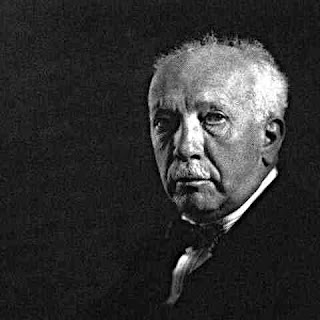

Here's a short excerpt from page 203 of the book, ending with a quote from old Richard himself:
Great orchestras continued to perform great music under the baton of great conductors, although the range of music performed, and the number of prominent conductors who directed it, were both smaller than before 1933. Yet many considered that there were no new great composers. Strauss himself took this view. If anything, it even increased his already unshakeable sense of his own importance as the heir of the great tradition of German composers. 'I am the last mountain of a large mountain range, ' he said: 'After me come the flatlands."

JOHN ADAMS


Mixed Meters regulars will know of my relationship with John Adams. Along with allowing me to make a living in music, I get a unique (if somewhat tunnel-vision) look at his scores long before they're performed. I've known him for many years but that doesn't mean we get many chances to talk. So to supplement my from the wings view of THE in-demand living composer, I resort to reading what he says to the media.

Last summer, the premiere of his Doctor Atomic Symphony was broadcast over the Internet by the BBC. Here's a paragraph transcribed from the back announcement (what the announcer said over the applause at the end) :
"Well, I like something John Adams said recently, when he was talking about being a contemporary classical composer in today's American cultures, being pretty much a useless activity even though he's one of the most performed living composers. He says he's off the broad cultural radar in the U.S.A. but that he consoles himself by thinking that Emily Dickinson and Walt Whitman were unappreciated and misunderstood in their lifetime and are now feted as amongst America's greatest cultural treasures. "I guess that's why we call it classical", he added "we're buying long term bonds here." (Andrew MacGregor, BBC announcer.)
Recently John has been in Baltimore. The Baltimore Sun website has this article by Tim Smith. John is quoted:
"There are a lot of composers today," Adams said, "just not a lot of original ones. You could count the number of great composers today on half a hand."
Later in the article he names names. Of course John's opinions are filtered through the critic's prose. To quibble about words for a bit, I think John might have been telling us who he thinks are the (other) "good" composers these days, those whose music he himself likes. But the quote and the article seem to confuse "originality" and "greatness" two very different things.

Here's a picture of John posing for a publicity photo in Disney Hall during December 2005.
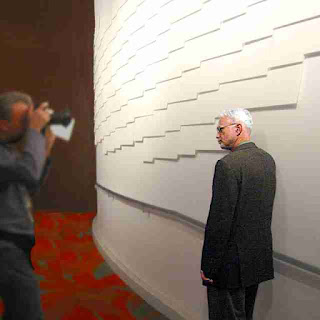
John Adams @ Disney Hall Dec 2005 (c) David Ocker
Being "great" means being accepted, even revered, by lots of people over a very long time. These days it means competing with guys like Bach or Beethoven. John is indeed a candidate for inclusion someday. Our culture doesn't allow easy entry into this category. Judging by the recent head counts it's easier to become a Catholic Saint than a truly Great Composer.

On the other hand "originality" means breaking barriers, being unique, unpredictable and unclassifiable. There's a whole spectrum of originality ranging from too much ("eccentric" "weird" or "incomprehensible") to not enough ("derivative" "repetitive" or "old-fashioned"). We demand just the right amount of originality from our contemporary music. We want it to be more original than pop music but not so original that we can't enjoy it at first hearing.

As John's elevation among the mountain range of living composers continues to increase he probably gets asked the "who else" question more and more. The question itself and apparently his recent responses tend to focus peoples attention on fewer and fewer candidates. Too bad about that.


RICHARD EMMET

I met Richard Emmet long ago at the CIA.1 I worked with him both at the ICA 2 and at the ICA 3. Then he showed good sense, moved away from LA to Portland, where he raised a family and is now finding happiness.

Several months ago he visited Southern California for the first time in a long while. Here's a picture of him at a local Thai restaurant attacking a plate of Mango Sticky Rice with great determination.
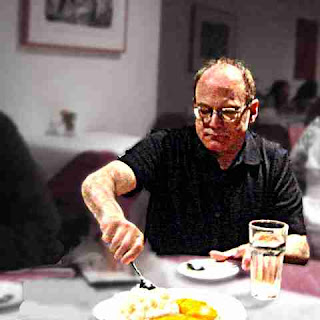
Composer Richard Emmet attacks a plate of Mango Sticky Rice (c) David Ocker
While he was here we were able to talk a little about the music we've both been writing lately. I promised to send him a disc of my stuff - which I have yet to do. Until then I suggested that he listen to some of my pieces on this very website (over there in the left hand column). Richard's own website, with samples of his music, is available here.

Richard did find a few moments to listen and he wrote about his reactions.
"Well, it took me awhile, but I finally listened to several of your electronic pieces. I don't think I can fully express how impressed I was. Your music is unmistakably unique: it has attitude, humor, amazing variety and tonal coloring, endless surprises and strange juxtapositions, great use of spatial perspective, and whatever this means, it feels like it could only have come from California. It has echoes of Harry Partch and maybe a bit of FZ [Frank Zappa], but it is completely your own. I hope you continue doing this."
I was flattered. He agreed to let me publish his comments here. Obviously Richard is a man of rare intelligence and perception. I don't really understand why my music could only come from California. Maybe he'll leave a comment and explain.

Meanwhile, here's a close up of that same plate of Mango Sticky Rice. It was very good; this picture is has the more accurate color.
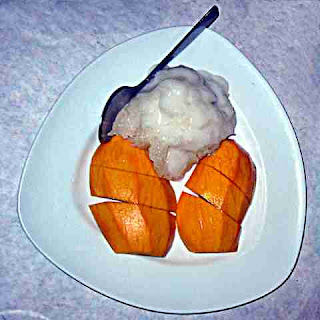
a plate of Mango Sticky Rice at Saladang, Pasadena CA (c) David Ocker

Cultural Radar Tags: . . . . . . . . . . . . . . . . . . . . . . . .

FOOTNOTES:

1 Richard and I met while students at the California Institute of the Arts.
2 Richard and I were both active in the Independent Composers Association.
3 Richard and I were both employees of InterContinental Absurties, Frank Zappa's production company.

Thursday, October 04, 2007

Hawaii - Buildings and Decay

I continue to post pictures from our Hawaii trip over at Flickr. Here's a link to all of them.

There's a set of panorama shots - mostly from Kiluaea volcano - stitched together with a program bundled with my new camera..

And here's a set of pictures of buildings - both from Hilo and Honolulu.

Rusty Roof at Hilo Jail (c) David Ocker
Hilo seemed like a bizarre combination of small Iowa city and lush tropical paradise. My first visual impression was of rust. The climate causes things to decay in a fashion unfamiliar to someone who has lived in an artificially irrigated desert since 1974.

A Rusty Shed in Hilo (c) David Ocker
Although Hilo is having a drought, an average month of rainfall there is still more than the total precipitation in Los Angeles for all of last year. When I mentioned to a local gentleman that this seemed like a good place to be in the roofing business he said "Termites are even better."

In Honolulu we stayed in just another of a zillion large tall hotels. Although I'm sure my first impression was of bluer water and whiter sand, my lasting impression of Waikiki will be of tall monotonous architecture.

high rise facing Waikiki (c) David Ocker
Yeah, it's a beautiful view. And in an effort to share the view with as many people as they can, developers seem to have told their architects to produce lots of ticky-tacky thereby cheapening the view. Touch the sky with a grid of balconies.

I spent one morning wandering a maze of Japanese-tourist-fueled Rodeo Drives, photographing an endless geometric progression of minimalist skyscrapers.
And new buildings are still going up - so the post-minimalist period may not have yet begun.

high rise facing Waikiki (c) David Ocker
These and other pictures are in my Buildings and Decay set at Flickr.
A few of my favorites were a rusty corrugated roof at the Hilo Jail and some deco buildings in Honolulu.

An older building facing Waikiki beach (c) David Ocker
Meanwhile, this trip was the first time I've traveled with an iPod. I found the experience largely wonderful. On long solitary walks (while Leslie slept or shopped or shipped out), on long airline flights with lousy movies, during interminable airport waits, or just about any other time I was alone, having a choice of my own "hand picked music" was "priceless".

I listened repeatedly to two albums which consistently fit any situation and amplified my good moods: Terry Riley's A Rainbow in Curved Air and Glenn Gould playing English Suites by J.S. Bach. Scarlatti sonatas deserve an honorable mention for breakfasting by the bay in Hilo. Music by Nancarrow and Feldman however struck out big time and have been banished from my little red Nano.

Ticky Tacky Tags: . . . . . . . . . . . . . . . . . . . . . . . . . . . . . . . . .

Every Mixed Meters post about our trip to Hawaii.
Click picture = see it larger.

Monday, October 01, 2007

Creatures - Real and Fantastic

Leslie is on a ship in the middle of the Pacific - somewhere in Hawaii but still in the middle of nowhere. She's working with government agents to identify illegal aliens - little spineless ones. "Introduced invertebrate marine species" she'd probably say.

But being cooped up in her lab in a big tin can tossed about on the endless waves has made her even more homesick than seasick.

Through the wonder of modern technology she's been calling home. The ship is equipped with a satellite phone. They get Internet too and she's been checking Mixed Meters from mid-ocean.

I volunteered to post some recent pictures of the creatures she shares her life on dry land with. Me, the dog, a couple of cats. You know the drill.

To make it a little more interesting for the rest of you I'm also including some fantasy creatures. Some are from our home, two are from Hawaii, others from elsewhere. She'll know.

Yellow Critter with Big Red Mouth (c) David OckerStuffed Frog and Plywood Cupholder (c) David OckerThe Ackles in a Laundry Basket (c) David OckerRide 'em colors (c) David OckerStingers (c) David OckerA Japanese Mole Like Critter (c) David OckerScary Owls (c) David OckerTwo green things with beady eyes (c) David OckerDavid Ocker (c) David OckerOaxacan Frog (c) David OckerA green critter with big eyes and a red star (c) David OckerChowderhead's Head (c) David OckerClick any pic to enlarge it. Besides our house and Hawaii, three pictures were taken at Robocon, a fascinating Japanese toy store near the Empress Pavilion (a fine place to eat dim sum in LA's Chinatown.) I took one picture at my doctors office, another at OSH in Pasadena.

Thursday, September 27, 2007

30 Second Spots - Three Pieces In The Shape Of Chowderhead's Genitalia

At least two of Mixed Meters' three readers think I'm unnaturally fixated on our dog Chowderhead's recent emasculation. (Read all about it.) My response to this criticism is ... yeah, probably.

However MM's third reader (our man at Oxford) wrote to suggest that there ought to be a Symphony for Chowderhead's Testicles. Leslie extended the suggestion: "It should be bouncy."

Taken in Hilo Hawaii - Hilo Guitars (c) David Ocker
So, always sensitive to requests from the readership, while I was in Hawaii I wrote three 30 Second Spots intended to form a larger piece. I entitled them

Three Pieces In The Shape of Chowderhead's Genitalia.

Not a good title. (It refers to this. Another link.)

The three pieces are entitled:
  1. Left Ball
  2. Penis
  3. Right Ball
You'll hear all three by clicking on this little MOG widget.


Meanwhile I've uploaded more of my 3000 Hawaii pictures to Flickr. Click here. They are forming themselves into thematic groups. This group contains pictures of all different varieties of signs and sculptures. For example, here are two sculptures of women:

The red-headed mannequin - near Waikiki beach (c) David Ocker
Above the fire place at Volcano House - Kiluaea Volcano in Hawaii (c) David Ocker

An explanation of 30 Second Spots Be sure to read my update comment.

Dog Tags: . . . . . . . . . . . . . . .

Sunday, September 23, 2007

Mister Composer Head Talks About Sincerity

I've just posted a new essay by Mister Composer Head, over there on the blog called Mister Composer Head. Mr. C. writes about sincerity in performing music. The story revolves around his own experiences singing a country song in concert and the various reactions it received.

You can read Mister Composer Head Talks About Sincerity by clicking on this sentence.

He also talks about the relative sincerities of Bruce Springsteen and Gloria Estefan and the effect of stardom on them.

Someone painted this on a sidewalk (c) David Ocker
Here's a personal comment: he says a nasty thing about editors. As a some-time editor of music and as Mr. Head's amanuensis-ist I would like to point out that my contribution to his posts is limited to adding a few pictures and highlighting a few sentences in red - sometimes for good reason. Nothing else. All spellings are Mr. C's own. Whatever.

One more thing - he tells a very touching story about singing while thinking about his wife Mrs. Composer Head. I think that bit of the story is actually about the power of music because Composer Head is not someone you think of as having tears in his eyes. Nope.


Sincere Tags: . . . . . . . . . . . .

Monday, September 17, 2007

Going To Hawaii

I read an article (like this one) about medical research showing that people who take regular vacations are healthier and live longer than people (like me) who don't. "Let's go on a vacation." I said to Leslie afterwards.

We decided to spend a week in Hawaii. Afterwards Leslie would join a cruise on the Oscar Elton Sette, a NOAA ship, and I would return home to the cats and the dog and the music copying.

The primary purpose of the cruise is to collect trash - mostly loose drift nets - from the ocean near the Northwest Hawaiian Islands Monument. Leslie was asked to go along to identify little sea critters.

My traytable in its upright and locked position (c) David Ocker
Much of my vacation time involves taking pictures with my new camera. The other travelling pictures are on Flickr here. As I cull my favorite shots I'll be posting them to this page at Flickr in various categories. Check it out. I'll also post a few here as teasers.

So far I've posted pictures from the first day. It began at Los Angeles International Airport, a strange place where toilets flush themselves, bars are open all day and bookstores are crowded at 7 in the morning.

After much sitting and waiting and sitting we arrived in Hilo, Hawaii, a different sort of strange place on the Big Island. We ended the day looking east over the Pacific Ocean.

Someone (like me) who has only seen the Pacific Ocean from California might be surprised to discover himself sitting right in the middle of it looking at it from the wrong direction. They tell me that's a good reason for taking a vacation - to get a new point of view.

Three Hawaiian Airlines airplane tails in Honolulu Airport (c) David Ocker

Travel Tags: . . . . . . . . . . . .

Sunday, September 09, 2007

Things Rarely Seen In Pasadena

Through the fault of bad traffic our family breakfast this morning was held in Venice California across the street from this Longs Drug Store.

Long's Drug Venice CA Sept 9 2007 (c) David Ocker
I was able to snap a few shots of things I very rarely see here -- like a huge sculpture of a ballerina with the head of a sad clown.

Ballerina's Head Venice CA Sept 9 2007 (c) David Ocker
This was the view from my seat at the breakfast table. The breakfast food was not very good.

from my breakfast table Venice CA Sept 9 2007 (c) David Ocker
Other typically non-Pasadenan sights: 1) beach parking, 2) a skull and crossbones up a flagpole and 3) an extempore political message.

beach parking Venice CA Sept 9 2007 (c) David Ocker
Jolly Roger Venice CA Sept 9 2007 (c) David Ocker
End Bush Venice CA Sept 9 2007 (c) David OckerThe next Mixed Meters post will originate from a place quite a bit west of Venice. Expect more beach pictures and considerably fewer of genderfuck public sculpture.

Emmet Kelly Tags: . . . . . .

Wednesday, September 05, 2007

Mr. Composerhead Tells A Cage Story (OR TWO)

A whole month went by during which Mr. Composerhead's overworked amanuensis (that's me) didn't post his writings over on his blog, Mister Composer Head.

But I have just remedied that situation and you are highly encourage to read

Mr. Composerhead Tells A Cage Story (OR TWO)


Behind the purple fence (c) David Ocker
Before he tells his Cage story (or two) Earle Brown's teaching method and pianists Aloys and Alfons Kontarsky are mentioned. Then a number of more or less complementary words are discussed. These words are:
  • nice
  • bad
  • tough
  • tits
  • harmless
  • interesting
The last, of course, is the well-known all-purpose any-meaning complement that composers find ever so tiresome. Mr. Composerhead wisely suggests some ways that "interesting" might find a second life.

A colorful plastic totem pole (c) David Ocker
Finally, after a highly amusing mention about his own spatial orientation to things he has trouble comprehending, Mr. Composerhead tells two John Cage stories.

In my opinion the first one is somewhat strange.

And so is the second.

You can decide for yourself - here again is the complete post at Mr. Composerhead's blog:

Mr. Composerhead Tells A Cage Story (OR TWO)


Anger Tags: . . . . . . . . . . . . . . .

Monday, September 03, 2007

The Lieutenant Colonel and the Untersturmfuhrer

The Lieutenant Colonel

Last week I read a news story (in my local Pasadena Star News) saying that the only U.S. military officer criminally charged for the Abu Ghraib tortures had been onvicted on just one of four counts.

Lieutenant Colonel Steven L. Jordan was acquitted of:
  1. cruelty and maltreatment for subjecting detainees to forced nudity and intimidation by dogs
  2. dereliction of a duty to properly train and supervise soldiers in humane interrogation rules
  3. failing to obey a lawful general order by ordering dogs used for interrogations without higher approval.
Lieutenant Colonel Steven L. Jordan
However, he WAS convicted of:
  1. disobeying a general's order not to talk to others about the investigation into the abuse
In other words, Colonel Jordan's only crime was his failture to conceal information about the torture from other people. Ultimately THEY wanted YOU and ME to know as little as possible about what went on.


What was the Colonel's punishment? He was given a reprimand. The most lenient punishment allowed. Case closed

Read about Abu Ghraib torture at Wikipedia (with lots of good links) and at Wikipedia and at Salon (where these torture images came from.) The picture of Colonel Jordan came from Wikipedia also. Read about the person who SHOULD have taken responsibility for Abu Ghraib here.


The S.S. Untersturmfuhrer

The news about Colonel Jordan reminded me of a chapter in the book "The Good Old Days" The Holocaust as Seen by Its Perpetrators and Bystanders (editors: Ernst Klee, Willi Dressen and Volker Riess). This chapter is about the case of S.S. Untersturmfuhrer Max Taubner (pp.195-207).


I'm not suggesting a correspondence between Abu Ghraib and the Jewish Holocaust. I'm not suggesting a comparison between Bush and Hitler. The U.S. has a long way to go before comparisons with Nazi Germany are germane. (Although we do need to check the truth of that statement rather more frequently lately, I fear.)

I am suggesting, however, a comparison between:
  • the case of Col. Jordan (who was the only officer convicted over Abu Ghraib but only for talking about it, not for torturing anyone) and

  • the case of Untersturmfuhrer Taubner (who was the only officer convicted by the Nazis for participation in the Holocaust but only for taking unauthorized pictures and showing them around, not for actually killing anyone - which he had actually done.)


In 1945 Taubner was given a full pardon. Case closed.

I scanned these pictures of and by Taubner from "The Good Old Days". The book is a reader of primary materials about wartime reactions to the Holocaust by average Germans. It's a very disturbing book. I recommend it. Here and here are reviews of the book.

Not much is available online about Taubner's story. Here's an abstract for an article (which you'd have to buy.) I probably shouldn't have posted the Taubner pictures without permission - so please buy a copy of the book and I won't feel so guilty.

The Killing Fields

Here are two excellent but disturbing pictures taken very recently by Kristina, a friendly barrista at my local Starbucks, on her visit to the Killing Fields in Cambodia.

Cambodian Killing Field skulls picture by Kristina

Torture Tags: . . . . . . . . . . . . . . . . . . . . .

I Can't Believe It's Not Torture

Saturday, September 01, 2007

Paul Horn - A Cosmic Boogie

This 33 year old concert poster flopped out of a pile of Leslie's old papers. September 7, 1974 was about the time I was driving from Iowa to California in my Chevy Vega to enter graduate school. Leslie, who has lived in LA all her life, said she didn't attend the concert; she just liked the image.

Click the picture to make it larger. The full text is below - each name is linked to a Google search if you wonder where they are now. Just click a name and go.

Paul Horn - A Cosmic Boogie (picture Johanna Van Zantwyk)


Cosmic Clinic Tags: . . . . . .