Friday, April 27, 2007

The Simpsons and Samuel Barber

Robert Gable is a blogger who I suspect stays up late - since his posts arrive in my reader very early in the morning. He has documented various appearances of the Adagio for Strings by Samuel Barber. The tune, funereal, beautiful, morbid, elegant, depressing, easy to recognize and therefore very popular, has obviously become an established "musical icon" in our culture.

Last week Leslie and I caught a new Simpsons episode which we had taped. In it Bart and Marge play online video games while Lisa and Homer get involved in soccer. That is until Lisa watches a DVD (from Canal+) on soccer hooliganism.

Here are four captures from the short clip (inexpertly done directly from the TV into my pocket point 'n shoot) which are accompanied by the narration below.

And the music to accompany this Rambo-like action scene? Why it's the Adagio for Strings by Samuel Barber, of course. I didn't actually fall out of my chair laughing. Came close.

NARRATOR: Last year in Brazil an onfield scuffle became so violent that locals say a statue of the virgin Mary came alive . . . and beat the holy snot out of everyone.


P.S. Someday I will explain my idea of "musical iconography" here on Mixed Meters - probably when I finally publish my midi-symphony Wagner and Schubert Have Intercourse, which makes use of the concept.

Hooliganism Tags: . . . . . . . . . . . . . . .

Here's a previous Mixed Meters post on the Simpsons.

Thursday, April 26, 2007

Korean Seafood Pancake

In my last post I mentioned Korean Seafood Pancakes. Today I had an opportunity to take this picture of one. What are the odds? Three eighths of this one is waiting in our refrigerator to provide further enjoyment.

Korean Seafood Pancake
Seouljung BBQ, our purveyor of Korean Seafood Pancakes is in Arcadia, California - the city just east of Pasadena.

Seouljung Korean BBQ restaurant Arcadia California
Music? Raymond Scott looking like he doesn't care to have his picture takenToday's addition to my CD Collection is music from the fifties - Raymond Scott & The Secret Seven "The Unexpected" Leslie looked at the picture and said "He looks like an engineer." I said "He was." The Raymond Scott Quintet(te) recordings from the late 30s are among the most massively brilliant moments in the history of music. Bar none.

Video? Over-produced Music Video of the Quintette performing War Dance for Wooden Indians - with tap-dancing Indians at the end.

Pancake Tags: . . . . . . . . . . . .

Tuesday, April 24, 2007

Los Angeles - New Music Backwater

I confess that my previous post wandered aimlessly. Eventually I touched on the history of new music in Los Angeles during my years. I also discussed who controls what music gets performed here (as if it matters). This post by Daniel Wolf and this post by Roger Bourland (to which I added a comment) tell the whole story better than I can.

Daniel appended this comment here at Mixed Meters:
Someone, someday, has to do the definitive Southern California new music history, with all the details, because that's where the music lives.
A few months ago I had a conversation with Carl Stone and Richard Amromin, both leading lights in the Independent Composers Association back then, on the subject of such a history. We were all for it - as long as someone else did the work.

Since then I've been reminded that a lot of equally invisible things were going on new-musically besides those I was aware of. There's a lot of material to be uncovered.
the Basses R Us truck in a Trader Joes parking lot
Such a book would be tremendously satisfying to the egos of anyone who gets mentioned. Here's the drill, the first time you open the book you turn immediately to the back index and check the number of mentions of your own name. I do this with Zappa books. You would too.

The big problem with such a book is that it would have no hook for snaring a readership. No earth-shakingly famous new music composer came out of the scene. No influential style evolved here. (Nor could it ever, but that's another rant.)

Even the Monday Evening Concerts (which had at least one book written about it) had the hook of Schoenberg and Stravinsky. To my knowledge Arnie and Igor were never labeled as "California Composers." All they did was live here. If the MEC ever had a hey-day it was because of them. Plenty of California musicians have shaken up the world, for example John Cage and Charles Mingus whose music shook me up personally. Would they have had such successful careers had they remained L.A. residents?

Claudio Abbado and Fleetwood Mac together again in a Best Buy CD rack
So I wonder, does new music really "live" in Los Angeles - or does it just manage to survive? Our vast metropolis never seemed conducive to a small, intense, creative forward-looking musical scene. It doesn't seem so now. I fear it never will.

SoCal is a nice place to live if you like dim sum or soba noodles or Korean seafood pancakes or tacos al carbon. We have lots of sun and lots of green plants. You'd like that. We also have lots of isolation from places where new music seems to actually matter to people. This is a huge boon to us. We can keep tabs via the Internet on all you other guys as you do important stuff.

a hip young cellist on a discarded McDonald's bag
Alex Ross, in his blog, today mentioned Princeton as a place where new music IS REALLY happening. He linked to a music theorist whose "groundbreaking theoretical explorations" have discovered voice leading. That's pretty funny. Voice leading was the single most important issue in my earliest studies of harmony. Could we take up a collection and send some hymnals to Princeton?

Ross has written a "big article" on Esa-Pekka Salonen in the current New Yorker. That's the magazine with the good cartoons. I'll try to get a copy. The last "big article" I remember reading in a New Yorker (a very long time ago) was about Nicolas Slonimsky, another "California composer".

Here's my ancient post about the Princeton Laptop Orchestra. - including links to my 30 second spot "The Laptop in Live Performance?" and to my failed graduate piece for clarinet and electronics "Voluntary Solitude."

Here's my ancient post about Nicolas (and Frank and Edgard).

Backwater Tags: . . . . . . . . . . . . . . . . . . . . . . . . . . .

P.S. The pictures will be more interesting if you click on them so some of the words are readable.

Sunday, April 22, 2007

Bunches of Bunnies - Bunches of Balloons - 3

David Raksin, the genial and gentlemanly master of ceremonies of New Music in Los Angeles for many years, once regaled me for about 20 minutes with stories of 1940's MGM staff-composer banter. Or was it 20th Century Fox staff-composer banter. It was pretty funny. (Here's a better bio.)

Basically he made it sound like a bad pun competition - but collective nouns could be used as weapons as well. You remember "a murder of crows", right? That's the best known example of a collective noun, there are lots more. Here's a list of animal collective nouns. Think of it as taxonomy for poets.

California Dreamin' - Balloons and PalmsDavid's funniest collective nouns did not describe groups of animals but groups of people. I wonder if that's where I heard the phrase "a waiting of ushers". I wish I remembered more. My memory you know.

I'd like to suggest that the proper name for a group of composers is an "asylum".

Marshmallow Bunny PeepsI'm moved to this comment by what Daniel Wolf wrote about an off-hand comment from Roger Bourland. (Like me, both of those bloggers have day jobs and are also composers.) Daniel even mentions the Independent Composers Association, the group I wasted so much of my own life on.

In Roger's rebuttal to Daniel he names names of the West Coast Music Mafia (actually, he just names the L.A. "family", but whatever.) Those are the people who, according to Roger, decide what gets heard here-abouts.

3 dirty, lonely pastel balloonsComposers (even failed composers like myself) have long memories and a sense of entitlement and don't mind carrying grudges for a long, long time. And of course we have that one sine qua non of being a composer - a BIG ego. (A little musical talent helps, of course, but it's not essential.)

I think these are plastic Bunny cookie cutters or somethingWhen confronted with such emotions I try to remind myself to concentrate on writing music. That's what makes someone a composer. Yeah, a little recognition would be nice. But it ain't gonna happen for most of us.

Balloon wrapping paperIn other news, I've finally started work on the fourth and final movement of my Midi-Symphony entitled "Wagner and Schubert Have Intercourse". Ask for it by name!

Ceramic chopstick-holder bunniesP.S. I would suggest that Daniel's list of L.A. composers' groups from back in the day should also include LAFMS and CRMO Maybe others too. My memory you know.

P.P.S. Click on the bunny or balloon pictures to see the larger versions.

Bunny-Balloon-Composer Tags: . . . . . . . . . . . . . . . . . . . . . . . . . . . . . . . . .

P.P.P.S. Before I could press "publish", Roger's list of names was removed from Daniel's blog. Ah, I fear for his personal safety because the West Coast Music Mafia probably knows where he works. The names on his list that I remember were Ernest, Dorrance, Betty, Esa-Pekka, Alan, Mark and John. There may have been others. My memory you know. And he made a reference to a review by (another, now deceased) Daniel which actually made me curious about how bad his Jackie O piece could possibly have been. I think that's the reference - it was a while ago. My memory.

P.P.P.P.S. Maybe someday I'll tell the story of how I broke into David Raksin's house and why Leslie and I associate that event with cheesecake.


P.P.P.P.P.S. If you're interested in the whole WCMMM (West Coast Music Mafia Meme) Roger Bourland did continue the thought in his post Updating Opinions.

Monday, April 16, 2007

3 Minute Climax - In A Pissy Mood

One of Mixed Meters two readers pointed out recently that we're close to defaulting on our contractual obligation to post cat pictures. So we interrupt the Balloons & Bunnies series for this: a sculpture of Garfield the cartoon cat which I found abandoned on a Pasadena street recently. Can you tell what it really is? (Answer below).
Garfield, the headshot

Garfield, the headboard - found on Allen Avenue in Pasadena CAWe've still got only 4 indoor cats. Here they are in order of seniority. OJ, the old man of the group, contemplates taking a nap.

OJ - Orange Jack - our cat in the kitchen window
Ivy contemplates what a nice set of whiskers she has.

Miss Ivy Turnstiles, the six-toed cat
This is Crackle, contemplating whether my camera is good to eat.

Crackle, now 10 months old, brother of Spackle
This is Spackle, contemplating whether she might be able to catch the birds outside.

Spackle, twin sister of Crackle - a lady never tells her age
This is McTee - the scrawny outdoor cat - contemplating being fed. Our backyard has become a very popular place for many neighborhood cats, all contemplating being feed. Also possums and skunks.

McTee - the Mackerel Tabby - our outside cat who likes to eat but isn't friendly

Now for a piece of music I wrote last month. The title was inspired by human emotions. Just try to tell me you've never had a pissy mood. But since this post is about cats, In a Pissy Mood is dedicated to our long-suffering upholstered furniture which lives underneath large sheets of plastic. We suspect Ivy of being responsible.

click here to hear In A Pissy Mood

Copyright (c) 2007 by David Ocker - 282 seconds

Listening tip: try to identify the Theme of Repeated Minor Annoyance.

Explanation of 30 second spots (check for an update to this in the comments)

Previous Mixed Meters Pictures of Our Cats - here or here or here or here


Pissy Cat Tags: . . . . . . . . . . . . . . . . . . . . . . . .

The Garfield sculpture is a headboard for a bed. Here's part of a bed spring that appeared at the same spot a few days earlier.

bedspring - presumably for the Garfield headboard

Wednesday, April 11, 2007

Bunches of Bunnies - Bunches of Balloons - 2

Don't worry. Just more Blog Filler that won't trouble your busy schedule. Or mine.

Balloons at night attached to a locked cage around an attractive nuisance (water pipes) at a local high school
A Choir of Chocolate Bunnies on sale at Vons
Want music? Here's an excellent free album by the Cartesian Reunion Memorial Orchestra, a group from back in the day when I was part of a different Los Angeles new music scene. Here's a Because They Are Dead post on the history of and sequels to the CRMO. (I'm amazed that I don't recognize a single name. It really was a different L.A. Or maybe my memory is worse than I thought. Yes, that must be it.)

Here's a photo of two more chocolate bunnies, sent to me by Deanna Hull, the pleasant and efficient factotum to a man whose publishing company name means "Empty Tea" in Chinese.

Two Chocolate Bunnies walk into a bar and one gets a lobotomy
Can't live without my deathless prose? Here's a Renewable Music post to which I added a comment that wouldn't die about why it's completely natural for Classical music to be dead


Chocolate Bunny Tags: . . . . . .
. . . . . .

Thursday, April 05, 2007

Bunches of Bunnies - Bunches of Balloons - 1

Expect less words from Mixed Meters for a while. Expect more blog filler pictures like these. Expect the expected.

Fecund Potted Bunnies for sale somewhere, reminds me of Alice in Wonderland
Balloons and a Bus Stop - Colorado Blvd Pasadena CA
There's a solo bunny in the upper left of both pictures.

Exactly one year ago today you missed this Mixed Meters post in which a cool auto parts commercial worthy of the name Goldberg led David to wonder what started IT ALL. There's also a 79 second long 30-Second Spot you also missed. And that's all. So?

Missed Tags: . . . . . .

Wednesday, March 21, 2007

If Music Be The Food Of Love . . . .

. . . then of course there needs to be a label to help music consumers select the most wholesome and nutritious product.

The Improvising Guitarist, mysterious force behind the blog The Improvising Guitar, provided this example in a post entitled daily recommended traditional intake:
Tradition Facts
Performance Duration 65' 00"
Amount Per Performance
Improv 48' 20"From Jazz 25' 00"
Total Improvisation74%
Non-Idiomatic8.5%
Jazz55%
Hard-Bop0.5%
Free Jazz40%
Trans-European15%
Euro-American10%
Rock/Pop35%
Folk20%
Nomadic8%
Non-Western12%
Musician may be nuts.
Jazz content may be higher than taste suggests.
At first I thought this was just a cool joke. But yesterday, cruising through Best Buy music department looking for a Kylie Minogue album (I kid you not, but I have my reasons), I marveled at how many artists in that shamefully small selection I've never heard of.

Certain packages might catch my eye because of bright colors or a surreal title or an obscene cover. But if that's all you know about a disk the chances of accidentally purchasing something interesting are zero. New CDs are exorbitantly expensive if you only play them once.

But a government mandated contents disclosure label (such as TIG's) would provide clues. I could make an informed choice by comparison shopping. Are there a lot of pop classics in this album? A lot of classical pop in that one? How about mindless-electronica, soft jazz, softer rock or misogynistic hip-hop? What if you're into Polynesian micro-tonal ska? (A Better Buy would be if Best Buy allowed me to listen to any album before purchase. That's pretty funny.)

Q: What are these people doing in my local Best Buy?

playing some sort of rock star guitar playing game at BEST BUY
A: Playing a video game.

Suppose the government did mandate such a label on all music; it would mean a vast new bureaucracy. Finally full employment for otherwise unemployable music school graduates. They could sit in cubicles identifying album contents by inspecting the underside of CDs with microscopes; search out that imaginary musical DNA. Pandora.com already does this with the Music Genome Project.

Of course, such a huge government project could never lead to censorship. Never. Nope. Can't happen here. Read all about music censorship in general and the PMRC, in particular.

The Improvising Guitarist also recently referred to the breathless question "Is Jazz Dead?" This reminded me of the myriad boring blog posts out there in Internet-land arguing the question "Is Classical Music Dead?" And that reminded me of this snap I took in a Vons grocery store.

10 Reasons Hip Hop Aint Dead - from a Vons Magazine Rack
I didn't bother to look inside to find out what the 10 reasons for Hip Hop's non-death might be. But it made me think I'd post my own musical obituary list. Remember, just because a music is dead doesn't mean you can't enjoy it - or imitate it - or worship it.

1) Classical Music has been dead pretty much since Bartok died. Problem is, people are still paying their respects every week by buying tickets to hear the same pieces over and over. Most of the audience wouldn't give a rats ass if all the orchestra and chamber music of the last 60 years just disappeared in a puff of

2) Jazz died much more recently. Every time someone is awarded a Doctorate in Jazz Studies jazz dies a little more. That also means that Jazz is becoming another Classical Music. This ought to be regarded as a kind of victory. Now we have two classical musics.

3) Rock and Roll is not dead, it is merely in a Persistent Vegetative State. The heart of Rock (the evil Back Beat) simply will not die.

4) Hip Hop, as the magazine cover says, is not dead. However Hip Hop has recently discovered its own mortality. It has recently learned that it ain't gonna live forever. Scholarly biographies, reunion tours and professors of Hip Hop can't be far behind. I saw a DJ with a Karaoke machine doing a kids birthday party at a Pasadena restaurant recently. I didn't get a picture - but I remember seeing the word "dizzle" in the lyrics.

Does all this make you want to listen to some music? Here are two albums that I have discovered in the last few days and enjoyed. The downloads are free.

Sid Peacock - You can't buy everything forever. Comes from somewhere UK-ish I think. I learned about this album from Kill Ugly Radio.

Móveis Coloniais de Acuja on a bricks and boards stageMóveis Coloniais de Acuja from Brazil. The name means Colonial Furniture of Acuja (a kind of wood apparently). Here's their website translated into apparently a kind-of-English by Altavista. And there's a fun video to watch on their MySpace space.


Musical Content Tags: . . . . . . . . . . . . . . . . . . . . . . . . . . . . . . . . . . . . . . .

P.S. I bought the Kylie Minogue album because I've started reading this. I'm pretty sure I already have the Alvin Lucier somewhere.

P.P.S. No I don't have I Am Sitting In A Room (although I have other Lucier recordings). Strangely, Paul Morley (in his book) says he doesn't have a copy either. (P.P.S.2 - Download I Am Sitting In A Room here.)

P.P.P.S. The Death of Classical Music reared its ugly head in the blogospheric realm again this very day. Click here to read how Alex Ross thinks Classical Music isn't dead because Classical CDs are still selling. By that logic, Ross must believe that Elvis isn't dead yet either.

Friday, March 16, 2007

30 Second Spots: Bill Kraft's San Francisco Waltz Toon

Two weeks ago I traveled to San Francisco to hear 2 performances of A Flowering Tree, the newest opera by John Adams. I feel some pressure to write a few words about the piece soon, before John premiers his next opera.

In short, A Flowering Tree is about a man who is turned on by a woman changing herself into a tree. The plot comes from a South Indian fable and, according to John & director Peter Sellars the opera was inspired by Mozart's Magic Flute. A Flowering Tree is a beautiful love story. (Click here to read about some of the ways humans are aroused by non-operatic non-Adamsian transformations.)

Here's a picture of the composer, director, choral conductor and entire cast of singers and dancers (3 each) acknowledging the excellent performance by the San Francisco Symphony. I liked the way one dancer and one singer combined to portray a single character and also the simple but dramatic lighting effects. This is called "reduced staging"; it was very effective.

A Flowering Tree - John Adams composer - San Francisco Symphony
The orchestra music of A Flowering Tree is indeed quite magical. John has discovered some new avenues of orchestra sound to explore. And I marvel how well he can control musical pacing over more than two hours . As someone who struggles with music that lasts only a few minutes I wonder more and more how it's possible to construct such long pieces - and to get audiences to sit still throughout.

I spoke with John after both performances and, pretty much, the above is what I told him. Here's a picture of the entertainment, largely ignored, at the post-concert party.


Indian music performed at after-the-opera party
I guess Indian music reflected the Indian origins of the story. I had an interesting conversation with Mike the sarod player. To the left of the tabla player you can see a brown, vaguely plaid, mass. That is the sport coat of the composer himself. Note the birthday cake for him between the two chairs.

The main backstage hallway at Davies Symphony Hall is adorned with row upon row of autographed headshots of famous celebrities who have performed with the San Francisco Symphony. I couldn't resist snapping evidence of a reunion between Star War's John Williams with Tutti Frutti's Little Richard.

John Williams and Little Richard - but which is which?
If you're wondering why I took the time to make this trip - since I'm neither a fan of opera or even of live performance - it's because I've been copying music for John Adams since 1985. Getting out of my little cave and hearing a whole completed work of music helps me keep some perspective on the purpose of my own small involvement.

Meanwhile I spent my time wandering around in San Francisco's Civic Center - snapping pictures and marveling at being in a real city. This is part of a metal fence outside War Memorial Opera House, kind of an Art Deco Mandala or maybe a shield for a supernumerary spear chucker.

metal fence part outside San Francisco Opera
Most of the architecture in that part of San Francisco is large blocks of stony permanence adorned with guilty gilt trips and ostentation - the sort of thing intended to remind people that they are doing important work.

But my eye was more fascinated by the nearby headquarters of the AAA where architectural conformity must be a serious human burden. This 50's-ugly office building has a color somewhere between oxidized copper and travel-sickness vomit.

In the finest Mixed Meters tradition, here is a picture of a blank wall desecrated only by the AAA corporate logo mandala in starkly contrasting red and blue.

Blank Wall - AAA building in San Francisco - this is the parking garage I think

Several weeks before this trip I had doodled a melody - just 7 notes - on Bill Kraft's piano. He asked "What's that?" and I replied "I don't know, I just made it up." For some reason I didn't forget it and used it as the seed for this 30 Second Spot, constructed mostly in a San Francisco Starbucks.

click here to hear Bill Kraft's San Francisco Waltz Toon It's vaguely waltz-like, not cartoonish at all and even, uncharacteristically, somewhat somber. Or maybe the right word is "empty." I doubt Bill will ever dance to it.

Here's a biography of William Kraft - I've been working for him even longer than I have for John Adams.

Copyright (c) March, 2007 by David Ocker - 80 seconds

Explanation of 30 second spots

Other Mixed Meters Blank Wall posts: click on the blanks blank wall or blank wall or blank wall or blank wall or blank wall.

Flowering Tags: . . . . . . . . . . . . . . . . . . . . . . . . . . .

Monday, March 12, 2007

Two Marks of Good Music Criticism

I have two confessions. One -- I used to play the bass clarinet. Two -- I occasionally ego surf (er, I search the web for my own name.)

My mind was completely blown last year when I surfed upon this July 2006 article by music critic Mark Saleski, someone I had never heard of. Obviously Mark is a very good critic. He opens his review of an album by bass clarinetist Bennie Maupin (another person with whom I'm not familiar) talking about me. There are several positive paragraphs reminiscing about an otherwise completely forgotten solo bass clarinet composition of mine. He lamented misplacing his recording of it. Saleski writes:
"My cassette recording of that performance has a lot of miles on it—the bass clarinet (so full of character!) being put through those winding passages was something that just made my ears light up."

David Ocker circa 1985 playing the bass clarinet
This particular piece (I'll tell you the title in a minute) was written for a recital I gave in 1985 at New Music America. It may be hard to believe now, but for more than a decade mostly in the 80s there was a major festival of composers and performers of contemporary music, established and wannabes alike. It was held in a different US city every year. It was actually a big deal.

In 1985 NMA happened in Los Angeles, actively supported by the city's Cultural Affairs Department. LA had had a vast international arts festival the year before, in the shadow of the Olympic Games, and festivals became all the vogue for a while.

My NMA recital was one of four held at the Arnold Schoenberg Institute (then located at USC in a building I think is designed to look like a piano). The other three new musicians were David Burge, piano, Bert Turetzky, bass, and William Winant, percussion.
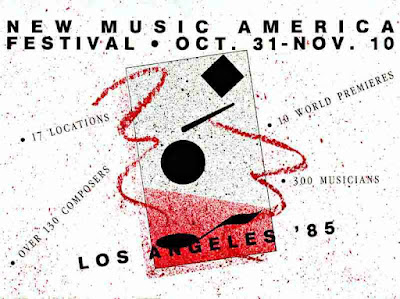
New Music America 1985 - Los Angeles - brochure cover
Recorded excerpts from these concerts (and other NMA LA events) were made available to a national public radio network. I seem to remember that the number of stations which actually broadcast these programs was firmly in the single digits. But obviously Mark Saleski listened to one of them. More than 20 years later his comments mark the first time I was aware of anyone who had actually listened.

If you do a web search for "New Music America" you'll find that it lives on mostly as entries in the biographies of countless composers and performers - myself included. I found only this one small Wikipedia entry describing the whole endeavor.

Anyway, after reading Mark Saleski's review, I resolved to provide him with a replacement recording. And also, naturally, to blog about the whole thing for my two regular readers. I've uploaded three audio excerpts from that recital, all are of me playing bass clarinet.

David Ocker with a bass clarinet against his nose circa 1985
The piece Mark Saleski wrote about is titled "The Allegro Fourth Movement from the Symphony Number 3 in F Opus 90 by Johannes Brahms by David Ocker." (yes, I put my own name right at the end of the title.) Fully describing the history and the process and the point of the piece would triple the length of this post - so I'll just say that I made a lead sheet of a Brahms symphonic movement and then changed the notes so I could claim it as my own.

click here to hear The Allegro Fourth Movement from the Symphony Number 3 in F Opus 90 by Johannes Brahms by David Ocker

Copyright (c) (p) 1985 and 2007 by David Ocker - 8 minutes 51 seconds

I opened the recital with a solo improvisation. Although I often improvised in public back then (as part of a trio with Vinny Golia and Anne La Berge) it was rare for me to improvise alone. This piece, my only named, marginally repeatable improv, is entitled "At Sixes and Sevens". The title refers to a rhythmic element that's difficult to hear. Mostly it was an opportunity to show off some of the strange bass clarinet noises I could make.

click here to hear At Sixes and Sevens

Copyright (c) (p) 1985 and 2007 by David Ocker - 4 minutes 22 seconds

I played an encore which was Non-new and Non-American: my arrangement for solo bass clarinet of the Dance of the Sugar Plum Fairies from Tchaikovsky's Nutcracker. Surreal, huh? I suppose I imagined back then that I could do just about anything on the bass clarinet. Even imitate a celesta.

click here to hear Dance of the Sugar Plum Fairies by Pyotr Ilyich Tchaikovsky, arranged and performed by David Ocker, bass clarinet

Copyright (c) (p) 1985 and 2007 by David Ocker - 2 minutes 26 seconds


This Sugar Plum Fairy picture came from here. The two shots of me with my bass clarinet are from the 80s, taken by John Livzey in Frank Zappa's UMRK studio. If you look at my beard carefully you can see my very first gray hairs. I've always particularly liked the picture with the clarinet pushing my nose out of joint.

I'm including the full program, the blurb text (also in the picture) and Mark Swed's complete LA Herald Examiner review. In a prior review Mark Swed had referred to me as a "super-clarinetist" and I, of course, used that term in my promotional materials as often as I could. Obviously Mark is a very good music critic. In this particular review he tries to define more precisely exactly what he meant by "super-clarinetist."

David Ocker - super-clarinetist - Benny Goodman never sounded like this

In 1985 Mark Swed and I didn't yet know that we were distant cousins by marriage. And I most certainly did not know that in 1992 I would marry Leslie Harris, Mark Swed's first cousin once removed. It's entirely possible that I'm related to Mark Saleski somehow as well. I just don't know quite how yet.

THE PROMOTIONAL BLURB

In Recital:
DAVID OCKER

Benny Goodman Never Sounded Like This! The composer/clarinetist performs music by Dolphy, Jarvinen, Martino, Ocker, Smith, Steinmetz, and Tenney.

"Super clarinetist" - Mark Swed, L.A. Herald Examiner

Sponsored by the ICA.

Arnold Schoenberg Institute, USC Campus Tickets: $5 advance, $7 after 10/15 and at the door ($4 students with ID, seniors and ICA members). For tickets after 10/15 call (213) 741-7111.

Info call: (213) 743-5362


THE PROGRAM

David Ocker At Sixes and Sevens solo bass clarinet   [listen]

Arthur Jarvinen Carbon solo bass clarinet  [listen]

Donald Martino B,a,b,b,it,t clarinet with extensions  [listen]

James Tenney Monody solo clarinet

William O. Smith Variants solo clarinet

Eric Dolphy, transcribed Ocker God Bless the Child solo bass clarinet [listen]

John Steinmetz DATACOMP Atari 800 computer and bass clarinet

David Ocker The Allegro Fourth Movement from Symphony Number 3 in F opus 90 by Johannes Brahms by David Ocker solo bass clarinet  [listen]

Pyotr Illich Tchaikovsky arr. Ocker Dance of the Sugar Plum Fairies solo bass clarinet  [listen]

Sheet music to Carbon and Allegro Fourth Movement etc etc can no longer be purchased from Leisure Planet music.

THE REVIEW

Los Angeles Herald Examiner Saturday November 9, 1985

New Music America

by Mark Swed
Herald music critic
David Ocker's solo clarinet recital at the Schoenberg Institute at USC on Wednesday afternoon represented the finest aspects of the Los Angeles new-music spirit. Ocker is an original, both as clarinetist and composer. I've called him a superclarinetist before -- not because he is the top virtuoso in the business, but for his inspired way of transcending limitations.
Technically, Ocker is good enough: he can finger and tongue his way through difficult, abtuse music. Better yet, he is musical. He made Donald Martino's too rationally disjointed "B,a,b,b,it,t" sound like music; and he did the same with Arthur Jarvinen's irrationally disjointed "Carbon." But that isn't what makes Ocker special.
Ocker, as both a performer and composer, brings to music the kind of personal quality that most professional musicians have had trained out of them. Ocker introduced each work, mostly by telling what it meant to him, and did so with dry humor and without the slightest pretense. He is ever-so-slightly awkward on stage, in his playing and composing, but he turns that awkwardness into something playful and curiously touching
All of this was found in Ocker's own version, for solo clarinet, of the Finale to Brahms' Third Symphony, where he follows Brahms' form and rhythms, but to his own melodies. Ocker said the work was meant to show the epiphany he felt upon first hearing it. It conveys the feeling of singing along with a record, loudly and exuberantly, just for oneself. It turns the art of transcription into modern performance art in an entirely new way that dramatically and spiritually confronts the notion of performing in public.
Ocker is also a funny, self effacing performer, and another highlight of his program was a hilarious spoof on modern music done up as a computer game by John Steinmetz.

Solo Clarinet Recital Tags: . . . . . . . . . . . . . . . . . . . . . . . .

Saturday, March 10, 2007

Graffiti Animals of California

Yes, these pictures are indeed blog filler. You'll find an L.A. Cat with no arms wearing a coat, a baseball-cap-wearing bird from San Francisco with money under its arm, a dragon with a heart who lives on a telephone switch box, a head of a young girl on the body of a dinosaur (or maybe the Loch Ness monster), a Santa Monica commentary about non-carnivorous hooliganism and, finally, the Think Outside the Box Monster.

a graffiti cat on a sticker on a light pole in La Canada California
a graffiti bird wearing a baseball cap and holding money on a sticker somewhere in San Francisco
graffiti on a telephone switch box in Pasadena, a dragon with a heart
graffiti on a sidewalk outside a church in Pasadena, a girl's head on the body of a dinosaur
Click here for an early Mixed Meters post devoted to pictures of Pasadena Fauna.

a graffiti rabbit drawn by someone in Santa Monica who doesn't like being told not to eat meat
Here's a story about how giant German bunny rabbits might feed hungry North Koreans.

Think Outside the Box Monster (what an original outside the box idea, huh?) in an alley in Santa Monica
This recent picture is the rear of the building in Santa Monica which used to be a dance studio called The House, site of this 1982 Independent Composers Association concert featuring music by John Cage.


Animal Graffiti Tags: . . . . . . . . .