Monday, October 29, 2012

Thirteen Ways of Looking at a Blue Glove

When I encounter a lost glove while on my walks I usually stop to photograph it.  Here's a collection of snaps of lonely, abandoned gloves.  Ah, the stories they could tell.


These are 'found objects'.  I am showing them exactly as I encountered them.  I have no idea why there are so many blue ones.


You can click any picture for an enlargement.


Check out a similar Mixed Meters post from over 4 years ago entitled Gloves in the Wild.  In it I mention that gloves are more photogenic than hats.  Socks, which I see periodically, are not very interesting to photograph either.  Someday I would like to start shooting pictures of abandoned shoes, which - unlike gloves - sometimes appear in the wild in pairs.


Here's a bonus shot - but it's the same as one of the gloves shown above.  I have many more glove pictures.  I'll save those for another glove post.  These are all the blue ones I could find.


Other "blue" Mixed Meters posts:
Blue Doodles 
Branches Before Blue
A New Rhapsody in Blue

Thursday, October 25, 2012

More Musical Merchandise

Musical Marketing is a Mixed Meters Meme. No one else cares much.

This installment we begin with three drinkables:
  • a Chardonnay with a hint of Chant, 
  • the reverse of a 45 and 
  • a home brew with operatic overtones. 


Then there's:
  • a South Asian stringed instrument, 
  • a frittered lead singer and 
  • a symphony from Sienna.


(Click any picture if you need to examine the merchandise up close.)

Tuesday, October 16, 2012

Che's Image

If you're a person who gets livid when confronted with pictures of Che Guevara, please, by all means, leave immediately. Possibly you'd prefer to read about a different murderer.

Mixed Meters has little interest in armed revolution, but I am very interested in THAT photo of Che Guevara, the one originally taken by Cuban photographer Alberto Korda and now used for just about any purpose imaginable, many of them completely, cravenly capitalistic.

Two previous Mixed Meters' posts have shown variations on the image.  First there was Che's Brand, a review of a book about the picture.  You can see Cherry Guevara candy and Che bubble bath.  Then there was A Combination of Jingle Bells and the Internationale which is the name of a piece I wrote which combines those two themes.  There you can check out the Che credit card and the Che Guevara Rolex ad.

I've been saving more Che images as I come across them.  A few good recent finds have prompted this post.

You can see two famous faces combined with the Che image, one is a composer and the other a muppet.  (I'm pretty sure Frank would not have been pleased but I don't really know what Oscar would say.  Probably that he's just trying to protect Big Bird from Mitt Romney.)


Korda's image seems to inspire artists.  Here are a couple of statuettes and a colorful vintage poster.  Then there's one done with nothing but dice.  It is so low-resolution that the star on the beret doesn't show.  (That would be a good one to click in order to view an enlargement.)


Che Guevara grew up in a middle-class background.  He gave up his privilege to fight for the poor, eventually accomplishing nothing and getting himself killed.  Still, curiously, he seems to speak to a a small slice of middle-class America.  Why else would they display this image?

Here's a cartoon which shows an Occupy protester, probably middle class, wearing the Korda image on a T-shirt as he is being confronted by real poverty right on Wall Street.  Chances are good that the protester is not going to give up his gadget, or much of anything, certainly not his life, to help this panhandler.


I took the last three pictures at random spots around Pasadena.  One shows Che on the back of a prosperous looking Nissan mini-van.  The others are of a small announcement pasted illegally in public spaces promoting a political meeting.  That was back in February 2011.


Remember, it's just an image, a graphic.  But it's one which can still push people's buttons.  The image has a meaning of its own, which, for most people, has long since been divorced from the actual story of the person shown or what he did or why.

Of course in this political silly season, many images (and countless words) are used repeatedly with no relationship to the original meanings.  The origins have been forgotten.  Only the emotions remain.  To bring them out all you have to do is push the button.


I found the two Occupy related images on Facebook.  The cartoon is by Glenn McCoy.  Most of the others came to my attention through the blog This Isn't Happiness although they originally came from here, here, here or here.  I got the Zappa/Che image from here (starting at 2'26").  You might be able to buy a Zappa/Che t-shirt here.  Find out about the organization behind the red and green stickers here.


Button Pushing Tags: . . . . . .

Sunday, September 30, 2012

1453

Would you be surprised if I described a book about medieval history as a page turner?  Specifically a book about the fall of Constantinople to the Ottoman army.  I certainly would have found such a description suspicious - until I read 1453 by Roger Crowley.


The book's title, 1453, is the year when the 21-year old Sultan Mehmet II besieged the fortified capital of Byzantium, remnant of the long-since faded Roman Empire.  Mehmet augmented clever military and political strategy with the latest high-tech weapons systems, namely huge bronze canon, up to 27 feet long and 30 inches in diameter, which fired half-ton boulders over a mile.  It was history's first artillery bombardment.  The story has twists and turns, colorful characters, intense religious superstition and even a volcanic eruption half a world away.

These events were well documented by contemporary writers who witnessed both sides of the fight, although it should come as no surprise that later historians muddied the facts.  Crowley's book, amazingly, is totally footnote-free.  If you want, you can look up sources in an appendix using the incipit of quotes.  He occasionally suggests that certain writers might have had reason to shade the truth and isn't afraid to speculate on questions history hasn't answered.

The outcome of the story is never in doubt: Mehmet wins, the city falls.  Thanks to careful narrative practice and exceptional descriptive writing Crowley keeps things moving.  I was completely caught up in it.

Oh,  yeah, one more thing.  It's still relevant in 2012.  The fall of Constantinople is one very ancient chapter in the ever-unending cultural conflict between fanatical Middle Eastern Muslims and fanatical Western Christians.  Today the news is still filled with twists and turns, colorful characters, intense religious superstition and the latest high-tech weaponry.  (Happily big volcanic eruptions are pretty rare these days.)

Here is a quote from near the end of 1453 which describes European reaction to the devastating news that Constantinople had fallen.
If there is any moment at which it is possible to recognize a modern sensibility in a medieval event, it is here in the account of reactions to the news of the fall of Constantinople.  Like the assassination of Kennedy or 9/11 it is clear that people throughout Europe could remember exactly where they were when they first heard the news. ... The news radiated outward across Europe as fast as a ship could sail, a horse could ride, a song could be sung.  It spread outward from Italy to France, Spain, Portugal, the Low Countries, Serbia, Hungary, Poland, and beyond.  ... The diplomatic channels between the courts of Europe hummed with news and warnings and ideas for projected Crusades.  Across the Christian world there was a huge outpouring of letters, chronicles, histories, prophecies, songs, laments, and sermons translated into all the languages of the Faith, from Serbian to French, from Armenian to English.  The tale of Constantinople was heard not just in palaces and castles but also at crossroads, market squares, and inns.  It reached the farthest corners of Europe and the humblest people: in due course even the Lutheran prayer book in Iceland would beg God's salvation from "the cunning of the Pope and the terror of the Turk."  It was just the start of a huge renewal of anti-Islamic sentiment.


Don't forget what President George W. Bush said, on the south lawn of the White House, Sept. 16, 2001
This crusade, this war on terrorism is going to take a while.


This is not the first book related to medieval history which Mixed Meters has reviewed.

Middle Age Business Man - The Merchant of Prato by Iris Origo  (This post also discusses the fall of Enron.)
"Francesco's personality shines through all this too. He was a man I would probably not like. A micro-manager who ignored advice, who wanted only the most expensive stuff just because it cost more, who adhered uncritically to the superstitions of his day and who seemed to enjoy nothing much beyond his work."
The Merchant of Prato is also mentioned in In Which Using Your Head Has A Medieval Meaning about certain bizarre forms of entertainment of the time.

In Which David Finishes Reading a Book - Baudalino by Umberto Eco
"In all this I find parallels to our time. Religous belief in "what is written" makes people do strange things now, too. Eco reminds us that history is what the historians say. Is telling history the same as telling the truth? These days people who disagree with our accepted story are regarded with suspicion."
Other very tangentially related posts:
Magazine for Renaissance Brass Players?
In Which Music Moves Slowwwly


The painting came from here.

Medieval Tags: . . . . . .

Saturday, September 22, 2012

Summer 2012 from The Seasons

Today is the Southward Equinox, an astronomical mid-point and the designated start of Autumn in my hemisphere.

This event also marks the end of summer and the completion of the latest segment of my ongoing work The Seasons. Predictably, this one is entitled Summer 2012. (click that link to listen)

Here's how The Seasons works:

Every day I write a very short "piece" of music, often no more than a few seconds.  These events are separated by longer silences.  The daily alternations of music and silence are gathered into "seasons" arranged to correspond with the astronomical seasons. As each astronomical season ends I post my musical analog of it here on Mixed Meters.  This takes the form of an audio file somewhere around an hour in length.  For example Summer 2012 is 4397 seconds long.  About 78% of that is silence.  The sounds in Summer 2012 are restricted primarily to unpitched percussion just as Spring 2012 used mostly string sounds.

Would metaphors help you understand what's going on?

You might compare this project with a personal diary in which I jot down a short reflection every day.  Only I use music instead of words.  Or, you might think that The Seasons is like a calendar.  Imagine one of those "thought for the day" jobs where you rip off each page precisely at midnight to reveal today's provocative new idea.  Only with my "calendar" the thought enters your brain through your ears instead of through your eyes.  Sadly, my version fails completely to tell you what day of the month  or even which month it is.  That's okay because the particular days which these sounds represent are now long gone.  These are old calendars.

I've extended the calendar analogy slightly in two ways.

First, I composed each musical "day" in Summer 2012 to have 24 sounds - more or less.  This is sort of like using one note to represent each hour, although of course my rhythms are musical rather than clock-like.

Also, I've continued Garbage Day Periodicity.  This is also found in Spring 2012.  GDP means that on Mondays, which is the day I take our three dumpsters out to the street for the City of Pasadena's weird trucks to grab and empty using their big metal pincers, I use slightly different musical rules.  In Summer 2012 I celebrated Garbage Day by adding pitched instruments playing the theme BACH.  For one week, mysteriously, the theme transformed into The Musical Offering.

Why did I use Bach?  I don't know exactly.  Maybe it has something to do with this piece.

There is one more important facet to The Seasons.  They are combinatorial.

Combinatoriality is a word I've stolen from musical serialism.  Why should they get all the good words?  In my usage it means that I intend my Seasons to be played simultaneously with other music, especially with other Seasons.  This works because of the long silences.  I have to trust you, my three listeners, to experiment with this.  Now that there are three completed Seasons,  you can go to The Seasons Page and click on the three [listen] links to get the pieces all going together.

I don't know yet how many simultaneously-playing Seasons are optimal.  I quite like hearing the three I've got so far playing together.  I don't know yet how many Seasons I will compose.  At least four, of course, to create one full year.  I hope to continue for more years after that.  Stay tuned to Mixed Meters to find out.  I guarantee you won't get news about The Seasons anywhere else.


Seasonal Tags: . . . . . .

Sunday, September 16, 2012

In which Mixed Meters survives seven years

On September 16, 2005 I posted to Mixed Meters for the first time - 69 words including the title.  I said I would be keeping my posts short.  That worked for about a year.  It wasn't long before I started sharing my short music pieces.  I called those Thirty Second Spots.

My written posts got longer and longer over the years and so did my music.  The name Thirty Second Spots seemed fine up to around 2 minutes.  Then I invented the name Three Minute Climaxes (pieces from 2 up to 8 minutes) and finally Ten Minute Breaks (so far the longest one is 12 minutes.)

These categories are fluid and largely pointless so of course I still adhere to them only when I feel like it.

Online storage space was a problem at first.  Most early pieces disappeared.  Eventually I found more room.  I started uploading historical live performances which document my pre-blog activities (roughly 1975 through 1995).  Within the last year or so I've started posting my recordings with the Peter Schmid Quartet and my very long day-to-day calendar pieces, The Seasons.  (Expect a new one next week.)

AND NOW ... there's a new feature to make finding and playing all those recordings much easier.

Near the top of the right hand column of Mixed Meters you'll see a box marked Listen To Music.  There are six options, each of which will open a page of links.  Each link has a [listen] button (a new window will open and the piece will play automatically) and a [read] button (a new window with the relevant MM post will open).  The Video option takes you directly to a YouTube playlist.

I'm hoping that you, my three dear readers, will find this addition helpful for exploring my music.  I'll be posting more music in the future and will update the links pages as I do.


About Timings

At first, all the Thirty Second Spots were less than a minute long.  I would list the length in seconds along with the copyright notice.  When a piece broke the 1-minute barrier I thought it would be cute to list the total number of seconds rather than use minutes and seconds.  After all, "64 seconds" is no more confusing than "1 minute, 4 seconds".

But I didn't know when to quit.  I've listed the lengths of nearly all pieces as a total number of seconds - no minutes, no hours.  For example I recently uploaded the recording of Vexations. You might think that it's over 6 hours long - but I say it is really 23,085 seconds!

Here is a breakdown as of today of all my musical categories with total timings.

Category Number of Pieces Total Time in seconds
30 Second Spots 34 1,887
3 Minute Climaxes 15 3,900
10 Minute Breaks 4 2,537
Videos 21 3,576
The Seasons etc. 9 11,307
Peter Schmid 5 1,973
Historical Performances 14 8,175
Vexations 1 23,085

That's a grand total of 55,393 seconds.  (Because there are a few pieces listed in two categories, the total is not an exact sum of column three.)

Do you wonder how long 55,393 seconds is in hours and minutes?  Well, go ahead, do the math.


Another post from the first day: In Which David Rewrites The Pledge of Allegiance.  (114 words)

30 Second Tags: . . . . . .

Wednesday, September 12, 2012

John Cage's Second Century

The day on which John Cage would have turned 100 years old was last week.  In certain circles it was a big deal.  (Here's a list of events.)

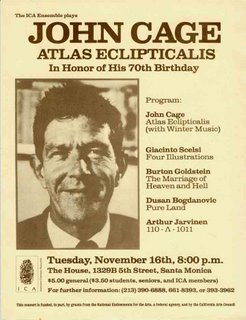
I am offering two recordings of the music of John Cage.  Both were performed in Los Angeles in the early 1980s on concerts produced by the Independent Composers Association.  I no longer remember exactly why I saved these cassette recordings.  Subconciously, I guess, I knew that I would need material for my blog one day, once my hair turned gray.

Both concerts were apparently reviewed by the L.A. Times although I don't have access to either article nor to concert programs.  I do remember that the reviewer remarked how Atlas Eclipticalis felt like the 'classical' work on a program of modern music.  Imaginary Landscape was part of a tape music concert which also included pieces by Scott Fraser, Luc Ferrari and Jonathan Harvey.

listen to John Cage Atlas Eclipticalis with Winter Music - 1756 seconds - November 16, 1982 - The House, Santa Monica, California - The Independent Composers Assn. Ensemble, Delores Stevens, pianist, Stephen Mitchell, conductor

listen to John Cage Imaginary Landscape #4 with Radio Music - 497 seconds - May 21, 1983 - Stella-Polaris Gallery, Los Angeles, California - The Independent Composers Assn. Radio Ensemble


(Read about: why I have this flyer and how I know the other composers on the tape concert.  At some point I made a copy of the Atlas Eclipticalis tape at half speed.  I much preferred listening to it that way.)


As someone whose musical thinking was greatly influenced by Cage's work and ideas, I would be remiss to let this occasion pass without comment. On the other hand, these days I'm really more interested in observing how Cage is being remembered by the classical music establishment than I am in the man or his music.

I see Cage as the ultimate 20th century iconoclastic artist, someone who smashed the sacred ideas of the music world. In their place he brilliantly offered indeterminacy, new performance techniques, electronics, wildly inventive compositional systems and a sense of calm, unflappable, detached theatricality.  He leavened this mixture with a galaxy of personal anecdotes, ideas from Zen teachings, mycology and the force of his own personality.

Indeed, I believe that the man himself sets Cage apart from the other composers of his time.  He injected himself uniquely into his music by performing, lecturing or just being charming.   In his second hundred years how essential will his persona be to the continued acceptance of his music?  Eventually everyone who directly knew and revered Cage will be gone.  Time will tell us if his music alone will continue to inspire new listeners.  Or maybe his writings and ideas will motivate future generations to become fans.  

In the coming decades the ears of the audience will, no doubt, continue to blend the music of the entire post-World War II avant-garde into a more homogenous musical experience.  Although there will be plenty of academic types to make plenty of fine distinctions, it will be harder and harder for more casual listeners to choose sides in those ancient artistic conflicts.  Total control via serialism or total randomness using chance operations?  As it turned out, the aesthetics were much the same either way.

The centennial celebrations are heavy with the idea that Cage was a strong artistic wind that will blow through the ages.  I suppose it is possible that Cage, by the year 2112, could land a spot in the pantheon of the greatest dead white male composers.  Even so "Bach, Mozart, Beethoven, Wagner and Cage" would be quite a stretch.  I wouldn't be surprised if he comes to be regarded as the essential 20th century serial composer, eclipsing all those famous Europeans and academic Americans of the last fifty years.

Cage made a big deal out of studying with Schoenberg - and spent much of his later career trying to curry the approval of his long-dead teacher.  Here's an excerpt from a fascinating L.A. Times article by Mark Swed about Cage's early life in Los Angeles:
Still the young composer continued to, as he put it, worship Schoenberg like a god. He took away from Schoenberg the idea that a composer always needed some kind of system. And Cage always came up with one.
Schoenberg would likely have said that music needs more than a system of rules.  I'm pretty sure he would have insisted that music also requires meaning and expression.

Recently, in a BBC interview with Norman Lebrecht, John Adams talked about John Cage (This is from the 9/3/12 podcast, starting about 15'48")
Actually there was a four or five year period when I was not that cognizant of minimalism.  I was a real acolyte of John Cage. . . . I knew all my John Cage very well and I was very deeply imbued in John's orthodoxy.  I do think that Cage is a very orthodox composer.  That surprises people because they think of him as an iconoclast but he actually is a strangely intolerant composer in a certain way, when it comes to anything which doesn't fit into his very precise world.  That means most of western music whether it's Miles Davis or Beethoven.  Eventually I just had to throw that out.  Because I had fun doing John Cage and you could talk about it forever but my background and my musical breeding had brought me up to love great music.  Also I keep going back to this experience about music is essentially the art of feeling and Cage had no place in that.  
(Here's a fun anecdote about Cage's intolerance.)

We can argue later about what Cage is and what Cage is not.  After that we can take a swing at what is great music and what is not.  Or we can just agree to disagree.

Right now the question I am more interested in is 'How will perceptions of Cage change over time?'  The best way to find out is to simply wait and see.  It's more fun to guess.

I expect that the great iconoclast will gradually be transformed by his remaining acolytes into a great icon.  He will be revered, Zen-like, in concerts and concert halls.  Cage, I'm sure, would have liked nothing better.  I also expect that the manner in which his music is performed will become increasingly conventional and prescribed.  That's sad, but it is the way of what we call classical music.

Personally, the harder it becomes to experience the music of John Cage on a street corner, the more we will lose what I think is the real value of his work and life.
As John Cage has said, music is all around us if only we had ears. There would be no need for concert halls if man could only learn to enjoy the sounds which envelop him, for example at Seventh and Broadway at four p.m. on a rainy day.
(That quote comes from the spoken introduction to the 1970 Everest recording of Variations IV by John Cage.)

(Seventh and Broadway: 1 2 3 4 5 6)

Random Tags: . . . . . . . . . . . . . . .

Thursday, August 30, 2012

Vexations in Los Angeles

(Listen to a live recording of Vexations while you read.)

Vexation n.
  1. The act of annoying, irritating, or vexing.
  2. The quality or condition of being vexed; annoyance.
  3. A source of irritation or annoyance.
Vexations
a noted musical work by Erik Satie.

I think Erik Satie's Vexations is one piece of music with a perfect title.  A title should give you some insight into the music itself.   And in the case of Vexations, if the music itself were not annoying, irritating or vexing enough (and it is aplenty), the composer compounded the annoyance with his instruction:
"In order to play the theme 840 times in succession, it would be advisable to prepare oneself beforehand, and in the deepest silence, by serious immobilities"
If you spend even a short while thinking about and listening to Vexations you'll end up scratching your head.  That is a good thing.

John Cage, whose 100 birth anniversary is being celebrated far and wide at the moment, reveled in music which made listeners think.  It was Cage who brought Vexations to the attention of the music world.  In 1963 he organized the first complete performance in New York City.

This piece is now so associated with Cage himself that complete Vexations performances (which take upwards of 18 hours) are presented in Cage's memory.  I know of two coming soon in California, one on the Berkeley Arts Festival and the other on the Jacaranda Series in Santa Monica.  Check them out.


This Mixed Meters post will feature two decades-old complete local performances of Satie's Vexations.  I was lucky enough to be a performer in both of them.

The first was on radio station KPFK on September 6, 1981 - all 840 repetitions were performed and broadcast live.  For 19 hours there were no station identifications.

The other was performed at a West Hollywood art gallery and was organized by the composer Randy Hostetler as part of his Living Room concert series.  It happened on August 1, 1992.

We'll go in reverse chronological order:


Composer Randy Hostetler lived from 1963 to 1996.  His short life and his music are honored and recounted at livingroommusic.org.   His piece "8" for piano and eight ball (in the side pocket) is a good introduction to the spirit Randy brought to his work.  Randy's close friend Art Jarvinen wrote 8 revealing stories about Randy.

One of Randy's projects was a concert series entitled The Living Room Series.  On one of these he produced Vexations. Here's the silk-screened concert poster:


Click on the poster for an enlargement.  Here's the text:

THE LIVING ROOM SERIES PRESENTS

SATIE
VEXATIONS
vexations by erik satie

1 august 1992, asher-faure gallery, 612 n. almont drive, west hollywood
beginning at 7 am and running continuously for close to 24 hours
for more information: 310 271-3665

scheduled pianists: gaylord mowrey, michael fink, jim fox, christopher hobbs,
david hatt, lorna eder, randolph hostetler, david ocker, chas smith, sandra brown,
david peck, francesca talenti, michael webster, brian howrey, wendy prober,
joe metzler, dan lawrence, sarah simons, daniel mettler, alan zychek

designed and printed by i.c. and a.b. at the rollins printing office of the school of art, yale university

(If you click on the address you'll be taken to the Google Street View.  Next click on the double arrow pointing toward the building and you can look around inside the now renamed gallery.)

Here are some memories of that event.

Alan Zychek:
I remember Vexations, that was a wonderful day over in WEHO. There was the vexation room with the piano and rugs. Outside the room there was food, drink and good times.  I think there was someone asleep under the piano when my turn came. I remember trying to discern stylistic nuances when the next player took over, but finding none. It was as if the piece neutered any personality a pianist would normally strive for.
I also remember Randy's LR concerts.  He placed mirophones throughout the entire space, inside and out -  and the back room is where you could listen to a mix of random conversations in real time.  Good luck and thank's for dislodging some wonderful memories. 

Jim Fox:
One thing I remember about the '92 Vexations performance was its lovely mix of the sacred and the profane. In the gallery itself, where the music--ever different, yet ever the same--slowly and quietly spun forth from the assembled musicians, I recall that the mood was sacredly hushed. The tempo shifted from player to player, sometimes slightly, sometimes dramatically. Interpretations of a pass through the single page of notes drifted, sometimes as willed, sometimes as fatigue dictated. Well-schooled fingers milked its chords for all they could find and less-schooled ones went about the task in a workmanly fashion, and sometimes a note or two disappeared beneath the keyboard. 
Listeners were strewn about the floor or draped over chairs or even sitting on the edges of chairs, as if waiting for one of the players to keel over. They generally gazed into space or stared intently, chins cradled in hands, at a performer. (Many seemed lost in near-sleep or reverie.) Some performers and some listeners were there for the duration (or some reasonable facsimile of it), some seemed to merely pop in for a few moments. 
But just outside the gallery doors--on a concrete patio as I recall--was a wonderful, long-winded, nearly off-the-rails (or perhaps that was just me) party, a spontaneous and at times slightly raucous celebration among new and old friends, blessed by a broad sense of camaraderie, and fueled by the consumption of much volatile liquid. And that day's odd blend of the sacred and profane seemed altogether Satie-esque in a good and simply simpatico way. 


The 1981 KPFK performance of Vexations was organized by the station's music director Carl Stone and assistant Lois V. Vierk.  The event was scheduled as a special event for Labor Day weekend.  The station would often suspend regular programs on holidays in favor of unusual programming.

Here's a page from the KPFK September 1981 Folio, their program guide.  Even then Vexations was associated with John Cage's birthday.  At the time he was turning 69.   A 12-hour broadcast of Cage's Empty Words is announced for later in the month.  In that folio you can read a 3-page interview of Cage by Roger Reynolds.


Carl sent me the thank-you announcement from the October 1981 Folio.  (That month also announced the resignation of both Carl and Lois from their positions at the station.)
The performance of Vexations by Erik Satie was one of the larger and more fun undertakings of the Music Department. Carl Stone and Lois Vierk co-ordinated the schedule of the 18 pianists who played in half-hour shifts. They were: Gloria Cheng, Paul Reale, Bob Fernandez, Gaylord Mowry, Mike McCandless, Lorna Little, Zita Carno, Reymond Berney, Heidi Lesemann, Del ores Stevens, Alan Oettinger, Felix De Cola, Richard Grayson, Milus Scruggs, Lucky Mosko, Ani Schwartz, David Ocker, and Leonid Hambro.

Audrey Tawa stayed from 6 am to 1 am the next day with the task of keeping an accurate tally of the 840 repetitions demanded by the composer. Ahna Armour prepared a grande bouffe for all the participants, and Kathy Harada stayed to make sure things went smoothly. Special thanks to David Ocker for staying at the piano for an extra hour to finish up.

By the end of the 19 hours, the station had received a total of 89 phone calls to comment on the broadcast: 67 favorable and 22 not. Below is a sample of some of the telegrams and letters the station received in the days that followed.
You can read the sample of telegrams and letters here (search for "Vexations".)  Note the "special thanks" to me for playing the clean up position.  I tell the full story of that below.

Here are a couple personal recollections.

Heidi Lesemann:
Carl had set it up so that we paired with another pianist for 2 hours, each of us taking half hour shifts, as Carl said. My partner was Dee Stevens. The music was easy, about 12 bars, but I was very nervous coming into the studio. I had been listening to it for a couple of hours beforehand. When the half hour was close, the relief pianist sat with the first pianist and slid into place in the keys as the first pianist slid off the bench. Seamless. I remember feeling like I was part of an historic event! Honored to be part of it.
Lois Vierk:
I remember organizing the event with Carl. It actually wasn't too hard to get together because the musicians were so gracious with their time and energy. And Audrey Tawa was, as always, a terrific person to work with.
Audrey Tawa was the person charged with tracking the number of repetitions.  She had a mechanical counter, a little chrome job with a plunger.  Each push on that increased the count by one.  She pushed it for each phrase.  One repetition - out of the 840 - consists of four phrases.  Therefore the magic number which needed to be reached on the counter was 3360.  

Before I went to the studio that day I made a home air check of the broadcast.  I recorded off the air onto a 10 1/2 inch reel-to-reel half track tape deck running at 3 3/4 inches per second, the slowest possible speed.  I recorded in mono in one direction.  Later in the day I flipped the tape over and recorded the other side of the tape.  I put the tape in a box.  It remained untouched for nearly 31 years.

A few weeks ago I found the tape and digitized it.  I have the same tape machine which still works!  I improved the sound as best I could and combined both sides into one file.  The total length is 6 hours, 24 minutes and 45 seconds.  I've uploaded this recording and you can listen to it.

Listen to Erik Satie Vexations - 1981 KPFK live broadcast

Yes, the sound quality sucks.  There is wow and flutter.  I think the piece transcends the poor sound quality.  Unlike other recordings you might find online, which likely have only a few repetitions, this has several hundred - about one third of the entire piece.

I do not know who the specific players are.  I'm pretty sure none of them are me.  If you listen carefully you can hear the style change as the players change.  Some are very precise and repetitive.  One in particular has problems.  Another seems to be trying to play each repetition slightly differently.  The tempos change, at one point quite abruptly.  Hesitations.  Mistakes.  If you listen long enough these little variations will no longer matter.  At that point I suppose you will have achieved Serious Immobility.


Here's the story of my extra hour ...

In 1981, like now, I kept a strange schedule of sleeping and waking.  Since I was staying up all night I chose a time slot in the Vexations schedule when I would be wide awake - i.e. the middle of the night for everyone else.  That's why I was one of the last pianists.  I think I was alternating with Lee Hambro.

It's impossible to know ahead of time precisely how long a complete performance of Vexations will last.  Carl and Lois had arranged for enough performers to cover 18 hours, thinking that would be sufficient.  But as that evening wore on, as Audrey kept clicking her counter, it became clear that 840 repetitions would take more time.

By then most everyone had gone home.  The people who had been there all day were exhausted.  On the other hand, I was wide awake.  It was still "morning" for me.  That's why, after I had done the two half hours for which I had signed up, I found myself back in the studio playing the rest of the piece.  How long would that take?

Studio A, a room with a very high ceiling, was dark except for a reading lamp on the music.  The piano was positioned so the player could not see into the control room.   It was a very isolated experience to sit there alone, nothing at all like performing in front of a live audience, even a small one.  The music contributed to the isolation.  It is quiet.  I repeats.  It meanders.  It repeats.  It repeats.  Vexation, indeed.

After a while I noticed that the sound of the piano was changing.  Strange.  I was shocked because pianos don't do that and KPFK had an excellent instrument.  As I kept playing over and over and over - hoping that someone would open the door to tell me that this was the last repetition - but no one did - I became increasingly certain that the sound was indeed slowly morphing.

As I listened more and more carefully to each repetition it became indisputable.  I could hear beats in the sound.  Beating is an indication of mistuning.   The piano was going out of tune!  Yes, it was. The effect became intense and I became quite anxious because of it.  Strings on a piano do not simply begin to slip, except what I was hearing could only be explained by exactly that.

Finally ... finally the door opened and I was told to stop.  After a suitable short silence Carl would have announced the long delayed station identification "KPFK Los Angeles" and then gone on to explain what had just happened.  I stood up, stretched and left the studio.  Someone introduced the overnight program ...

Once I was certain that the microphones were off, I returned to the piano to test the tuning.  I played some octaves and open fifths - intervals which are not found anywhere in Vexations and which easily reveal how well in-tune an instrument is.  To my astonishment, the piano remained in perfect tune.  My jaw dropped because the out-of-tune sound had been completely in my head.  Vexations had warped my hearing, an unmistakable hallucinogenic effect.  Vexations had drugged my brain.

That's the only time anything remotely resembling that kind of effect has ever happened to me.


Gaylord Mowrey, who performed in both of these Vexations performances, sent me some of his thoughts.  He wraps things up nicely, mentions performances of which I was unaware and reminds us of an important work inspired by Vexations.
David, I appreciate that you brought up the Satie Vexations events in this forum. It has always been a pleasure to be a "Vexadigitator" (Randy's term) in all these events.  
You probably are aware that during the 24 years I was involved with the California State Summer School for the Arts, the last 15 of which were at CalArts, I organized 14 consecutive yearly presentations of Vexations with students and faculty and friends, always a strangely moving and transformative experience for many. 
The piece is so controversial and challenging, so quirky and vexing, that almost everyone who give themselves to it for any length of time must come to terms with its aesthetic, somehow. And the original material is so rich that it grabbed Art Jarvinen to create the massive variations - some of his deepest work.
Gaylord is referring to Art Jarvinen's piece Serious Immobilities, 840 distinct variations on Vexations, which will someday will be the subject of another Mixed Meters post.

UPDATE:  Arthur Javinen's massive work, Serious Immobilities, was eventually described in two Mixed Meters posts.  Read the first one first.


I'd like to thank all those who contributed their memories of Vexations in Los Angeles for this post:
  • Zona Hostetler
  • Eric Hostetler
  • Carl Stone
  • Lois Vierk
  • Heidi Lesemann
  • Alan Zychek
  • Jim "Mr. Memory" Fox
  • Gloria Cheng
A recent Microfest program in Los Angeles featured Vexations performed on specially re-tuned keyboards.  You can hear samples here.

Another remembrance of the Living Room Series performance of Vexations.


840 Tags: . . . . . . . . .

Sunday, August 26, 2012

Lies, Damn Lies, Statistics and Politics

It's hard to know what to believe in the run-up to this years Presidential election.  The Republicans and Democrats are now pretty much lying through their teeth every time they open their mouths.  There's still more than two months to go.  Of course you can refer to fact-check websites - but you can't even be sure those tell the truth.

As a public service of sorts, Mixed Meters is presenting some big lies to watch out for over the remainder of the campaign.  I guarantee that I'm making these up.  Well, that's not completely true.  Some of the ideas come from online news stories which I didn't really believe to begin with.

If any of these stories actually do happen to come true there can only be one reason: truth is stranger than fiction.

Disclaimer ... I have no inside information.
Disclaimer ... I am not a psychic.
Disclaimer ... these are not ntended to be funny.


Hurricane Isaac gives the Republican convention a near miss.  The name Isaac reminds many Republicans of Jews and several delegates take this as a sign of the End Times and impending Rapture and are severely injured by debris when they stand outside in a heavy storm.  The convention resolves to abolish the National Weather Service in order to prevent future hurricanes.  

Pat Robertson claims that the hurricane is God's punishment because the Republican party allows Blacks and gays to vote for their candidates.  Many prominent Republicans ask him to leave the party but he refuses saying God has told him that gay and black Republicans do not really exist.  While Blacks represent only 1% of the delegates, they are shown on screen 23% of the time.

It is revealed that Paul Ryan has had a long term sexual affair with a female Wall Street investment executive.   The woman produces a RED dress which she claims is stained with his semen.  When pictures of the two of them together surface, Ryan explains that he only wanted insider trading information that he could pass along to his blind trust.  Asked about this, Mitt Romney compliments Ryan's business ethics.

It is reported that face recognition software at the Democratic convention identifies 30 Tea Party organizers, 10 convicted felons, two of Osama bin Laden's sons and Pope Benedict in the vast crowd.  None of the identifications are proven correct but most news sources do not print the retraction.

At a fund raising dinner Ann Romney asks a black man in a tuxedo to hang up her coat and get her a glass of chardonnay because she assumes that he's a butler.  It turns out to be Herman Cain.  Herman, interviewed the next day on Good Morning America, says that he thinks Ann is a tremendously sexy woman.

The frequency of mass shooting using automatic weapons approaches one per week as election gets closer, including at least two at mosques and one at a political rally.  Both candidates respond immediately to each event saying things like "oh, that's too bad", "I'm so sorry" and "I don't know what more we could do to stop this."

Secret Service agents subdue and arrest a man wearing what appears to be a suicide vest at an Obama speech.   The "explosive canisters" are actually insulated beer can holders and the "wires" are tubes through which he can drink.  The man has a tattoo which reads "God Guns and Beer" which quickly becomes the title of a new Ted Nugent song.

In the Vice-Presidential debate Paul Ryan describes the policy differences between the two parties as being "as simple as black and white".  Although he denies that he is talking about race, "Simple As Black and White" buttons and bumper stickers are distributed by the Republican Party for the remainder of the campaign.

A Democratic SuperPac runs a "Harry and Louise" style ad campaign showing the now elderly couple worried about Medicare and Social Security under Romney/Ryan.  The Republicans blast the ads as "un-American" not because of anything in the script but because the couple is no longer portrayed as white.  Instead the new actors have indeterminate mixed racial characteristics.

Making an issue out of Attorney General Eric Holder, Republicans start showing the movie Fast and Furious at campaign events and simultaneously hold gun sales nearby.  Showing the movie is declared a violation of copyright but selling guns at political events is deemed legal.

When asked about the Guantanamo prison at the Presidential debate, Romney actually compliments Obama saying "I wouldn't do anything differently than the President on that."

The Republican party asks the Koch brothers to stop making donations to Republican Super Pacs because those funds already have far more cash than they can spend.  Offended, the Kochs offer to pay Paul Ryan's taxes while he is vice-president.

The man whose hair Mitt Romney forcibly cut as a school boy because he was thought to be gay comes forward and admits that he indeed is gay, lives in Massachusetts, is married to another man and the couple is raising two adopted boys, whose names, by a staggering coincidence, are Willard and Paul.

A Republican congressional candidate charges that Osama bin Laden is not dead and is really living in Chicago under the FBI witness protection program.  To counter this a picture purporting to be the dead Osama is leaked but it is eventually identified as a still photo from CSI New York.

Mitt Romney, trying to bolster his credibility as someone who can create economic growth, refers to his time as governor as the "Massachusetts Miracle".   Democrats laugh but don't remind him about what happened to Michael Dukakis.

Controversy erupts when Republicans use a picture of Michelle Obama working in the White House garden which shows her skin tone many shades darker than it really is.  After suggesting that this is merely dirt on her face, Mitt Romney also quips "Latinos make better gardeners because their skin reflects more sunlight."

Television stations in toss-up states start preempting nightly news so they can sell more political ads.  One station sets a record by broadcasting the same clip 14 times in a single hour.  Sales of feminine hygiene products, McDonalds fruit smoothies and lite beer plummet because, without constant advertising, consumers forget they need those products.

News reports report that Osama bin Laden, who has been living in Syria under an assumed name, has asked the U.S. for asylum to escape the turmoil there.  To counter this a picture purporting to be the dead Osama is leaked but it is eventually identified as the same still photo from CSI New York.

Calls for Mitt Romney to release his tax returns so overwhelm the political discussion that he actually releases his returns revealing that he would have lost money and paid no taxes in most years except for his investments in contraceptive pharmaceuticals, Nevada brothels, riverboat gambling, privatized prisons and Iraqi oil companies.

Obama, courting the remaining three hundred undecided gun-owning Democrats in North Carolina, visits a shooting range for target practice.  He fires 20 rounds, hits the target once.  The NRA responds by issuing press releases claiming that lives would be saved if more people including Obama would carry concealed weapons and offering the President a free Glock after he leaves office.

Mitt Romney alludes to Barack Obama's birth certificate so often that he asks Donald Trump to appear at his campaign stops, but when the two get into a shouting match each telling the other "No, you're fired" the relationship ends abruptly.

Protestant voters in Western states pledge to convert to Mormonism if Romney wins.   When told that Mormons are expected to tithe, they modify their promise to convert only their ancestors.  Taking a cue from Mormon baptisms, the Democrats symbolically re-register "liberal" Republicans Dwight Eisenhower and Richard Nixon as Democrats.  Republicans immediately charge them with ancestral voter fraud.  Democrats respond by re-registering Ronald Reagan as a Democrat as well and also paying his back dues to the Screen Actors Guild, bringing his union membership up-to-date.  Republicans try to re-register Joseph McCarthy as a Republican but are surprised to discover that he already was a Republican.

Many right-wing candidates sign a pledge agreeing with Rep. Todd Akin of Missouri that women who are "legitimately" raped will not get pregnant.  Polls show that 43% of the electorate agree that this is a logical argument against abortion.  It is also shown that over 85% of Republicans disbelieve the theory of evolution and 18% have doubts about the theory of gravity.

It is revealed that Ayn Rand, then in her sixties, and the Rev. Jeremiah Wright, then in his twenties, had a brief sexual affair at the 1968 Democratic convention in Chicago.

Members of the Occupy movement and supporters of Ron Paul, trying to prove they are not hopelessly marginalized in this election, throw rocks at one another.  When they run out of rocks they throw mud.  When the mud runs out they use their own excrement.  This becomes the top news stories for 6 days running.

Obama is accused of racism when he tells an audience that members of the KKK in full regalia should not be allowed to attended Tea Party rallys, as happens in several small Southern cities.

Paul Ryan, trying to capture some Gen-X voters, jams on stage with Kid Rock, Pat Boone and Gene Simmons - all Romney supporters.  Hank Williams Jr. makes a surprise appearance and tries to get Ryan to tell the crowd that President Obama is really an alien socialist Muslim.  Video of the event quickly appears in television ads for Obama.

Democrats, shaking Etch-a-Sketches to protest Romney flip-flops, discover one Etch-a-Sketch has accidentally produced a picture of Jesus looking suspiciously like Jim Caviezel in that Mel Gibson movie.  The unit sells for a 7-figure amount on E-Bay.  The buyers are revealed to be David and Charles Koch who suddenly become the largest contributors to the Democratic campaign as well as to the Republican.  As soon as they take possession of the unit Charles shakes it and clears the screen.

In the last few days of the campaign a tired Vice President Biden accidentally refers to "President Osama".

Knowing that Americans cannot focus on foreign affairs during an election, Israel secretly bombs Iran to no effect.  Iran claims that they were actually attacked by U.S. Predator drones.  U.S. news media fails to cover the story at all and both candidates deny the reports from Iranian news sources.   Years later it becomes known that both Israel and the U.S. attacked Iran simultaneously - a total coincidence.

The night before the election Mitt Romney makes a nationwide television broadcast in which he says that the election is not really about the economy or about jobs or the fact that Obama is a Black alien Muslim.  "This election is about God, Guns and Beer" he screams.  He then hoists a cold Miller as a choir starts to sing the new Ted Nugent song, now the official campaign theme song, "God, Guns and Beer".  Romney pumps the air twice, then high fives and chest bumps Paul Ryan who has been standing nearby.

On Election Day fistfights between voters and Republican pollwatchers challenging their right to vote are too numerous to count.  Repeated instances of concealed weapons being drawn to stop suspect voters are reported.  In one Texas town, a "citizens committee" surrounds a polling station allowing only White people with Southern accents carrying weapons to vote.

In several toss-up states thousands of people line up at over-crowded polling stations but are not allowed to vote before the polls close.  One state's vote count is deleted by a computer virus.  Lawsuits are filed in eighteen states challenging state-wide election results.  The winner of the Presidential race and the balance of power in the Senate is not decided until Pearl Harbor Day.  Half the U.S. population spends the next 4 years refusing to believe that the sitting President holds his office legitimately.


If you found this depressing, I have news for you - the truth is bound to be much more of a downer.  I had hoped that writing this post would somehow be cathartic.  I was wrong.

If you found this one-sided, I have news for you - I'm a liberal progressive and proud of it  If you're an easily-offended fascist Republican Tea-Party fundamentalist my best suggestion is that you go away and get your own blog.


Ayn Ryan Tags: . . . . . .

Wednesday, August 22, 2012

The Peter Schmid Quartet Plays Waiting For The Trickle Down

Peter, Lori, Cornel and Luis manage to play every crazy thing I throw at them.  I don't know how they do it.

In this track, Waiting for the Trickle Down, the guitar and bass are both electric and the drums are hand drums.  Since, like Godot, the Trickle Down never comes, this is kind of a sad and mournful piece.  Leslie says this is not my best work - and she makes a good point.

Click here to hear Waiting for the Trickle Down - by David Ocker © 2012 - 501 seconds

The quartet is:
Peter Schmid, piano
Lori Terhune, electric guitar
Cornel Reasoner, electric bass
Luis 'Pulpo' Jolla, hand drums

Recorded at Aphrodita Japonica Studios, Pasadena, California.  You can hear all the tracks by the Peter Schmid Trio and Quartet on the Peter Schmid Quartet Page.


"The Trickle Down" of course refers to the widely believed but even more widely discredited economic theory first implemented during the term of "Saint" Ronald Reagan.  It is currently being preached by Willard "Mitt" Rmoney and Paul "Ayn" Ryan.

Their idea was that giving more money to rich people would benefit everyone because the rich would use that money to hire the poor.  Since it was the rich people who created this crazy plan, the only poor people who have been helped are the ones with jobs selling yachts and fancy sports cars.

Here's a chart showing income distribution in the United States since 1947.  The income of the top 1% - indicated by the red triangle - has experienced cancerous growth since the start of the Trickle Down era, indicated by the arrow.


This chart came from the blog PrairePopulistsandProgressives.net

Trickle Down Tags: . . . . . .