Today's Powerball Lottery is worth one and half billion dollars, the biggest jackpot ever. I bought my tickets. Of course, I'm not going to win -- and neither are you. Buying a ticket doesn't change the chances of not winning. You have a nearly identical chance to not win if you don't buy a ticket as you do if you buy some. Either way, you'll lose. I guarantee it.
They say "the lottery is a tax on people who don't understand mathematics". Here's a website that convinces me that I don't understand mathematics. I say "Screw math. The fantasy of a big win is worth a few bucks." I enjoy immersing myself in the occasional delusion of sudden, unlimited wealth.
I wonder how big the jackpot would have to be before Bill Gates or Warren Buffet purchased tickets. And if someone who was already obscenely wealthy won another billion dollars in the lottery, how long would it take for people to start believing that the lottery is rigged.
I'm reading George Orwell's 1984. I read it once when I was much younger, before the year 1984. Orwell seems to have accurately predicted some annoying features of our society. He was even better at describing life today in North Korea.
Here's a passage that seems relevant. Our hero, Winston Smith, resident of Oceania and member of the INGSOC party, has taken a walk in the bad part of London, the part of town where the lower-class proles live, a place where Winston is not really supposed to go:
In an angle formed by a projecting house-front three men were standing very close together, the middle one of them holding a folded-up newspaper which the other two were studying over his shoulder. Even before he was near enough to make out the expression on their faces, Winston could see absorption in every line of their bodies. It was obviously some serious piece of news that they were reading. He was a few paces away from them when suddenly the group broke up and two of the men were in violent altercation. For a moment they seemed almost on the point of blows. "Can’t you bleeding well listen to what I say? I tell you no number ending in seven ain’t won for over fourteen months!" "Yes, it ’as, then!" "No, it ’as not! Back ’ome I got the ’ole lot of ’em for over two years wrote down on a piece of paper. I takes ’em down reg’lar as the clock. An’ I tell you, no number ending in seven -- " "Yes, a seven ‘as won! I could pretty near tell you the bleeding number. Four oh seven, it ended in. It were in February -- second week in February." "February your grandmother! I got it all down in black and white. An’ I tell you, no number -- " "Oh, pack it in!" said the third man. They were talking about the Lottery. Winston looked back when he had gone thirty meters. They were still arguing, with vivid, passionate faces. The Lottery, with its weekly pay-out of enormous prizes, was the one public event to which the proles paid serious attention. It was probable that there were some millions of proles for whom the Lottery was the principal if not the only reason for remaining alive. It was their delight, their folly, their anodyne, their intellectual stimulant. Where the Lottery was concerned, even people who could barely read and write seemed capable of intricate calculations and staggering feats of memory. There was a whole tribe of men who made a living simply by selling systems, forecasts, and lucky amulets. Winston had nothing to do with the running of the Lottery, which was managed by the Ministry of Plenty, but he was aware (indeed everyone in the party was aware) that the prizes were largely imaginary. Only small sums were actually paid out, the winners of the big prizes being non-existent persons. In the absence of any real intercommunication between one part of Oceania and another, this was not difficult to arrange.
There are a lot of books in our home, most of them Leslie's. One set of old volumes has occupied a prominent location in our den since we moved here nineteen years ago. We have long since stopped noticing it. It's decoration, like an art object, just sitting there because, well, what else would we do with it?
So, anyway. One evening last week Leslie and I were sitting in the den, probably watching something boring and forgettable on television, when I happened to pick up Volume VI. Thumbing through it, my eye fell upon the title "The Genial Idiot Discusses the Music Cure" by John Kendrick Bangs.
This turned out to be a short story in which our hero, the Genial Idiot, confers with his doctor, Capsule M.D., about the efficacy of using music to cure physical ills. In spite of the medical professional's skepticism, the Idiot proceeds to offer copious anecdotal evidence that music does indeed have healing powers and eventually suggests it will soon become a dominant medical treatment modality. What was apparently just a silly joke over a hundred years ago has now become an accepted treatment in our times. Thus civilization advances, first comedy, then remedy.
Of course, from my all-too-modern viewpoint, the story is neither funny nor well-written. I have no way to evaluate how someone would have reacted to it in 1907 or thereabouts. Probably rolling on the floor laughing, or whatever acronym for ROFL the hipsters used back then.
So, anyway, my interest in Bangs' story was piqued by mentions of composer Richard Wagner, who would have been ever so popular during those times. And, as you know, Wagner's awful, endless opera music is one of Mixed Meters' favorite bugaboos.
First the Idiot tells the Doctor about claims for the healing power of music which he has read in the press:
It may not be able to perform a surgical operation like that which is required for the removal of a leg, and I don't believe even Wagner ever composed a measure that could be counted on successfully to eliminate one's vermiform appendix from its chief sphere of usefulness, but for other things, like measles, mumps, the snuffles, or indigestion, it is said to be wonderfully efficacious.
Then, after describing his own experience of how his insomnia was cured by attending both Parsifal and Gotterdammerung, the Idiot adds this:
Clearly Wagner, according to my way of thinking, then deserves to rank among the most effective narcotics known to modern science. I have tried all sorts of other things - sulfonal, trionel, bromide powders, and all the rest and not one of them produced anything like the soporific results that two doses of Wagner brought about in one instant, and best of all there was no reaction. No splitting headache or shaky hand the next day, but just the calm, quiet, contented feeling that goes with the sense of having got completely rested up.
Doctor Capsule is unimpressed. He responds:
You run a dreadful risk, however. The Wagner habit is a terrible thing to acquire, Mr. Idiot.
The Idiot is not worried about getting addicted to Wagner.
I am in no danger of becoming a victim to it while it costs from five to seven dollars a dose.
That's about $120 to $170 in today's money. Sounds about right for a half-way decent seat at a live opera. (If we're lucky maybe Martin Shkreli will buy up all rights to Wagner and raise the price by 5000 per cent.)
The Idiot then tells another story about his friend, an artist, whose upset stomach was cured by a neighbor playing Arthur Sullivan's The Lost Chord on a cornet.
As the story concludes our Idiot makes predictions on how music will, in the future, cure nearly all medical ailments and revolutionize the medical industry.
If a small boy goes swimming and catches a cold in his head and is down with a fever his nurse, an expert on the accordion, can bring him back to health again with three bars of Under the Bamboo Tree after each meal.
So, anyway, I'm sure that by now you're anxious to read The Genial Discusses the Music Cure. It's available widely online. You can even find audio versions.
For your convenience I scanned and OCR'd and posted the story myself. Read it right here on Mixed Meters. It might cure your insomnia better than a Wagner opera.
Today is Towel Day. As literary holidays go celebrating the works of author Douglas Adams isn't quite yet in the league of Bloomsday. That's because Joyce had a head start.
I'm not dorky enough to actually carry a towel in public on Towel Day. Instead I will mark the occasion by posting some quotes from the later books of the Hitchhiker's Guide to the Galaxy. I marked these the last time I read through the canon.
Many of Adams' quotes are well known. What other author can claim to have invented a whole new meaning for a single number? (You know which one I mean.) Some of his quotes have become life principles for me. For example
"Anyone who is capable of getting themselves made President should on no account be allowed to do the job."
pretty much defines my attitude towards national politics these days.
The following quotes may not always be his greatest or most universal. Instead, these are the ones that jumped out at me because of who I am, because I'm a musician, because I live in Los Angeles or just because I thought they were wry or twisted or funny. Or some other reason.
From Life, The Universe and Everything (book three of the trilogy)
Prove it to me and I still won't believe it. (Chapter 10)
He had been planning to learn to play the octaventral heebiephone, a pleasantly futile task, he knew, because he had the wrong number of mouths. (Chapter 14)
He had returned to his own ship, the Bistromath, had a furious row with the waiter and disappeared off into an entirely subjective idea of what space was. (Chapter 32)
In Relativity, Matter tells Space how to curve, and Space tells Matter how to move. (Chapter 34)
from So Long, and Thanks For All the Fish (book four of the trilogy)
They've discovered how to turn excess body fat into gold. (Chapter 9, referring to Californians.)
Being like several thousand square miles of American Express junk mail, but without the same sense of moral depth. (Chapter 15, a description of Los Angeles)
They agreed that the sense of dazzle stopped immediately at the back of their eyes and didn't touch any other part of them and came away strangely unsatisfied by the spectacle. As dramatic seas of light went, it was fine, but light is meant to illuminate something, and having driven through what this particularly dramatic sea of light was illuminating they didn't think much of it. (Chapter 30, describing the San Fernando Valley)
Their mood gradually lifted as they walked along the beach in Malibu and watched all the millionaires in their chic shanty huts carefully keeping an eye on one another to check how rich they were getting. (Chapter 30)
They were suddenly feeling astonishingly and irrationally happy and didn't even mind that the terrible old car radio would only play two stations, and those simultaneously. So what, they were both playing good rock and roll. (Chapter 30)
But the reason I call myself by my childhood name is to remind myself that a scientist must also be absolutely like a child. If he sees a thing, he must say that he sees it, whether it was what he thought he was going to see or not. See first, think later, then test. But always see first. Otherwise you will only see what you were expecting. Most scientists forget that. (Chapter 31)
If we find something we can't understand we like to call it something you can't understand. (Chapter 31)
from Mostly Harmless (book five of the trilogy)
The last time anybody made a list of the top hundred character attributes of New Yorkers, common sense snuck in at number 79. (Chapter 2)
When it's fall in New York, the air smells as if someone's been frying goats in it, and if you are keen to breathe, the best plan is to open a window and stick your head in a building. (Chapter 2)
Nobody likes a whistler, particularly not the divinity that shapes our ends. (Chapter 8)
Being virtually killed by virtual laser in virtual space is just as effective as the real thing, because you are as dead as you think you are. (Chapter 8)
Most of the ascetics, it turned out, had not known about chocolate before they took up asceticism. (Chapter 9)
"Oh, all right," said the old man. "Here's a prayer for you. Got a pencil?" "Yes," said Arthur. "It goes like this. Let's see now: 'Protect me from knowing what I don't need to know. Protect me from even knowing that there are things to know that I don't know. Protect me from knowing that I decided not to know about the things that I decided not to know about. Amen.' That's it. It what you pray silently inside yourself anyway, so you may as well have it out in the open." "Hmmm," said Arthur. "Well, thank you-" "There's another prayer that goes with it that's very important," continued the old man, "so you'd better jot this down, too." "Okay." "It goes, 'Lord, lord, lord . . . ' It's best to put that bit in, just in case. You can never be too sure. 'Lord, lord, lord. Protect me from the consequences of the above prayer. Amen.' And that's it. Most of the trouble people people get into in life comes from leaving out that last part." (Chapter 9)
The major difference between a thing that might go wrong and a thing that cannot possibly go wrong is that when a thing that cannot possibly go wrong goes wrong it usually turns out to be impossible to get at or repair. (Chapter 12)
All you really need to know for the moment is that the universe is a lot more complicated than you might think, even if you start from a position of thinking it's pretty damn complicated in the first place. (Chapter 17)
Old Thrashbarg had said on one occasion that sometimes if you received an answer, the question might be taken away. (Chapter 19)
Other Mixed Meters' name checks of Douglas Adams can be found in these posts:
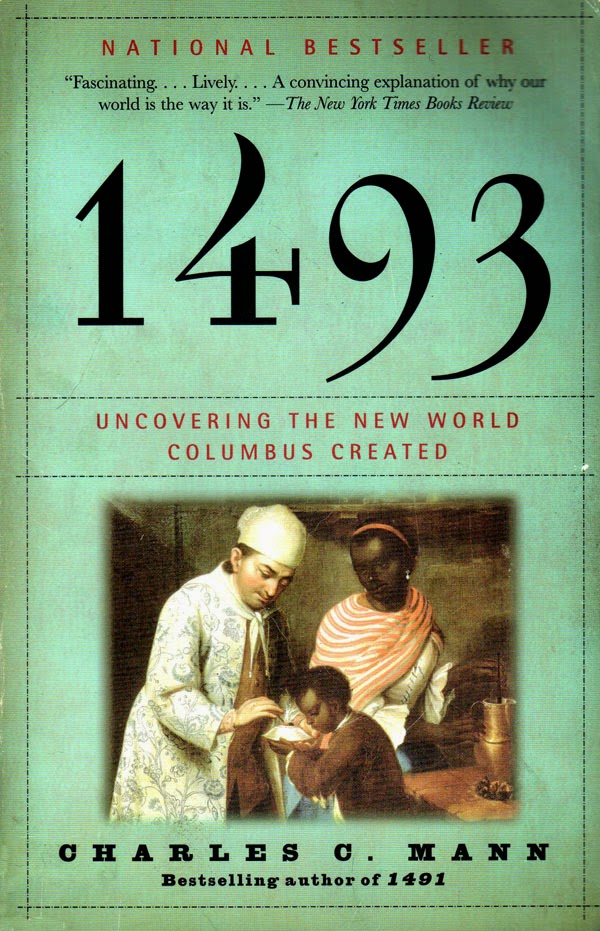
Some time ago I heard author Charles C. Mann interviewed on NPR. He spoke about his book 1493. 1493 details the aftereffects of Christopher Columbus' "discovery" of the New World. Mann grandly describes this as:
the greatest event in the history of life since the death of the dinosaurs.
I was fascinated by the interview and resolved to read his book. First I read his earlier book 1491 about what the Western Hemisphere was like before the Europeans. I blogged about 1491 last year.
You might assume that because 1491 focused specifically on the Western Hemisphere before the year 1492 that 1493 would concentrate on what happened here after 1492. You'd be correct only up to a point. Many surprising things happened when the nations of Europe fell over themselves in cutthroat competition, sometimes comically, often unwittingly, to bring religion, greed, weapons, animals, diseases and slaves to this strange, dangerous new world.
The other half of the story concerns how the Europeans tried to exploit their discoveries back in the old world. These discoveries included:
seemingly limitless quantities of silver,
essential foodstuffs like corn (Mann calls it maize) and potatoes,
rubber (which blew the European's minds)
tobacco (which blew their minds in a different way) and
(most remarkably) vast amounts of bird shit.
To describe the constant interactions between old and new worlds, he adopts the term Columbian Exchange. Mann follows this subject matter in surprising directions:
How the life cycle of the malaria parasite affected the position of the Mason-Dixon line.
How silver from South America impacted Chinese monetary policy and the founding of the city of Manila.
Why the potato famine in Ireland was exacerbated by modern agricultural practices.
How the mass deaths of American Indians might have caused temperatures to drop in Europe during the Little Ice Age.
Mann doesn't pass up chances to tell good tales about colorful characters, historical or modern. He follows several of his stories right up to the modern era, trying hard to bring his disparate subjects together. Still there's only so much you can fit into a 500 page book.
Bringing it all together, however, is really what 1493 is about. In a word, the book's subject is globalization. While we usually think of this in a contemporary context, Mann shows us that globalization actually started very soon after Columbus and has been going on ever since.
And Mann makes it clear that it is not just the human narrative which is important. Plants and animals, especially microscopic animals, have big parts in his story. Mann's overall approach is well summed up by a simple comment, tossed off in a footnote:
history is an interplay of social and biological processes.
He argues that the changes to the earth resulting from the human ability to encircle it are so massive that they constitute a whole new biologic epoch. He calls this period the homogenocene era, now just entering its second half millennium.
Indeed, humanity is not likely to undergo such a massive sudden change in environment, resources or basic conditions until that day when someone discovers how to get back and forth to another habitable planet, filled with strange plants and creatures whose intelligence is hard to identify, where humans will once again try anything they can think of to make a buck, proselytize their gods and plant their flags without giving the slightest thoughts to what the long-term repercussions might be.
A book completely unrelated to 1493, except in the form of its title, is 1453 by Roger Crowley.
Are you wondering about my reference to bird shit? Mann tells about the discovery of huge deposits of bird dropping on islands off the coast of Peru. In the mid-19th century Chinese slaves were used to mine the stuff and ship it back to Europe as potent agricultural fertilizer - far better than any other known at the time. It was especially useful for the potato crop. Here are two quotes from 1493 which describe the far-reaching effects of the humble potato and this huge pile of guano:
Before the potato and maize, before intensive fertilization, European living standards were roughly equivalent with those today in Cameroon and Bangladesh; they were below Bolivia or Zimbabwe. On average, European peasants ate less per day than hunting-and-gathering societies in Africa or the Amazon. Industrial monoculture with improved crops and high-intensity fertilizer allowed billions of people - Europe first, and then much of the rest of the world - to escape the Malthusian trap. (p.280)
"Potatoes, by feeding rapidly growing populations, permitted a handful of European nations to assert dominion over most of the world between 1750 and 1950." Hunger's end helped create the political stability that allowed European nations to take advantage of American silver. The potato fueled the rise of the West. (p.253)
So the next time you bite into a french fry at McDonalds, think about the global effects of that pigeon pooping under the bench next to you.
I was a junior in high school when I discovered absurdity. I understood absurdity immediately because it reflected my life so perfectly. Absurdity kicked me down the road of being a creative artsy type and it continues to have a strong pull on me to this day. Thanks, absurdity, old buddy.
My first encounter with absurdity took the form of The Bald Soprano, the play by Eugene Ionesco, presented as a particularly arresting picture book. Today, I guess we'd call it a graphic novel. Here's the cover:
That's Ionesco himself substituting both tragically and comically for the O's in his name. The full cast can be seen as well, left to right: Mrs. Martin, Mr. Smith, Mary the maid, the Fire Chief, Mrs. Smith and Mr. Martin. The whole book is rendered in black and white. Each couple's lines are rendered in a different type face, the women in italic. Pictures, stark high contrast black and white, show who is speaking and give a sense of the action. Here's the back cover:
I'm pretty sure I liked this play before I even opened the book the first time. Here's the text of the cover:
ionesco THE BALD SOPRANO followed by an unpublished scene. Translated by Donald M. Allen. Typographical interpretations by Massin and photographic interpretations by Henry Cohen. Based on the Niccolas Bataille Paris production. Grove Press, Inc. New York
I found The Bald Soprano in the library - I don't remember now whether that would have been my high school library or the public library. A couple of years later, in college, when I had an extra ten bucks, I ordered my own copy which I still have today. When it arrived I signed and dated it: October 3, 1970. This play, in this particular format, became one of my artistic touchstones. Eventually I saw a live performance - which disappointed me greatly.
The scene is a middle-class English interior. The plot is pretty simple, I guess. Mr. and Mrs. Smith tell some stories. Mr. and Mrs. Martin arrive and reintroduce themselves to each other. The Smiths and Martins tell more stories, occasionally interrupted by the Maid and the Fireman who, unsurprisingly, tell stories. Everything devolves into a screaming frenzy. And then it ends by beginning again at the beginning - except that the Martins and Smiths have switched places.
Nothing makes any real sense, of course. The lines make sense in only the smallest bits. Responses have tenuous relationship to what has preceded. I guess that's what makes it Theater of the Absurd. It's definitely that aspect which seemed to me to correspond exactly with what passed for conversation in my family - although for completely different reasons. My family came to its absurd interactions through a combo of age disparity, English as second language and hardness of hearing. None of that has anything to do with Ionesco. The resulting effects, however, were strikingly similar in my mind.
Here's a sample from the awkward conversation as the two couples are settling down for their social evening together:
Mr. Smith: Hm. [Silence] Mrs. Smith: Hm, hm. [Silence] Mrs. Martin: Hm, hm, hm. [Silence] Mr. Martin: Hm, hm, hm, hm. [Silence] Mrs. Martin: Oh, but definitely. [Silence] Mr. Martin: We all have colds. [Silence] Mr. Smith: Nevertheless, it's not chilly. [Silence] Mrs. Smith: There's no draft. [Silence] Mr. Martin: Oh no, fortunately. [Silence] Mr. Smith: Oh dear, oh dear, oh dear. [Silence] Mr. Martin: Don't you feel well? [Silence] Mrs. Smith: No, he's wet his pants [Silence] Mrs. Martin: Oh, sir, at your age, you shouldn't. [Silence] Mr. Smith: The heart is ageless [Silence] Mr. Martin: That's true. [Silence] Mrs. Smith: So they say. [Silence] Mrs. Martin: They also say the opposite. [Silence] Mr. Smith: The truth lies somewhere between the two. [Silence] Mr. Martin: That's true. [Silence]
In the book each of those lines gets two facing pages. All the space represents the long silences. The particular line "The truth lies somewhere between the two." has given me comfort many times in many different situations over the 45 years since I first read it.
Here's a pair of pages showing the (much more lively) responses to Mrs. Martin's story about seeing a man on the street who had bent over to tie his shoe:
Notice that "fantastic" is divided up among three actors. (Click on any picture for enlargements.) Later in the play:
Mrs. Martin: Thanks to you, we have passed a truly Cartesian quarter of an hour. Fire Chief: [moving towards the door, then stopping]: Speaking of that - the bald soprano? [General silence, embarrassment] Mrs. Smith: She always wears her hair in the same style.
One more page for good measure. Here the Fire Chief is encouraged to tell a story The Dog and the Cow - which I actually set to music sometime during my college years. (That, along with the only other song I ever wrote, has since been lost.)
So why am I dragging this subject up now - beyond the need for basic blog padding, of course. There's a story about that:
Leslie and I were having dinner in a local restaurant last month, one of those new-style buffets with the old-style trick of showing you the desserts while you're standing in line still hungry. We didn't have much to talk about. At the next table was a family - mother, father, grandmother and three tweens, two with smart phones. They had a lot to talk about, most of which didn't seem too important. There was an amusing lack of communication and several crises concerning the food. Leslie and I found ourselves watching them as carefully as we could without being obvious. They might have been somewhat embarrassed had they been able to watch themselves. Maybe not. On our way home, Leslie and I discussed various unresolved questions (like which parent was the child of the grandmother and the color of the mother's panties). I was reminded of my encounter with The Bald Soprano and I explained to Leslie why this literature was important to me. When I got home I re-read it for the first time in a very long time. It felt good to experience The Bald Soprano again. It brought back a lot of memories, although you can be very certain that none of them involved my mother letting anyone in a restaurant see the color of her panties.
Used copies of The Bald Soprano are available on Amazon.
I was fascinated recently by a radio interview with author Charles C. Mann who talked about his book 1493. It covers the social and ecological effects of the arrival of Europeans in the Western Hemisphere.
Before reading 1493 I decided it would be best to finally read Mann's earlier work 1491. 1491 is subtitled New Revelations of the Americas Before Columbus. It turns out that the stories we were most likely taught in grade school describing how American Indians lived before Columbus "discovered" them weren't terribly accurate. 1491, published in 2005, covers a plethora of recent discoveries and theories.
Primary sources of information dating from before the first Europeans are scarce. Some cultures had developed complex writing, like the Mayan hieroglyphs. But most Mayan manuscripts were destroyed by the Spanish who no doubt congratulated themselves for the enlightenment of their actions. Other pre-1492 records have survived but cannot be fully understood by modern scholars, like the Incan knotted strings called Quipu.
Then there were the very first Europeans who wrote about what they saw in the New World. This is another source of information about conditions just before the Europeans came. Some of these stories differed greatly from what was seen by visitors several generations later and the early descriptions came to be regarded as inaccurate or even fanciful. At the very beginning of 1491 Mann stresses that we not make the error of assuming, because conditions are a certain way now, that they must have been just so for ever.
For example: how many people inhabited America before Columbus arrived? Some explorers discovered vast uninhabited areas and they concluded that no one had ever lived there. In fact the native population had changed radically because the immune Europeans unwittingly brought deadly smallpox with them.
When microbes arrived in the Western Hemisphere, [anthropologist Henry F. Dobyns] argued, they must have swept from the coastlines first visited by Europeans to inland areas populated by Indians who had never seen a white person. Colonial writers knew that disease tilled the virgin soil of the Americas countless times in the sixteenth century. But what they did not, could not, know is that the epidemics shot out like ghastly arrows from the limited areas they saw to every corner of the hemisphere, wreaking destruction in places that never appeared in the European historical record. The first whites therefore would have encountered places that were already depopulated. (p.101)
Pre-Columbians left behind lots of archeological clues to their existence. Ruins of ancient citys, often including temples and pyramids, tools, pottery and trash. Massive earthworks in remote Bolivia that are only visible from the air. The ability of archeologists to decode these clues have improved over the years and the theories about what they mean have changed as well.
In fact, details concerning the ins and out of academic disputes over the archeological record was one of the most surprising facets of 1491. Mann tells these stories by introducing us to a lot of unfamiliar professorly types who, using rivers of ink, debated questions like
What percentage of the indigenous population were killed by smallpox?
When did the earliest humans arrive from Asia and did they use stone tools?
How many people lived in the Amazon basin?
The histories of these and other subjects, as detailed by Mann, all involve the overthrow of orthodox scholarly theories in favor of newer ones based on more recent evidence. The newer ones will, I betcha, eventually become orthodoxy themselves only to give way to improved interpretations as future generations of Indiana Joneses study the issues.
Finally, I found the information which Mann provides on the Native American's abilities to manipulate their environment the most interesting aspect of the book. Forest management using fire, changing the course of rivers, city planning and genetic manipulation are among the technologies which improved native lives in various locations. Here's just one example:
Using a different method, [botanists] concluded that Indians might have bred the modern peach palm by hybridizing palms from several areas, including the Peruvian Amazon. Whatever the origin, people domesticated the species thousands of years ago and then spread it rapidly, first through Amazonia and then up into the Caribbean and Central America. Bactris gasipaes was in Costa Rica 1,700 to 2,300 years ago and probably earlier. By the time of Columbus, one seventeenth-century observer wrote, Native Americans valued it so highly "that only their wives and children were held in higher regard."
Unlike maize or manioc, peach palm can thrive with no human attention. Tragically, this quality has proven to be enormously useful. In the seventeenth and eighteenth centuries many Amazonian Indians, the Yanomamo among them, abandoned their farm villages, which had made them sitting ducks for European diseases and slave trading. They hid out in the forest, preserving their freedom by moving from place to place; in what Balee calls "agricultural regression," these hunted peoples necessarily gave up farming and kept body and soul together by foraging. The "Stone Age tribespeople in the Amazon wilderness" that captured so many European imaginations were in large part a European creation and a historical novelty; they survived because the "wilderness" was largely composed of their ancestors' orchards. (p331)
While there are occasional dull passages in 1491 by Charles C. Mann, for the most part it is compellingly written. Although nominally it deals with an historical period which ended over 500 years ago, much of this information seems still relevant. Issues about our relationship with the descendants of the indigenous Americans and also preserving the native environment, which may not be what we think it is, are clearly affected by this information.
And it would be wonderful if some of these stories filtered down into grade school American History curricula - which I suspect hasn't kept up with modern discoveries since I was a grade school student some fifty years ago.
For the most part news is not a spectator sport. Only small groups of people directly witness major events. The rest of us must trust the media to find out what happened.
As time passes, people begin to agree that certain events were important. They observe the anniversaries, honor the heroes, slander the villains. Stories are told, songs sung. Books are written, movies made. Lessons are learned, courses organized. Eventually experts arise. Starting with petty disagreements these experts argue with one another. They form factions, wage verbal battles, assert opposite interpretations. They go to court. Their interpretations morph into articles of faith.
Beliefs have supplanted facts.
And then even more time passes. The important event is eclipsed by other important events. Direct witnesses die off, as do the rest of us. Generations disappear. The event loses relevance and becomes a dusty academic topic. Professors vainly try to explain to bored students what actually happened and how anyone could have thought it was so special in the first place.
This process is called History.
I recently finished reading a book, the story of a direct witness to important events of history. These particular events were monstrously inhuman, the systematic genocide of millions of people. Inside the Gas Chambers, Eight Months in the Sonderkommando of Auschwitz is an essential read because it is told by a direct witnesses to the Holocaust, one of the few who was made to work inside the Nazi crematoria and survived the war. This book deserves our attention because, these days, there are certain people (let's call them "experts") who deny that such events ever happened in the first place.
Shlomo Venezia was a Sephardic Jew living in Greece. In 1944 the Nazis deported him to a concentration camp where they systematically murdered in the gas chambers anyone who couldn't work. Venezia was selected for a special unit, the Sonderkommando, whose job it was to move the dead bodies and burn the corpses.
The book takes the form of an interview, with Venezia responding at length to short questions. His is not an overview of the huge ideology-driven Nazi murder enterprise. This is not a grand history. Instead Venezia tells his own tale very simply. He was one of many mice caught in a large trap.
(Question:) What did you see of the gas chamber when you arrived?
I wasn't one of those who had to take the corpses out of the gas chamber, but later on I frequently had to do it. Those given this task started by pulling the corpses out with their hands, but in a few minutes their hands were dirty and slippery. In order to avoid touching the bodies directly, they tried using a bit of cloth, but, of course, the cloth in turn became dirty and damp after a few moments. So people had to make do. Some tried to drag the bodies along with a belt, but this actually made the work even harder, since they had to keep tying and untying the belt. Finally, the simplest thing was to use a walking stick under the nape of the neck to pull the bodies along. You can see it very clearly in one of David Olère's drawings. There was no shortage of walking sticks, because of all the elderly people who were put to death. At least this meant we didn't have to drag the corpses with our hands. And this was hugely important for us. Not because it was a matter of corpses, though that was bad enough. . . . It was because their death had been anything but gentle. It was a foul, filthy death, difficult and experienced differently by each of them.
(David Olère was an artist who also survived the Sonderkommando and documented it after the war in drawings such as this one.)
I've never talked about this until now; it's such a weight, it's so heartrending, that I find it difficult to speak of those visions of the gas chamber. You could find people whose eyes hung out of their sockets because of the struggles the organism had undergone. Others were bleeding from everywhere, or were soiled by their own excrement, or that of other people. Because of the effect that their fear and the gas had on them, the victims often evacuated everything they had in their bodies. Some bodies were all red, others very pale, as everyone reacted differently. But they had all suffered in death. People often imagine that the gas was thrown in, and there you were, the victims died. But what death it was! . . . You found them gripping each other - everyone had desperately sought a little air. The gas was thrown onto the floor and gave off acid from underneath, so everyone tried to find some air even if each one needed to climb on top of another until the last one died. I personally think - I can't be sure but I think - that several people died even before the gas was thrown in. They were crammed in so tightly against one another that the smallest and weakest were inevitably suffocated. At a certain moment, under that pressure, that anguish, you become selfish and there's only one thing you can think of: how to save yourself. That was the effect the gas had. The sight that lay before us when we opened the door was terrible; nobody can even imagine what it was like.
Shlomo Venezia was an eye witness to history. In the many decades between the events and the interview I expect he forgot some small details. I would also expect that his overall story is true, corroborated as it is by so many other sources.
However, there are doubters. These are the "Holocaust Deniers", people who argue that no one died in the Nazi gas chambers. I didn't have to scour the Internet very long to unearth Bishop Richard Williamson as a good example. Williamson is a piece of work who spreads notions of hate and conspiracy with an aura of calm logical discourse..
The Bishop believes that no one died in Nazi gas chambers. He believes that they never existed. As you listen to him talk, notice his emphasis on his own belief. He has made this issue not about what actually happened but about what and who he believes. Religion does that to a guy, I guess.
He supports his beliefs with logical-sounding explanations given by experts. In the video below he argues that poison gas had to be vented by tall chimneys, but wartime reconnaissance photos show no chimney shadows, so therefore - his experts have concluded and he agrees - there could have been no gas chambers. This sort of argument, where a small inconsistency is used to undermine a large body of fact, seems very common in denial literature.
This small bit of feeble expertise is enough support for Williamson's beliefs. He doesn't need much support from facts or logic. I'm sure he'd find some contradiction in historical memoirs like Shlomo Venezia's. What this cleric is telling us are his beliefs. In his mind what he believes is more than sufficiently supported by his fundamentalist religious faith and his amply evident anti-Semitism.
Watch him in action.
I'm not here to debate the details of the Holocaust with people like the Bish. If you're a friend of his don't bother to leave comments. I won't publish them.
As time passes, each succeeding generation will have more difficulty distinguishing the facts of the Holocaust from the dogma and obfuscations of the deniers. The lessons of Nazi inhumanity might fade and the resolve to Never Forget could be slowly lost if the Bishop gets his way. Such a loss will pave the way for history to repeat itself. How slowly the loss happens depends on how well the deniers are countered right now.
Here's a quote by Robert McAfee Brown from the preface to Night, Ellie Wiesel's Holocaust survival memoir:
Having confronted the story, we would much prefer to disbelieve, treating it as the product of a diseased mind, perhaps. And there are those today who - feeding on that wish, and on the anti-Semitism that lurks near the surface of the lives of even cultured people - are trying to persuade the world that the story is not true, urging us to treat it as the product of diseased minds, indeed. They are committing the greatest indignity human beings can inflict on one another: telling people who have suffered excruciating pain and loss that their pain and loss were illusions. Perhaps there is is a greater indignity, it is committed by those who believe them.
Reading books like Inside The Gas Chambers and other first hand accounts of the Holocaust are good ways to fight the ignorance and hatred of people like Richard Williamson and anyone who might believe him.
Williamson's manner and British accent reminded me of Alan Watts, a wise Episcopal priest who spread notions of Eastern religion to Americans during the fifties and sixties. The comparison ends there. Watts' lectures are still very relevant to modern life.
Would you be surprised if I described a book about medieval history as a page turner? Specifically a book about the fall of Constantinople to the Ottoman army. I certainly would have found such a description suspicious - until I read 1453 by Roger Crowley.
The book's title, 1453, is the year when the 21-year old Sultan Mehmet II besieged the fortified capital of Byzantium, remnant of the long-since faded Roman Empire. Mehmet augmented clever military and political strategy with the latest high-tech weapons systems, namely huge bronze canon, up to 27 feet long and 30 inches in diameter, which fired half-ton boulders over a mile. It was history's first artillery bombardment. The story has twists and turns, colorful characters, intense religious superstition and even a volcanic eruption half a world away.
These events were well documented by contemporary writers who witnessed both sides of the fight, although it should come as no surprise that later historians muddied the facts. Crowley's book, amazingly, is totally footnote-free. If you want, you can look up sources in an appendix using the incipit of quotes. He occasionally suggests that certain writers might have had reason to shade the truth and isn't afraid to speculate on questions history hasn't answered.
The outcome of the story is never in doubt: Mehmet wins, the city falls. Thanks to careful narrative practice and exceptional descriptive writing Crowley keeps things moving. I was completely caught up in it.
Oh, yeah, one more thing. It's still relevant in 2012. The fall of Constantinople is one very ancient chapter in the ever-unending cultural conflict between fanatical Middle Eastern Muslims and fanatical Western Christians. Today the news is still filled with twists and turns, colorful characters, intense religious superstition and the latest high-tech weaponry. (Happily big volcanic eruptions are pretty rare these days.)
Here is a quote from near the end of 1453 which describes European reaction to the devastating news that Constantinople had fallen.
If there is any moment at which it is possible to recognize a modern sensibility in a medieval event, it is here in the account of reactions to the news of the fall of Constantinople. Like the assassination of Kennedy or 9/11 it is clear that people throughout Europe could remember exactly where they were when they first heard the news. ... The news radiated outward across Europe as fast as a ship could sail, a horse could ride, a song could be sung. It spread outward from Italy to France, Spain, Portugal, the Low Countries, Serbia, Hungary, Poland, and beyond. ... The diplomatic channels between the courts of Europe hummed with news and warnings and ideas for projected Crusades. Across the Christian world there was a huge outpouring of letters, chronicles, histories, prophecies, songs, laments, and sermons translated into all the languages of the Faith, from Serbian to French, from Armenian to English. The tale of Constantinople was heard not just in palaces and castles but also at crossroads, market squares, and inns. It reached the farthest corners of Europe and the humblest people: in due course even the Lutheran prayer book in Iceland would beg God's salvation from "the cunning of the Pope and the terror of the Turk." It was just the start of a huge renewal of anti-Islamic sentiment.
This crusade, this war on terrorism is going to take a while.
This is not the first book related to medieval history which Mixed Meters has reviewed.
Middle Age Business Man - The Merchant of Prato by Iris Origo (This post also discusses the fall of Enron.)
"Francesco's personality shines through all this too. He was a man I would probably not like. A micro-manager who ignored advice, who wanted only the most expensive stuff just because it cost more, who adhered uncritically to the superstitions of his day and who seemed to enjoy nothing much beyond his work."
"In all this I find parallels to our time. Religous belief in "what is written" makes people do strange things now, too. Eco reminds us that history is what the historians say. Is telling history the same as telling the truth? These days people who disagree with our accepted story are regarded with suspicion."
Behold the rubber duck. Plastic. Bright yellow. Wide-eyed. Buoyant. Innocent. Squeezable. Sensuous with its bright tumescent lips. A modern icon of the rituals of childhood bathing.
The very first picture I ever posted on my Tumblr blog, Mixed Messages, was of three little rubber duckies, each one riding in an empty cat food tin floating over our kitchen counter. That was on May 8, 2007. Amazingly, nearly 5 years later, these duckies in their protective cans still grace our kitchen, survivors of countless cleanings and purges. Why haven't we tossed them into the garbage? I wonder what mysterious rubber duckie enchantment has enabled them to survive so long.
Twenty years ago last month, somewhere in the vast Pacific ocean, a huge ship piled high with containers (containers are the business end of a semi-trailer truck which, divorced of chassis and cab, hitch rides on trains and boats and can be filled with anything; the essential tool for providing Americans with cheap foreign merchandise) endured a powerful storm. Containers fell overboard disgorging their innards into the water.
And so it happened that out of one such fallen container spilled 7200 boxes of plastic Chinese-made children's bath toys destined for sale to parents of American children in need of bathtime amusement. Each box contained a red beaver, a green frog, a blue turtle and, yes, a yellow duck. These critters proceded to follow a new destiny as they floated away on the ocean currents. The toys had found a bathtub rather larger than anyone might have imagined.
Eventually some of them washed up on beaches where they were found by humans. Certain of these humans become obsessed with tracking the toy's voyages. One such human (Dr. Curtis Ebbesmeyer) is shown in this picture with a full set of the escaped toys on his arm.
A different human chose to detail his obsession in a book called Moby-Duck. The subtitle reveals much:
The True Story of 28,800 Bath Toys Lost at Sea and of the Beachcombers, Oceanographers, Environmentalists, and Fools, Including the Author, Who Went in Search of Them
To me this sounded like it might be an interesting read. I had heard stories of these drifting bath toys from my resident marine biologist, Leslie, who mentions them in her talks on the Great Pacific Garbage Patch - an area of the North Pacific not far from the toy spill where, thanks to ocean currents, vast amounts of human trash reside permanently. Leslie has even travelled to the area on NOAA expeditions.
Herman Melville published Moby-Dick just about a century before I was born. It is a story of obsession and revenge. Poor Captain Ahab obsessively sets sail on the dangerous oceans seeking revenge on the white whale, Moby Dick, which had stolen his leg, eventually allowing the colorless beast to get the rest of him as well ... and not a moment too soon.
I first encountered excerpts from Moby-Dick in my hated high school English class. I immediately, and accurately, predicted that I would never have the interest or patience to read the whole book. I suppose this was an early example of my lifelong dislike of interminable nineteenth century art.
The author of Moby-Duck, it turns out, was not an avid beachcomber, a professional oceanographer nor a life-long environmentalist. He was, instead, a high school English teacher who chose to cast himself in the role of Ahab and to play his part against not a white whale but a horde of plastic ducks, frogs, turtles and beavers. Turns out that the author himself is the real subject of his book.
Instead of setting forth on a whaling vessel the author of Moby-Duck seeks his quarry by voyaging on
a coastal ferry in Alaska on his way to beachcomb for toys,
a research catamaran documenting plastic contamination off Hawaii,
a refurbished yacht on a mission to clean garbage from remote beaches,
a container ship braving Pacific storms as it brings us more crap from China,
a research vessel studying ocean currents off Greenland,
and finally, because the poor floating toys just might have found their way through the Arctic into the north Atlantic (but probably didn't), on a Canadian icebreaker as it traverses the Northwest Passage.
Along the way the author picks up trash. He attends a toy convention. He visits the very factory where the toys were made. He discusses ocean currents, our wasteful society, photographs of bald eagles, types of plastic, maritime law, childhood. He tells stories of his family, his health and his students. And he writes about other books besides Moby-Dick - books which I certainly will never have the interest or patience to read.
Along the way he meets many colorful characters, whom he describes colorfully. He carefully details his many largely adventureless adventures. He wanders off topic. He tries valiantly to tie everything together. He weaves a seemingly endless tapestry of verbal flotsam and jetsam. Or, possibly, he creates a huge garbage patch of beautiful literary tapestries floating on endless waves of words. So many words, in fact, that the author's most meandering asides are banished to footnotes at the back of the book where they are set in smaller type presumably to shorten the book by a few pages without leaving anything out. There are no pictures save for the cover - which shows a familiar rubber duckie, not one of those lost-at-sea ducks which the book was ostensibly about.
All in all, I came to think of Moby-Duck as the worlds longest magazine article, bright and cheery, plotless, nearly pointless, perfect for coffee shop or doctors' office reading. I could pick it up briefly and then put aside for days or weeks during which time I found myself wondering why I didn't put it back on the shelf and read something else.
Confused about why the title, Moby-Duck, has a hyphen in it? That's because Melville's book, Moby-Dick, has a hyphen. Confused about why Moby-Dick, the title, is hyphenated but, Moby Dick, the name of the whale, is not? Read this.
The dissatisfied group showered Stalin with declarations, signed personally and collectively. As Ilf and Petrov noted once, "Composers denounce each other on music paper." They overrated composers, they wrote denunciations on plain paper.
and one from page 202:
Of course, I know that an entire brigade of respected Russian dullards wrote a collective book praising that White Sea canal. If they have an excuse at all, it's that they were taken to the canal as tourists one day and the next day any one of them could have been shoveling dirt there. Then again, Ilf and Petrov got out of participating in that shameful "literary camp" anthology by saying that they "knew little" about the life of inmates. Ilf and Petrov were lucky, and they never did find out about that life, the way hundreds of other writers and poets did.
Shostakovich gives the impression that everyone will recognize the names Ilya Ilf and Evgeny Petrov, but of course I had no idea who they were. These two men co-wrote several comic novels in Soviet Russia during the 1920s and 1930s and are also known for an account of their 1935 auto trip across the United States. Their works have been made into movies several dozen times including once by Mel Brooks.
I was curious, so I ordered a DVD of Brooks' The Twelve Chairs and a new translation of Ilf and Petrov's other novel The Golden Calf.
Mel Brooks made The Twelve Chairs after The Producers but before Blazing Saddles. Since those are two of the funniest movies I've ever seen, I expected a lot from The Twelve Chairs. Yes, it's funny but not THAT funny. The leads are played by Ron Moody, Dom DeLuise and a very skinny Frank Langella as the petty criminal Ostap Bender. These characters compete to find a fortune hidden in one of twelve identical dining room chairs which had been taken from a nobleman's family by the Communists after the Revolution. The plot and the film itself remind me of a low-budget It's a Mad, Mad, Mad, Mad World, if you can imagine that classic happening in 1920's Russia rather than 1960s California.
At the end of the novel version of The Twelve Chairs, Ostap Bender dies. In spite of that, Ilf and Petrov brought him back as the lead character in The Golden Calf. Bender, with a small group of friends of ill-repute, are out to con a lot of money from another Russian who has amassed a large illegal fortune. Although this may have been a tremendously popular and influential book in Russia (where there is even a statue of the lead characters and their junker automobile, a Lorraine Dietrich), I found it only mildly amusing. However, as a window into a time and place far away where there was a very different society, it's quite fascinating.
I think America could benefit from a wider familiarity with The Twelve Chairs and The Golden Calf. In a time when greed is still good and we make heroes of rich people, even those who have twisted the law to get ahead, and when 40% of Americans expect to be part of the wealthiest 10% someday, it couldn't hurt us to hear a few counter opinions about the meaning of money and the folly of getting rich quick. Someone needs to ask whether our incessant chase after the almighty dollar is really worth it.
And if that question happened to be couched in comedy and comes to the people of the United States via a pair of long dead Soviet journalists who have earned a permanent place in the collective memory of their own collectivist nation, one reviled here for its anti-Capitalist dogmas, so much the better.
"The time, that we have, is the money, that we don’t have."
One final note: I've mentioned several times how hard I am on the books I read because I carry them back and forth on my daily walks to coffee shops. They are exposed to various elements, the foremost being sweat and coffee. After I have finished a book it definitely looks used. But my copy of The Golden Calf is a curious exception - it still looks great. It's a trade paperback and seems to have been printed on particularly high quality paper with a very resistant cover. The publisher, Open Letter at the University of Rochester, is to be commended for a quality product even in this era of e-readers.
The picture of the Golden Calf statue came from here. Both statues are located in Odessa which is now part of the Ukraine.
I knew about the controversy when I started Testimony, The Memoirs of Dmitri Shostakovich - as related to and edited by Solomon Volkov. This book, with an extra long title, was published in 1979, four years after the composer's death.
It wasn't until I finished reading that I did more research. Turns out that the controversy is a big one - but only for people in the dull-as-dust world of musicology. To them, deciding whether this book really is the memoirs of an important 20th century composer (or not) has become a humongous article of faith. For the rest of us, it should be no big deal.
My personal impression is that I was indeed reading the voice of a real composer. It reminded me of bitch sessions I myself have had with composers - although none nearly as famous as this one. After a drink or two, while sitting with trusted friends, out come stories about colorful but incompetent performers, dottering inscrutable professors, wonderful still unfinished pieces, unflattering unfair reviews and encounters with a sexy harpist or horny fellow composer or two -- successes, failures, life.
Unlike this book, however, most composers reminisce in small bits.
Testimony represents 276 pages of Shostakovich's first-person narrative. It is very much stream of consciousness. Improbably, Volkov claims to have created it from notes taken by hand during one-on-one conversations during Shostakovich's last years. He says the composer refused to allow tape recordings and insisted that it not be published until after his death. Volkov maintained that the manuscript had been approved by Shostakovich himself but provided no direct proof of that.
Yes, Volkov's story is a mite suspicious. Given the circumstances, he must have done an awful lot of "editing". But I'm okay with that. Shostakovich had good reason to be suspicious that people were looking over his shoulder. Telling the truth could have gotten him into trouble.
Testimony revealed Shostakovich as secretly opposed to certain political currents in the Soviet Union - most notably Stalinism. This upset Westerners who insisted that Shostakovich was a devoted Communist composer. This also upset Soviets who also insisted that Shostakovich was a devoted Communist composer. No one could agree on what sort of devoted Communist composer Shostakovich actually was. Did he really mean what he says in this book? Had he been hiding his true feelings all along? Are there secret messages composed into his music?
It's hard for us freedom-of-expression types to understand the times through which Shostakovich lived, when uppity creative artists could be taken away in the middle of the night and never be heard from again. Afterwards people were too afraid to ask what might have become of them or even mention their names. Shostakovich had good reason to fear this might happen to him. One of the reasons he gives for dictating his memoirs is to preserve some memory of people who did disappear.
Here are the first few paragraphs of Testimony:
These are not memoirs about myself. These are memoirs about other people. Others will write about us. And naturally they'll lie through their teeth - but that's their business.
One must speak the truth about the past or not at all. It's very hard to reminisce and it's worth doing only in the name of truth.
Looking back, I see nothing but ruins, only mountains of corpses. And I do not wish to build new Potemkin villages on these ruins.
Let's try to tell only the truth. It's difficult. I was an eyewitness to many events and they were important events. I knew many outstanding people. I'll try to tell what I know about them. I'll try not to color or falsify anything. This will be the testimony of an eyewitness.
Of course, we do have the saying "He lies like an eyewitness."
Here is a video showing Shostakovich in 1975 about the time of his interviews with Volkov. He talks at the beginning and again at 6'40". He was in poor health and seems nervous.
It's not unreasonable to assume that Dmitri Shostakovich harbored a certain ill will about some of the difficult conditions under which he lived. In order to survive, Shostakovich adapted his music to the political conditions and demands of his time, writing pieces celebrating the Russian revolution or adapting to "just criticism". He may have survived, while others did not, thanks to his name recognition outside the Soviet Union plus the fact that Stalin liked his film scores. If he harbored secret personal opinions, he also knew better than to speak them in public.
Of course the Soviet Union was not the only 20th century society in which artists knew which things they were supposed to say in public. I've written about the experiences of composers during the Nazi regime. Even in the United States, during certain periods, composers have been expected to toe the political-speak line. You can read Aaron Copland's 1953 testimony before Senator Joe McCarthy's Senate investigating committee. Copland denied being a Commie, of course, but his Lincoln Portrait was still removed from a concert celebrating the inauguration of President Eisenhower.
So, if Shostakovich knew how to keep his mouth shut and only ventured to tell his stories when he knew death was near, who among us can blame him. Some of his stories are pretty good - especially when he tells how Soviet musicians tied themselves in knots to please their musically unsophisticated dictator.
But, in the end, you can only feel sympathy for Dimitri Shostakovich. Here are some quotes from the last few pages:
No, I can't go on describing my unhappy life, and I'm sure that no one can doubt now that it is unhappy. There were no particularly happy moments in my life, no great joys. It was gray and dull and it makes me sad to think about it. It saddens me to admit it, but it's the truth, the unhappy truth. ...
No, every new day of my life brings me no joy. I thought I would find distraction reminiscing about my friends and acquaintances. Many of them were famous and talented people, who told me interesting things, instructive stories. I thought that telling about my outstanding contemporaries would also be interesting and instructive. Some of these people played an important role in my life and I felt it was my duty to tell what I still remembered about them.
But even this undertaking has turned out to be a sad one.
I have thought that my life was replete with sorrow and that it would be hard to find a more miserable man. But when I started going over the life stories of my friends and acquaintances, I was horrified. Not one of them had an easy or a happy life. Some came to a terrible end, some died in terrible suffering, and the lives of many of them could easily be called more miserable than mine.
And that made me even sadder. I was remembering my friends and all I saw was corpses, mountains of corpses. I'm not exaggerating, I mean mountains. And the picture filled me with a horrible depression. I'm sad, I'm grieving all the time. I tried to drop this unhappy undertaking several times and stop remembering things from my past, since I saw nothing good in it. I didn't want to remember at all.
And so, in this book, I read that at the end of his life one of the greatest composers of the twentieth century could find nothing whatsoever to smile about. Should I believe this? I think so. The reason is simple: because Shostakovich makes the same point elsewhere - in his music. Here again is the link to his last string quartet, number 15, written the year before he died.
The website Shostakoviana includes an even-handed introduction to the Testimony controversy entitled A Manual for Beginners. There's a lot more beyond that. You're welcome to it. As controversies go, it's far less interesting than wondering who really shot Bobby Kennedy.
The Time Magazine cover is from July 1942. You can read the article about Shostakovich in that issue. This was that unique time when the Soviet Union and the United States were friends.
The photo of Shostakovich playing the piano while an obviously retouched Stalin looks over his shoulder comes from Testimony.