Sunday, November 14, 2010

Going Coastal by David Ocker

Yesterday (Saturday, Nov. 13) Leslie and I along with our friends Larry, Jan and Vasily did touristy things down near Santa Monica bay. We visited three different locations in three different cities.

I took a lot of pictures and video using the Point'n'Shoot in my pocket.  This in itself is not unusual.  I resolved to make some sort of edited video out of the raw footage.  Such resolutions are not unusual either.  But yesterday I said to myself "David, either you go right home and edit some video tonight or you'll never do it."

Apparently I believed what I told myself because I did go home and I actually made the video.  I rationalized the time as good experience using Final Cut Express - which I'm trying to learn.  At 6 a.m. this morning, after nine hours of increasingly blurry-eyed video editing and musical composition (using old 30 Second Spots that no one but me has ever heard as musical source material), I completed a six-minute video.  It has three sections - one for each of the stops we made during the day.

If you've ever wondered what I did Saturday, this is definitely the video for you.  Enjoy.   If you've never wondered about my doings yesterday, you can still watch. Just don't expect much.


Going Coastal © 2010 by David Ocker - 362 seconds.

Previous pieces of my music with my video which you might not wonder about:
Our friend and houseguest Vasily Rasaschevsky has appeared in a previous MM post about the song Pasadena by the group Maywood.


Coastal Tags: . . . . . .

Friday, November 12, 2010

Desktop Stilllife

In the early days of 30 Second Spots, back when I composed mostly on a laptop at Starbucks, I would use "found titles" for my pieces. These were usually snippets of conversation overheard sometime before or during the composing time. I needed a title before the first save of the computer file. No attempt was made to find titles relevant to the content of the music.


These days I'm composing at home on my iMac, not at Starbucks. Mozart watches from the wall.  Cats lounge about.  Snippets of overheard conversation are scarce.

So I've hit on a new title picking scheme: I've been naming my spots after objects sitting on one of my desks. 

There are lots of things on my desks.  Clutter rules.  The items I selected for names are mostly paperweights. These are made from various minerals.  Some have simple geometric shapes; others have animalian form. One was a wedding gift to Leslie and myself. One was actually a found object. As in the coffee-shop old days, the title/object and the music itself bear absolutely no relationship to one another.


I've elected to combine five 30 Second Spots (average length: about 90 seconds) into a single larger work.  Multiple short musical movements might suggest historical forms such as a suite to the classically inclined.  Instead, I've used a visual metaphor - the still life.

Once I completed the five musical pieces and selected an order for them I then created a video which introduces each object together with the music it names.  Just like a painted still life, nothing much happens in the video.  To find out what the objects are and eventually see/hear the complete still life, you'll have to watch the entire video.  Here it is:


Desktop Stilllife © 2010 by David Ocker - 407 seconds.  (I've opted to write "still life" as a single word in the title because I like seeing three ells in a row.)

Here's a photo I took in 2004.  I called it "Still Life in our Kitchen".  I could write more 30 Second  Spots and call them after fruits and vegetables. 


You can watch other 30 Second Spots which come with video:

Desktop Tags: . . . . . . . . .

Sunday, November 07, 2010

And So On And So On

Listen to a Thirty Second Spot entitled And So On And So On


Copyright © November 7, 2010 by David Ocker - 30 seconds
(Yes, it's a Thirty Second Spot which is exactly 30 seconds long.)
Read about Thirty Second Spots.


And So On Tags: . . . . . .

Friday, November 05, 2010

Arthur Jarvinen Memorial

On October 30, 2010, a memorial was held for my friend Arthur Jarvinen.  The well-attended service was led by Martin Mosko, a Zen abbot and elder brother of Art's composition teacher Lucky Mosko.  Before his death Art had been studying with Martin with the intention of becoming a Zen Buddhist himself.

At the service Art's music was played, rituals were performed and people had the opportunity to share their memories of Art.  Art's Mother and older brother were among those who talked, along with a number of Art's friends.

In this post you'll find the eulogies given by Jim Rohrig and myself.  Jim at various times was a classmate, a housemate and a bandmate of Art Jarvinen. Jim and his wife Dee McMillan were among those who helped Art's wife Lynn through this difficult time.

You can view a pdf of the program from the service.  It details the pieces, the performers and the chant used in the memorial.  The program also included this excerpt from Art's own writing:
A teacher of mine once said to me "You don't ask enough questions."  Ever since then, I have been trying to come up with the question worth asking.  Most of what I was taught were "answers" to "questions" that I didn't have.  Giving up the answer was hard.  Finding the question worth asking is even harder.  The answers are all pretty much there.  You just have to ask the right question.  What is the right question? You tell me! I just know it has to be MY question, or all the answers are wrong.  (from Arthur's last notebook).


My name is Jim Rohrig, and I’ve known Art since my first semester at CalArts. That was a while ago.

For those of you who may not have known Art, he was a complicated guy. He loved surf music, and he loved the music of John Cage. He loved camping out in the desert, and he enjoyed making Christmas gifts for his friends. He had a deep interest in mummies and Egyptian hieroglyphics, and he always had a bunch of cats running around the house. He liked listening to Frank Zappa and Captain Beefheart, and he thought the Carpenters had written some great songs. And he loved composing music, making drawings, building model train layouts and creating Christmas villages full of miniature zombies. He was a complicated guy

Art and I and Toby Holmes and Miroslav Tadic and Leonice Shinneman used to play together in an “alternative rock” band called The Mope, “Five Ugly Guys With No Record Interest,” although it probably wasn’t “alternative” in quite the way you might think. It was five guys with Masters degrees in music rehearsing up in the office space Leonice used to live in in a business park out in Canyon Country. We used to call it the most over-educated rock band in history.

I remember how Art used to talk about the idea of “Serious Fun,” and just about everything I ever saw Art do or create had large helpings of both of those two things, fun and seriousness. The Invisible Guy, Sgt. Pekker, Egyptian Two-Step, the Physical Poetry. There always seemed to be some spirit of whimsy or maybe just a twinkle in the eye in serious projects. Chris Garcia was telling me recently about the time he and Art and M.B. Gordy were about to perform a piece of Art’s called "Zone" down at LACC.  It consisted entirely of slowly scraping large metal gongs, creating something akin to the sound of fingernails on a blackboard. Only louder. And when Chris asked Art how long he wanted the piece to last, Art said, “Until the audience can’t take it any more.” He was a complicated guy.

Now it was always my experience that Art wasn’t shy about telling you exactly what he thought. He had a gift for being “direct.” Some might call it “blunt.” A little bit of an “acid tongue.” Maybe some of you here today can recall being on the receiving end of that “directness.” In fact, I remember one time somebody told me that Art had “the manner of an automobile mechanic”…although those weren't the exact words that she used, and I always thought that was a little unfair to mechanics.

But Art also had a gift for engaging with people. Back when Dee worked at CalArts we used to have these big Thanksgiving dinners. And she would invite all the foreign students over who didn't have any place to go, and they'd get to be the "Indians" and the rest of us would get to be the "Pilgrims." One year we were joined by Dee's sister and brother-in-law and their eight year-old daughter Rachael, the only child there that day. And as it turned out, in a crowd of 20 or 25 people, this eight year-old girl ended up sitting at the table next to Art. Now you can probably imagine what it's like to be the only child at Thanksgiving dinner with a bunch of grown-ups that you’ve never met. And on top of that, she ends up sitting next to Art for the entire meal. This just didn’t seem like it was going to go well. But actually it did.

Art spent much of his Thanksgiving dinner that year entertaining eight year-old Rachael. He started telling her a tongue-twister he’d come up with called "The Seven Swarmy Swamis," and he told it to her over and over again. It just fascinated her. He’d tell it to her, and she’d start to repeat it until she stumbled over some word. And then she’d laugh. And Art would correct her and then say the whole tongue-twister again. So Art sat there telling her “The Seven Swarmy Swamis” over and over until slowly Rachael finally got the hang of repeating it back to him word for word.

When I first moved in with Art into the house on the 8th Street back in 1982, I didn’t have a clue about cooking. So Art started teaching me. In those days Art pretty much exclusively ate Thai food, so that’s what he taught me to cook. Now those of you who used come over to the house for dinner in those days will remember that Art had a particularly high tolerance for spicy food. In fact, he could eat food that was so hot it was thermonuclear. He didn’t eat any kind of dessert or anything that tasted sweet. At all. But he was all about eating food so hot and spicy it would cauterize your throat on the way down. And he loved cooking with these little green pieces of napalm called serrano chilies. They’re so nasty that once you touch them, you have to be extremely careful about what parts of your body you touch.

Art once explained to me that his recipe for Garlic Chile Chicken was a simple matter of ratios. First you cut up your chicken into little pieces and put that all in one pile. Then you mince enough garlic to make a second pile the same size. Then you chop up enough serrano chilies to make a third pile the same size as each of the other two. So the ratio was one-to-one-to-one.

I worked on a couple of collaborative projects with Art: the performance group Le Momo that he and Dee and I formed, and typopera, a sound/text piece that we created with Eve Beglarian. And the way the process worked was that Art would announce what his parts of the show would be, and then it was up to the rest of us to do whatever it was that we were going to do. By the time Art told you about any of his ideas, they were already thought out. He didn’t “spitball” ideas or talk them to death. That just wasn’t the kind of guy Art was.

Of course, there are as many different creative processes as there are creative people. When you look at Beethoven’s sketchbooks, for example, you see revisions piled upon revisions between initial concept and the finished composition, while Mozart’s scores show hardly any places where he’s crossed something out or changed his mind. By the time he put his music on paper, it was finished. So Art was a lot more like Mozart than Beethoven, although if you listen carefully to their music, you’ll be able to tell the difference.

I've celebrated just about every Christmas since 1982 with Art. Sometimes there were family obligations that caused Christmas to get postponed a little, but I think that's right around 28 Christmases we spent together, which is a pretty large percentage of all the Christmases I've been around for.

That first Christmas didn’t exactly get off to a great start, though. We were living together in Newhall, and I mentioned to Art that with Christmas coming up I was thinking about getting a tree for the living room. So Art responded that he would prefer that we not have any Christmas trees at all whatsoever in the house, although I don't think that was exactly the way he phrased it. But I went ahead and got a tree anyway. The next year I think we even had a few presents.

Between Dee & I and Art & Lynn and Miroslav, we didn't have much money for presents in those days. Usually we’d give each other things like silly glasses or plastic ears or simple toys or some kind of globby stuff that stuck to the wall when you threw it there. But to make up for it we had contests to see who could come up with the most creative wrapping. A lot of times the wrapping was a whole lot more interesting than what was inside. And of course, Art had some of the all time great packaging ideas. Now, his ideas tended more toward the "sculptural." And some times it was hard to tell whether the wrapping itself was the gift, or whether there might actually be something inside the sculpture. There were even times when the wrapping on his present was so soundly structural that he had to include tools for taking the wrapping apart.

I’ve got a lot of memories of Art. The time he started burning dried red chilies at my recital reception and released enough noxious gas to chase all the guests outside onto the lawn. The time we decided to have a beach party in February at our house up in Newhall, and Erika painted a huge picture of the ocean and some seagulls that we put on the wall just above the sand we spread out on the living room floor. Of rooming together on the road with the EAR Unit, and how we’d always be on the lookout for some good food when we were on tour. The Bad Poetry Soirees, and the Fourth of July pig roasts. Bruce the cat, and the big plans for the house in Vermont. All the fun we had living together on the 8th Street, and the time the S.W.A.T. team showed up in our driveway because the guy next door was running a meth lab in his garage.

One of my favorite memories of Art was from Christmas this past year. I’d bought a new DVD of a log burning in a fireplace to replace the old VHS tape that I’d somehow lost. So we had that playing on the TV while we opened presents. An old tradition of ours. I don’t remember if we made his mother’s Finn Pancake recipe—the one that Art liked so much—for breakfast, or not. But after we got done opening all the presents, we just sat in the living room and talked, Art and I and Dee and Lynn. We laughed about the Christmas that Susan and Harold were down, the time we had the bacon tasting. We talked about how many Christmases we’d celebrated together, the four of us. And about the year we’d all independently come up with a “food theme” for wrapping presents, and Miroslav had won the prize for wrapping something in a hollowed-out loaf of bread. We caught up on where Nate—the brother Art thought so much of—was spending his Christmas. And his mother. And the rest of the family. But mostly we just talked for hour after hour until it was late in the afternoon. I don’t even remember what it was that we talked about. I just remember that it was the best talk we’d had in a long, long time.

Art and I used to go out to the desert and stay with a friend of mine who had a cabin out near Joshua Tree. We’d play desert croquet and go hiking and sit up late at night. And I remember one time in particular when we went out hiking. It was the year that it snowed out in the monument, and the little pond behind Barker Dam had frozen over. It doesn’t snow very often out in the desert, and when it does, it’s magical. Having grown up in a number of little Midwestern towns, all of them really cold in the winter, Art was no stranger to snow. And so when we got out to Barker Dam, Art started making snowballs and heaving them out into the middle of the pond. Now since this was the desert and not the Midwest, the ice on the pond that day wasn't very thick. So the snowballs would actually break a little hole in the ice when they landed, and then the water underneath would make the ice above it "undulate" up and down in concentric circles slowly spreading out from where the snowball had landed. Art threw snowball after snowball out into the middle of that pond, each one making a small hole in the ice, and the ice slowly rippling outward. The rest of us just stood there watching. Art throwing snowball after snowball. And the rest of us watching. The ice rippling outward. I don’t know if they do this all the time back in the Midwest where Art grew up, or not. But it was pretty magical to us. So we decided to call it the "Jarvinen Effect."


My name is David Ocker. I don't remember exactly when I met Art Jarvinen, only that it was about 30 years ago. Most of our many interactions over the years have been about music. Art got a lot of sustenance from music. Music had great power for him.

He was a composer of great creativity. Of course, we expect all composers to be creative. He was also a unique composer. These days there are fewer unique composers than we might wish.

You could call Art a musical explorer. If you imagine all the music that has ever been heard by everyone - sort of the 'known world' of music - you could say that Art was more interested in the unknown music, beyond the edge.  Like 'terra incognita' on old maps, Art was interested in searching out 'musica incognita'.

Art Jarvinen was a multi-faceted musician. He had many musical influences and he wrote music in different styles. If you knew one of his pieces, you couldn't predict what another of his works might sound like. Even if you knew every piece he had ever written, the next one might be completely different.

And Art was a very talented performer. He could play music of the highest difficulty.  He did it very well.  And he knew how to write  challenging parts for other people to play.

But Art's greatest musical quality was enthusiasm.  He had so much enthusiasm that there was enough to share.  He gave away his excess enthusiasm. I'm sure there are others here today who, like me, were the recipients of Art's enthusiasm for our creative endeavors. I'll always be grateful to him for that.

Here's one example of how Art supported me. About 5 years ago I started a blog - and Art was an early regular reader, one of a very small handful. Often he would send comments about the things I wrote.  These comments always came by private email.  When I asked him why he didn't publish directly on the blog, he said that wasn't interested in a public discourse.

After a couple years of this, he sent me a very clever short comment about composing.  The first line was:
I like best the notes I could have written but didn't.

And at the end he added "And you can quote me."

I immediately asked him if I could post this message online and give him credit as "guest blogger".  He agreed as long as he remained anonymous.  He chose a pseudonym, his non de plume: Mister Composer Head.

Mister Composer Head started sending me more articles and for a while they came very quickly.  It's easy to start a new blog so I created one just for him.  It is called Mister Composer Head.  I listed myself as "Mister Composer Head's Amanuensis".  He would write the articles and I would post them.

After a few months Art stopped doing this.  But everything he wrote is still online and you can still read it.  It's easy to find with Google.  (Or click here.)

This month I went back to re-read what he wrote.  One story seemed appropriate to share today.

Here's the setup:  Art was writing about a party held in honor of his mother's 80th birthday.  At this party Art's wife Lynn and his niece, who he doesn't name, performed some spirituals.  They chose the music because it held particular meaning for Art's mother.    

Art first discusses his religious upbringing and his own level of belief.  I thought a lot about the right word to describe Art's belief.  The best I could come up with was "slight" -- but the fact is that Art reflected on the issue of belief quite a lot.  And he liked ritual.  He liked to create ritual.  He would have loved a service like this.

Art finishes the story like this:
So the cello and piano duo start up Swing Low, Sweet Chariot. One of my brothers, who does believe, just jumped up and went over by my wife and started singing. He was just moved by the spirit to burst out in song. I was so moved by how moved he was that I went and stood next to him, singing in full voice. Then my oldest brother came and joined us. Three brothers, not much faith among them, singing as one, a song that means a lot to one of them, maybe a bit more to the oldest, and very very precious little to me.

But it was the first and only time I have ever raised my voice in song with my two brothers. And you can't buy that kind of experience. Music that just happens, in a moment unplanned, for no real reason except I am not going to miss the chance to sing with my brothers! Hell, we didn't even harmonize. We just sang in unison. And we didn't really know the words, so we just recycled the first verse.

Then we sang Amazing Grace. I hate that song, and I hate what it means. But God, please give me one more chance to sing like that with my brothers. I still won't believe, but I will give thanks.

That was a blessing, and my mom was filled with joy. Not such a bad thing for music to do to a person, or family.


Other Mixed Meters Memorials to Art Jarvinen:
Arthur Jarvinen 1956-2010
Arthur Jarvinen - Carbon for Bass Clarinet Solo

The needle and toothbrush drawing is by Art Jarvinen.  It was the cover of the memorial program.

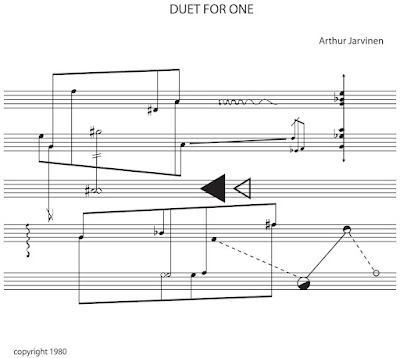
Art's graphical score Duet For One was sent to me by Alan Zychek, who created the computer engraving from Art's hand manuscript.  It comes from Art's book Experimental Etudes.

Robert Jacobson, guitarist on Art's "real soundtrack for an imaginary spy film" The Invisible Guy, took the picture of Art at a USC ceramics class about two weeks before he died.

Click on pictures for enlargements.


Memorial Tags:

Sunday, October 31, 2010

Prostitution, Obscenity and California Politics

Election season is almost over again.  Because I don't own a television station I can't rake in the bucks selling time for sleazy political ads.   I do have a blog and I can rant about politics - that's what blogs are for.

We Californians are enduring a gubernatorial combat between former California governor Jerry Brown, who wants his old job back, and former E-Bay CEO Meg Whitman, who apparently can't find work elsewhere.  Brown has been a politician all his life and has achieved a personal net worth of $4 million (source).  Whitman rode the crest of the Internet boom and has a net worth of $1.2 billion. Billion!  That ties her for number 332 on the list of the 400 richest Americans (source).  So far she's spent more than 10% of her fortune trying to get elected.

Why is becoming governor of California worth millions of dollars to Meg?  Meg tells us that she isn't running for office because of money.

I know she isn't running because she wants a paycheck of $206,000.  Meg has SO much money already that she could pay herself a governor's salary out of pocket for over 63 centuries - roughly until the year 8310.  If she puts all her money in a simple savings account (one with a paltry .25% interest) in one year her money will earn over 157 times the governor's salary. Honestly, that's enough for even rich people to live on - or so I'm told.


I actually think Meg wants to be Governor mostly because of the money.    Someone who has accumulated so much money (and done it so quickly) probably spends her time thinking about nothing else except money.

Meg argues that her vast horde of money will keep her independent.  I think that's wrong.  As governor I think she would be a hostage to her money pile and would have trouble making decisions which would adversely affect the net worth of the ultra-wealthy. 

Meg Whitman's wealth is vastly out of scale for our society.  It's far beyond anything an average American can ever hope for.  Immense wealth gives its owner great power.  It is obscene for a few individuals to have so much wealth and influence.  America is harmed by this disparity between richest and poorest.  And recent tax laws have been increasing the distance.  That's very wrong. 

It's time to bring back a more progressive tax code - where people with higher income pay ever higher tax rates.  Government is supposed to take enough money away from people who can get along just fine without it in order to help people who really need help.  People who pay high taxes ought to think of paying taxes as simple patriotism.  The idea is elementary, but, alas, the details are staggeringly complex.


Californians have been handed this line that "my obscene wealth makes me a better politician" before - by our current failure of a governor, actor Arnold Schwarzenegger (net worth $400,000,000 source).  Meg Whitman's talking points in her current campaign are eerily similar to what Arnold has told us in previous elections.  Watch this fun Jerry Brown attack ad:


Arnold, who now must bear the burden of an actual political record, was clearly lying when he recited these nostrums.  California has an immense revenue problem.  In no way have Schwarzenegger's actions in Sacramento resembled those of a good business leader.  He has not created jobs.  He has not made government more efficient.

All the while Arnold has taken over $143,000,000 in special interest money (source) and we must suspect that he says the things he says because other people paid him to say them.  After all, Arnold's real experience is as an actor and that's what a professional actor does.  Here's a fun compendium of 160 things he was paid to say (many of which are not safe for the ears of your co-workers or republican prudes):


Want more?  Here's another 130. 


Imagine California actually was a private business and that Meg Whitman applied for the job of governor.  Let's listen in on the initial interview:
Human Resources Interviewer: Welcome, Meg. Being governor of California involves lots of politics. What political experience have you had?
Meg Whitman: All my experience was running corporations.  I feel that I must have been very good at that job because I made a mountain of money.
H.R. Interviewer: Here at California Ltd. we believe that politics is the ability to convince people who already have money to hand it over to us so we can give it away to people who need it more than they do.  Is that something you know how to do?
Meg Whitman: I think government should allow people with money to accumulate even more money so they can pay salaries to people who need money.
H.R. Interviewer: How many California jobs have you created with your own mountain of money?
Meg Whitman: I had a housekeeper for a while.
H.R. Interviewer: Okay, thank you for coming in.  We'll call you if we need more information.
Meg Whitman's housekeeper (she's the one who claimed in public that she had been fired by Whitman from her $23 an hour job of nine years because candidate Whitman finally realized that having an undocumented maid was bad political form) became a hot topic during this election.   Whitman's campaign countered this mud with a tape in which one of Jerry Brown's assistants referred to Meg as a "whore" because she accepted an endorsement from a police union in exchange for exempting members of that same union from her own proposed pension cuts.

During one of those unwatchable debates Meg expressed great outrage at being called a whore:
I think every Californian, and especially women, know exactly what's going on here.  And that is a deeply offensive term to women.
It seems that Meg doesn't understand the most obvious implication of the word whore.  A whore is someone who "gets paid for it".  "It" can be anything, not just sex, and in these gender neutral times the person doesn't even have to be female. 

Being a whore means doing it for money.

You can see a list of contributors to the Whitman campaign here. 


If you are a California voter and you read this before November 2, 2010, please vote for Proposition 19 (because the current situation clearly isn't working) and also for Proposition 25 (because the current situation clearly isn't working.)

Read a Sunday Times (of London) article about current U.S. income tax rates:
Warren Buffett, the third-richest man in the world, has criticised the US tax system for allowing him to pay a lower rate than his secretary and his cleaner.
L.A. Times columnist Steve Lopez writes about what Meg Whitman could have done with her money instead. 

L.A. Times columnist Michael Hiltzik writes about why big-time CEOs make lousy politicians.

Money Tags: . . . . . . . . . . . .

Thursday, October 14, 2010

Arthur Jarvinen - Carbon for Bass Clarinet Solo

(You can read about the Arthur Jarvinen Memorial held October 30, 2010.  Or read my initial post called Arthur Jarvinen 1956-2010.)

In 1982 Art Jarvinen wrote a solo piece for bass clarinet entitled Carbon.  I performed that piece a lot.  (For me "a lot" was still less than a dozen times.)  One of those performances was at the New Music America Festival held here in Los Angeles in 1985.  I did a solo clarinet recital at the Arnold Schoenberg Institute, then located at USC.   (You can read about that recital in the MM post Two Marks of Good Music Criticism.)

I often introduced the pieces I performed directly from the stage.  That was a lucky thing at this event because the programs didn't arrive until the concert was nearly finished. 

Listen to my introduction of Carbon by Arthur Jarvinen on New Music America 1985  (142 seconds)

Here is a transcription of Art's program notes and biography as I read them to the audience.  My other verbal interpolations are only available if you listen.
Arthur Jarvinen provided the following notes for Carbon: This work was through-composed on a purely intuitive basis at a time when I was infatuated with Antarctica. I imagine Antarctica to be the place on the planet with the most nothing or the least of everything. The work is now dedicated to David Ocker for repeatedly bringing his considerable talents to bear on an odd and difficult piece.

Art also provided the following biography and noted that some people thought it uninformative. Arthur Jarvinen was raised in Finnish communities in the midwestern United States and Canada, the son of a Lutheran clergyman. A boy scout for three years he once snowshoed twenty miles in one day. Mr. Jarvinen has been a student of Thai cooking for several years and enjoys entertaining his friends. In 1983 he made dinner for Drumbo. His favorite footwear is a pair of jump boots he got in 1975.
Listen to Carbon by Arthur Jarvinen (482 seconds)

Here's an email which I received from Arthur.  It's dated March 17, 2007, at 3:10PM:
As a composer, I have really valued my relationships with people like you, Marty Walker and others who chose to play the bass clarinet, and focus on it, and do it so well. God's gift to me was the ability to easily play the vibraphone, the most boring instrument on earth. I would have asked for bass clarinet chops, were that an option.
I always wondered why he called the piece Carbon.  I can't remember ever asking him directly.  Possibly he chose the title because there's so little of the element carbon in the Antarctic.  That would mean it is music about things which are not present.  The music is filled with a great deal of emptiness. 

After an opening section of about 90 seconds, Art abruptly discards most of the material he has set forth, choosing to keep only a few simple musical phrases characterized by long steady tones.  These are unpredictably repeated over and over, contrasting loud and soft.

At each successive performance I remember trying to make those long tones even steadier and even longer.  And to make the silences between them longer as well.  Art eventually noticed this and told me that's not what he intended.  He didn't specifically say 'don't do it'. I remember ignoring his comment.

Today, based on this performance, I don't feel that the piece is too long.  But Carbon does feel like it speaks about things which are missing.  Foremost among them now, of course, is Art himself.  I suspect that the meaning of all of his music will change for those of us who knew him, now that we must live in a world without him. It's a poorer world now - one without the one-of-a-kind creativity of Art.


A note on this recording.  My 25-year old archive tape was afflicted with horrible print-through, a condition where the magnetism of one loop of recording tape magnetizes the next loop.  This results in little echos of things which are about to happen.  Needless to say, the listening experience is ruined - especially for Carbon.  

Through the miracle of digital audio editing and because of the reptitive nature of this music,  I've been able to remove the print-through artifacts and restore the music experience.  Audiophiles who listen critically at high volumes will be scandalized.  The rest of us, who listen at normal volume, should have no problem in contemplating the musical events as Art himself intended them.

Carbon Dating Tags: . . . . . . . . .

Sunday, October 03, 2010

Arthur Jarvinen 1956-2010

Art Jarvinen passed away yesterday.  He was a composer and a percussionist and a bass player.  He called himself a physical poet.  He created stuff.  Lots of stuff.  Much of what he created was music.  Other times he created things which pushed the boundaries of music.  Sometimes he pushed those boundaries quite hard.


I considered Art one of my closest friends.  We met in the late seventies.  He performed on Independent Composers Association concerts.  He was in music ensembles (EAR Unit, The Mope, Antenna Repairmen) which played my music.  I was in an esemble (XTET) which played his music.  He started a publishing company (Leisure Planet) which published my music.  We both worked for Frank Zappa.

I didn't always understood what motivated Art.  Nor did I always understand his music.  A performance of a Jarvinen piece could leave you scratching your head.  Sadly, our last few conversations left me scratching my head.  There will always be things about Art which I will never understand.


Art kept a website, arthurjarvinen.com.  There's a bio and lists of his compositions and recordings.

I'd like to point your attention to three projects which will tell you more about Art than I can.  All of them are well worth your time.

First, The Invisible Guy.  I'm listening as I write this post.  I love the music to The Invisible Guy - although I often find it difficult to reconcile with Art Jarvinen the person.   Art called it:
a real soundtrack for an imaginary spy film
Fifty episodes of music and written narrative,
inspired by the surf music/spy movie genres.
There are dozens of tunes you can listen to (you can also tap your foot or sing along) - while reading about the adventures of The Invisible Guy himself.  You want to know about Art's musical influences?  Try listening to The Invisible Guy.


Second, an interview Art did in 2008 on Kalvos and Damian.  (Look for show #539.) Kalvos and Damian are two guys who are not named Kalvos or Damian.  However, in two hours they covered a lot of Things Jarvinen.   This is the best overview of Arts career of which I'm aware


Third, Mister Composer Head.   Mister Composer Head is a blog.  Well, it was a blog briefly in 2007.  An anonymous blog.  Well, there's no point in keeping the secret now.  Art Jarvinen was Mister Composerhead.   Back then I wrote this bit to describe how the project started:
  1. David asked Mister Composer Head to write some guest posts.
  2. Mister Composer Head did one.
  3. Mister Composer Head then did another. And another. Mister Composer Head REALLY got into it.
  4. David suggested that Mister Composer Head should have his own blog. But Mister Composer Head didn't want to do that.
  5. So David is doing it for him.
I also wrote text for the Mister Composer Head header:
MISTER COMPOSER HEAD.  Being the comments of Mister Composer Head, composer of music, thinker of thoughts, writer of words, player of instruments and teller of stories who says what he wants to say and doesn't care how you react as long as we keep his name out it.
Art told me he really liked that paragraph.  Damn it, Art, you should have written more.


Here is a previous MM post, Independently Celebrating Independence, about a 4th of July pig roast thrown by Art and his wife Lynn and by Robert Fernandez (a fine and friendly percussionist and Antenna Repairman who knows how to do many things, not just roasting a pig, like the Cubans do.)  And here is another, Trixie - the Independence Day Pig, about an earlier similar event.  (It includes video of Art playing a simantron.)

Here is a search of all MM articles which mention Art.  There are a bunch.

Here are excellent tributes to Art by Kyle Gann and Jack Vees and on the CalArts Blog
and on Kill Ugly Radio (a really fine blog).  The last is about Art's work for Frank Zappa and the infamous While You Were Art incident and it quotes from this fascinating interview Art did in 2007.

Mona Hostetler, whose composer son Randy passed away at a very young age and was a close friend of Art, wrote this remembrance of Art Jarvinen.  I like the story of the performance with the toaster.

You can read about and listen to my performance of one of Art's compositions: Arthur Jarvinen - Carbon for Bass Clarinet Solo

Read about the memorial for Art held on October 30, 2010.

Leslie and I send our sincerest condolences to Art's wife, Lynn Angebranndt.  

Art Jarvinen Tags: . . . . . .

Saturday, October 02, 2010

Drawings by Oscar Littlefield

My last post, Pointing at my iMac, included a 20-year old Everex computer advertisement.  I kept it so long just to use on Mixed Meters.  Yup. In my search for it I came upon a manila envelope I've been saving for even longer.  Dating the envelope is easy - here's the return address:


Inside are four pen and ink drawings.  I intended to have them framed.  As my Mother always said, "The road to hell is paved with good intentions."  Words to live by.

The framing and hanging might still happen someday.  Until that day comes I've scanned them for display here.  (Click on any of the drawings for an enlargement.)


The artist is Oscar Littlefield. He was a resident of Sioux City, Iowa, during the period when I was a child growing up there.  He earned his living as the director of the Sioux City Jewish Federation.  Art was his hobby.  I didn't know Oscar until the mid-80s, the last few years of his life, when he, a widower, had married my Mother's best friend, a widow like my Mom.

There had never been artist role models for me while growing up in Sioux City.  One very minor exception was a visiting composer who wasn't even close to being an inspiration. (Read a little about that guy in Drummer Replaced by a Machine.)


Oscar, however, was different.  When I met him I had finished my education.  My music had been inspired by a number of abstract modern artists.  He and I fell easily into talking about the creative process - and he quickly became a reason to look forward to my visits to Iowa.

Oscar's principal medium was woodcarving.  Some of his sculptures are visible now on the Sioux City Art Center's website.  Check them out.

His drawings made a big impact on me.  I saw them, framed, hanging on the wall in his home.  Even more impressive was a hand-written letter from Albert Einstein, displayed nearby.  Einstein was saying (in German) how hard it was then (in the '30s) to find a job for a young physicist - because he was Jewish. 


These four drawings, like most pen-and-ink drawings, are about lines.  Oscar generally makes his lines of even thickness.  Darker shadows are represented by carefully placed parallel lines.  The lines swoop and curve.  They go places.  Oscar uses them to suggest three dimensions, especially in the last one.  The skull-like silhouette is the only real bit of representation.  I may not have picked his intended orientation - especially in the first two. (Feel free to swivel your monitor around to check out other possibilities.)

This page at the Sioux City Art Center website discusses Oscar's working method as a woodcarver.  It says:
The approach is very simple: an artist looks for inspiration in random patterns and pays attention to their own personal, subjective responses and imaginings
These drawings seem to have resulted from exactly that method as well.


Oscar's drawings were comparable to my own pen-and-ink "doodles" - little drawings I've done my entire life.    I think that the abstraction, the process, the long curved lines and the medium itself reveal many similarities between us.

Examples of my own "doodle" drawings are viewable in one, two, three, four, five, six different Mixed Meters post.  (If you time for only one I suggest #3.)  Also, you could see some doodles done in the medium of refrigerator magnets (along with a good story about cat piss.)

Here's a post, not about drawing, but about growing up musical in Iowa: Me and Mahler, Me and Iowa.

Finally, here's a post called Sevens, in which I discuss the large pile of manure Sioux City, Iowa, is famous for.

Pen-and-ink Tags: . . . . . .

Friday, September 24, 2010

Pointing at my iMac

After using a Commodore 64 for several years I purchased my first PC in 1989.  It was an Everex Step 386.  It got raves in all the computer magazines. It came with Microsoft DOS 4.0.

 (Click on the picture to read about all the advanced features.)

In my notes I listed the cost of its various components:
    25 Mhz. 4 Mbyte. Computer   $4000.00
    80 Megabyte Hard Drive      $ 850.00
    1.44M Floppy                $ 110.00
    NEC 13" Montor              $ 667.00
    VGA Graphics Card           $ 350.00
    Serial Interface            $ 100.00
    Math Co-Processor           $ 600.00
    6.5% Sales Tax              $ 434.00
                               ----------
               Total            $7111.00

According to this site, $7,111.00 in 1989 is equivalent to $12,699.00 today.  My entire system (including software and an Apple Postscript printer) cost about $13K back then.  Money well spent. 

Over two decades I owned a succession of ever faster, ever cheaper PC computers.  During those years I developed a deep antipathy for all Microsoft products.  This was especially true of their operating systems.  But I was stuck with those because my principal work program, Score, still runs under DOS.

My hatred for Bill Gates' products grew extreme and I wanted a way to vote against Microsoft with my future purchases.  Rest assured that I am leaving a number of lengthy anti-Microsoft rants out of this post.  My obvious choice, of course, was to switch to Apple.

I can pinpoint the moment at which my mind was made up.  In 2008, PC Magazine, which I had been reading since before I purchased the Everex, ran an article called OS Wars, The Battle for Your Desktop.  It declared Apple OSX the winner (computer magazines like to declare winners).  The article suggested the best OS for different professions, including:
ARTIST/MUSICIAN
Mac OS. The other artsy people will laugh at you if you use anything else.
You think I would have figured that out for myself - all my clients and most of my friends use Macs.  When the PC magazines are telling me to get a Mac, even I got the message.

So, last fall, I ordered a 24" iMac for $2,059.00 - or one sixth the price the Everex would have cost today.    The Mac is 120 times faster than the Everex and has 1000 times the RAM and 12,500 times the hard disk space.

It arrived exactly one year ago today, September 24.  Here's what it looked like.  (I did take it out of the box just after snapping this picture.  Notice the completely useless book Switching to the Mac on the desk next to the box.)


Suddenly faced with doing daily tasks, I discovered the real meaning of switching from PC to Mac.  Yes, those clever television ads ("I'm a PC" "I'm a Mac") would have you believe that switching is SO simple.  Possibly true, I suppose, for a more casual user.   But I've had two decades to form my computer-using ways - by which I mean that many of my work habits are set in stone.  Every old familiar task became a new adventure.

Would it be so hard to throw a bone to possible Windows-to-Mac converts with a few Windows-mode options?  Suddenly having to do things the Macintosh OSX way was very frustrating.  For the first few months I swore at my new computer just as much as I had ever railed at any of my Windows computers.   And I bitched to any Mac user who'd listen.  Most of them wouldn't.  "Mac users are like pre-verbal infants." I'd say.  "If they want something, they point at it."  There were plenty of times I regretted my purchase.

Here's a couple examples:
  • Every program, Mac and PC, has a menu bar: File, Edit, View etc.  On PC there is easy access to these commands from the keyboard - Alt-F opens the File menu, then every sub-menu has a letter highlighted to show how to invoke it.  I used these extensively on PC.  Mac has a similar but completely irrational function.  You're supposed to be able to customize the behavior (although I can't get that to work.)
  • On PC, if a Window is not in front but you can still see it, if you click on a visible command it is invoked.  On Mac you must click twice - first to bring the window forward, then again to invoke the command.  Curiously, Apple's own software iTunes works like a PC in this regard.
  • Switching windows using Alt-Tab on a PC is straight forward.  If you tab to the running program you want, it appears.  On OSX, after 1 full year of trying to suss the rationale behind Command-Tab, I can not predict whether or not a window will open when I switch to it.
  • Apple keyboards are crap.  The computer came with a free-standing laptop keyboard.  I replaced this with a mushy, plastic, older Apple keyboard which I hate less than the first one but at least it has all the keys.  The writing on the wall in Apple land is that keyboards are old fashioned.  All those iPads, iPods, iPhones and MagicMice make it clear that in the future if you want something you should just point at it.
I guess I'm learning to ignore the petty annoyances with which Mac burdens a PC user.  I occasionally find suitable workarounds.  There are probably geeky ways of fixing the other vexations, but life is too short.  I dream of waking up one morning completely able to use Unix, the foundation of OSX.  It's easier to put up with the hassles.

And, yes, there are good things about switching:
  • Music programs - especially Sibelius and the various plug-ins I use with it - run like a dream in comparison to Windows.  
  • OSX really is more stable.  It ran for over 60 days without rebooting once.  It might still be going except that Leslie pulled the power cord out with her foot.  
  • I love the beautiful screen and graphics - although sometimes it takes a bit of negotiating with Leslie to decide who gets to use the iMac first.
  • Microsoft Windows runs directly on the iMac using a translator program.  This means I didn't have to purchase an expensive new copy of Photoshop and I can keep using certain geeky Windows only programs on the Mac.  I'm still using all three of the computers I had before albeit for fewer, more specific tasks.  I now have even more Windows computers than I used to (if you count the Mac as one).  In my experience computers don't get replaced, they multiply.
All in all - I do like having the Macintosh.  Now that I've got one, I'll probably always want to have one.  I doubt I'll ever be a Mac only person.  Having the Mac has both made my computing life both simpler and more complicated.

And someday, maybe, when I go back and forth between Windows and Mac I'll be able to remember when the close and minimize buttons are on the left (OSX) and when they're on the right (Windows).  That will be a great day. 


Pre-Verbal Tags: . . . . . . . . . . . . . . .

Thursday, September 16, 2010

In which Mixed Meters Turns Five

On September 16, 2005 - exactly five years ago today -  I posted the first three articles to this blog Mixed Meters.  Yes, three in one day.   Here's the entire first post "In Which David Fails to Find An Interesting First Comment":
Every new adventure begins with the words "Why am I doing this?" It would be so much easier not to bother trying new things.

If you, future person reading these words, discover that this blog hasn't changed in months . . . years . . . then you'll know I couldn't find a good answer for the question.

My philosophy will be . . . keep it short.
In the following two weeks I published 14 more articles:
  • In which David Reveals What He Listens to While Listening to NPR
  • In which David Rewrites the Pledge of Allegiance
  • In which David Plugs Ham Hocks and Cornbread
  • In which David Introduces a New Character
  • In which David First Refers to His Hair
  • In which David Eats Cheese Before Bed
  • In which a Docker Award goes to Oolon Colluphid
  • In which David Hears Things
  • In which David Envies the Leisure Classes
  • In which David Collects Random Thoughts
  • In which David Doesn't Often Go To the Movies, But...
  • In which David Links to Writers He Respects
  • In which David Has A Clarinet Flashback
  • In which David Rants About His Wireless Router
Read all of them, in reverse order, by clicking here.

Today, in 2010, after more than 500 posts which are always way longer and much less frequent than those early ones, I realize the utter foolishness of me ever trying to keep things short.  And the question "Why am I doing this?" has as yet to find an answer.

And ... I'm still blogging.  Go figure.

Here's a picture of me on my actual fifth birthday - in 1956:


After a period of practice blogging I formally announced Mixed Meters in an email on Nov. 1, 2005:
To Friends, Relatives, Colleagues, Clients, People With Whom I've Exchanged At Least One Email Within Five Years, People Who Send Me Repeated E-mail Promotions and Others:

DAVID OCKER HAS BLOGGED.  It's called MIXED METERS.  I know you're all thrilled.  Please check it out.

I've been posting to it for about a month.  It's mostly about the music I enjoy, but there are also remarks about politics, movies and the pop culture to which I'm subjected.  Plus silly rants and pictures. Lots of links.

You can listen to selected 30 Second Spots.  These are half-minute low-fidelity Midi pieces which I've been writing.  Click on "Read about 30 Second Spots" for an explanation.

I've even created the Docker Awards - presented only to fictitious characters so far. They're kind of like Grammys or Oscars, only more pointless.

I try to keep everything short.  Expect a new post two or three times a week - at least until I get bored.  That will happen sooner if no one is reading.  So you know what to do.  (And please tell your friends.) Thanks.
I like it when people read what I post, but let's face facts - Mixed Meters has not set the Internet on fire.  I do seem to have a few really engaged readers.  I am very grateful to you for returning repeatedly.  My range of subject matter can't make Mixed Meters easy to understand, so I assume that on some level you're kindred spirits.

Sometimes I claim that Mixed Meters has only three readers.  That's supposed to be a small joke.  On the Internet the important metric isn't readers, it's hits.  Here's the five-year history of MM's daily hit counts:

Pretty erratic, huh?  Some of the features do have explanations.  Letter A, for example, represents the initial email announcement above.  Letter B is my first post about Frank Zappa, an article entitled Varese, Zappa, Slonimsky.

Letter C marks a post called In Which David Is Confused By The Second Coming.  I wrote about a hip hop artist, Juelz Santana, who had used the Dies Irae in a track which became part of a Nike television commercial.  I was interested in Dies Irae while other people were interested in Juelz.  Fortunately that wore off.

The single busiest day was November 16, 2008 (D) when Mixed Meters was hit up 415 times.   A few days later I posted about Hitler, Wagner and Ring Festival LA for the first time.  You can plainly see that the hit count has declined steadily ever since.  The increase in green on the graph suggests that some people have begun exploring Mixed Meters once they get here, not just landing on one page and then surfing off again.

Also notice the mysterious trough at letter E.  I don't know what it represents.  Maybe it was some sort of glitch at Google.  A large portion of MM hits originate from Google.

All in all, I think Mixed Meters has been good for me.  I'm happy when I'm working on it.  I think I'll keep doing it.  Its real purpose, I suppose, is to reflect my interests.  It's just that I have no real clue about what will interest me next.


Please feel free to explore what's already here while I figure out what's to come.  Here are some starting points ...
... plus much, much more.  You could try searching the so-called archives.  Let me know what you find.
    Things that happened on September 16, 2005, according to the L.A. Times
    Things that happened on September 16, including 2005, according to Wikipedia.


    Mixed Meters Tags: . . . . . .

    Saturday, September 11, 2010

    My Trilobite

    Sometime last year I was looking for a book to read.  I picked up Leslie's copy of Trilobite, Eyewitness to Evolution by Richard Fortey.  Fortey is a trilobite expert and a highly praised author of books about science for non-scientists.  I found his writing to be equally fascinating and wearisome.
    • Trilobites are extinct marine arthropods. 
    • Arthropods are animals. 
    • Living arthropods include shrimp, crabs and insects. 
    • Marine arthropods live in the sea. 
    • Extinct arthropods are known only through their fossil remains. 
    • People who study fossils are called paleontologists. 
    • Richard Fortey is a paleontologist who works at a natural history museum.  
    • Leslie, my resident biologist, also works at a natural history museum.
    • She can explain these things much better than I can.
    Fortey's best known work is Life, An Unauthorized Biography. It deals with 4 billion years of evolution, beginning with one-celled critters and ending with you and me.  In the preface Fortey says that he wrote Trilobite because in Life he could only give "a page or two" to his passion for trilobites.  That gives you an idea of how important trilobites, which existed for about 275 million years, were to evolution.  Can you say "dead end"?


    Trilobite impressed on me just how strange these animals must have been.  And of course I have a strong affinity for "strange".  Pictures of trilobite fossils show bizarre, segmented, armored, tentacled little creepy crawlies perfect to be cast in a horror movie or as some threatening species on an alien planet where astronauts accidentally crash their spaceship.

    I wanted one of my own.  Leslie picked up on a few hints that I dropped.  She's very good that way.  For my recent birthday she presented me with a genuine trilobite fossil.  Here it is.  (Click any of the pictures for enlargements.)


    My little guy came with this scant information:
    • Fossil Trilobite Phacops speculator
    • Age: Devonian Period
    • Classification: Phacops speculator
    • Location: Anti-Atlas Mountains Alnif, Morocco
    • Origin: Hammar L'aghdad Limestone
    "Anti-Atlas" mountains?  Are there Pro-Atlas mountains somewhere?   And where is Alnif?  Here are more pictures of fossils from Alnif.

    You'll notice that this particular Pracops speculator is curled up in a ball.  Trilobitologists say it is "enrolled" - although they never talk about trilobite schools.  It's likely that trilobites which were afraid something was about to kill them curled up to protect their soft undersides.  Getting encased in muck was probably a pretty traumatic experience.

    Whoever chipped away the limestone in which this particular critter was discovered left a little base for it to stand up upon.  It's like a small statue.  A trilobite bust.

    I have no clue about the phrase "Hammar L'aghdad Limestone".  The Internet is no help.

    So when was the Devonian Period?  Well, roughly it was 416 to 359.2 million years ago.  That's how long it has been since my Pracops speculator curled up in a ball and died.   That long ago Morocco could have been almost anywhere.  And the Anti-Atlas mountains didn't even exist yet.


    I now present The Mixed Meters Method for Conceptualizing How Long Ago My Trilobite Lived.

    STEP ONE: Imagine all the things which have happened since the year one, 2010 years ago, from Jesus to Justin Bieber.  Think carefully about the changes in religion, technology, society, language and government since then.  Think of all the people who have lived and died.  Think of all the arthropods which have lived and died.  Remember that there have been 734,406 days since the beginning of year one, days just like today.  A lot has happened since the year one.


    STEP TWO: Count to 500.  For each number from one to five hundred, repeat STEP ONE.  This may take you a while.  If each number between one and five hundred represents two millennia, which you considered in step one, then when you get to 500 you have thought about one million years.


    STEP THREE:  Repeat steps one and two each day for one entire year.


    Have you done all that?  Once you successfully complete steps one, two and three you have conceptualized 365 million years.  That long ago would put you back near the end of the Devonian period  when my trilobite lived.

    For a guy celebrating his birthday, the last birthday before the first digit of his age number increments yet again, this little fossil was a really good gift.  Envisioning how extremely old it is makes me feel quite young by comparison.

    Thanks, Leslie.  Love you.


    I took the first three pictures with Leslie's fancy schmancy camera.  The last two were taken with the point and shoot in my pocket.  They're not as good but I always say "you can never have too many pictures of your own personal trilobite."


    Pracops speculator Tags: . . . . . .