Thursday, December 03, 2009

BLOBS

Here's a short piece of music, a 30 Second Spot, combined with some simple video to distract you. The title is BLOBS. The reason for the title should be obvious. Other things are less obvious.

But this haiku will explain everything:
Pure Cholesterol,
Floating, artery clogging.
Can you get the phone?


Copyright © 2009 by David Ocker - 125 seconds


Blobs Tags: . . . . . .

Got no clue why I call this a "30 Second Spot"? Read this.

Tuesday, December 01, 2009

Walking Pictures

I walk quite a lot every day. On most walks I take no pictures. Today however I found a deceased rodent in everlasting repose on the grass, a defaced stop sign praising pacifism outside a Catholic church, a metaphor for birth and death outside a mortuary parking lot and a preview of the upcoming Rose Parade which doesn't even happen until January 1, 2010. Mixed Meters brings you the future, now.


Exit and Enter the Mortuary
Dead Squirrel on the Grass
Stop All War stop sign
Here's a picture of another recent guerilla art piece in Pasadena which has become famous but is not particularly deep philosophically. I mean, is a pun on the word FORK comparable in any sense with an urgent exhortation to stop all war?


Walking Picture Tags: . . . . . . . . .

Monday, November 23, 2009

In which I remember the Great Cranberry Scare of 1959

I would have been eight years old in 1959, fifty years ago. The government announced that year, just before Thanksgiving, that some cranberries should not be eaten because of possible contamination. Here's the November 9, 1959, press release:
The Food and Drug Administration today urged that no further sales be made of cranberries and cranberry products produced in Washington and Oregon in 1958 and 1959 because of their possible contamination by a chemical weed killer, aminotriazole, which causes cancer in the thyroids of rats when it is contained in their diet, until the cranberry industry has submitted a workable plan to separate the contaminated berries from those that are not contaminated.
As a result of this announcement a nationwide panic ensued.

I, a highly impressionable and not-too-savvy-about-matters-of-food-borne-news-inflamed-misinformation eight-year-old living far from Oregon or Washington, resolved never to eat cranberries again. It was years, decades even, before I could securely eat any cranberry product. Even now, every Thanksgiving as the dish of red goo gets served, my childhood fears return: those little red round berries could kill me. I've learned to keep my mouth shut about it.

Of course, since then, I've even discovered that I like cranberries - including cranberry bagels (which ought to be an affront to nature, but aren't).

I was reminded of this little shading of my personality by a front page of the Los Angeles Mirror (an evening newspaper) from November 11, 1959, reproduced in a recent LA Times blog post about policemen damaging an LA restaurant because of a typographical error. The massive headline is pure scandal rag. But those pesky contaminated cranberries are front and center a few inches down.


A little research into the subject reveals that this event was an early example of food panic. The genre has gotten rather more sophisticated since then.

If you go to the Times blog you can enlarge the newspaper page enough to read the other stories. But here's the text of the cranberry story to help Mrs. Google run up my hit counter.

Go Ahead and Eat, Say Cranberry Expert

Claims Even Tainted Crop Safe

WAREHAM, Mass., Nov. 11 (AP) - The scientist who presides over the world's leading cranberry agricultural experiment station said today he can see no reason why people should not eat cranberries now and during the holiday season.

Dr. Chester E. Cross of the University of Massachusetts directs the Massachusetts agricultural experiment station to which agricultural scientists of the world come to learn about cranberry growing.

[Sidebar: For tasty cranberry substitutes, see story, Page 19.]

This station is largely responsible for the Massachusetts cranberry production, which this year totals 595,000 barrels or half the world crop.

Dr. Cross points out that weed-spraying has been questioned only in a small fraction of the nation's crop in two Pacific Coast states.

He said he would eat a helping of even the suspected West Coast cranberries with no more concern than he would feel over smoking a cigarette.

He chided Welfare Secretary Arthur S. Flemming for stating Monday that improper use of the weed killer aminotriazole had contaminated portions of the Oregon-Washington crop.

Timing Blasted

He said that Flemming's statement at this pre-Thanksgiving time is damaging to the entire industry and that information upon which it was based was "miserable and meager".

In nearby Hattson (?) the National Cranberry Assn. said that all suspected West Coast cranberries already have been segregated from the market.

Meanwhile, the U.S. government sent 100 inspectors and 60 chemists to all parts of the country to test cranberries for possible contamination.

Few Contaminated

Only limited quantities of berries from Oregon and Washington have been found to be contaminated, the government says. But it is making safety checks on cranberries from all producing areas.

Ambrose E. Stevens, executive vice president of Ocean Spray Cranberries, Inc., said in New York that Flem- (turn to Page 19, Column 4)

The National Cranberry Association is now known as Ocean Spray Cranberries, Inc., and apparently it survived the 1959 panic thanks to a government subsidy on unsold cranberries. They now sell nearly $1.5 Billion dollars worth of cranberries per year. An early version of "Too big to fail"? Read more than you want to know about the cranberry business here.

Scare Tags: . . . . . .

Tuesday, November 17, 2009

Musical Signs

Check out a tuneful restaurant, ride in a fast RV, buy some fancy clothing, enjoy wine with multiple voices, sip some Bachian java or relax in Mozartean elegance.

Musical Signs - Melody Restaurant
Musical Signs - Allegro Bus built by Tiffin Motor Homes, Red Bay Alabama
Musical Signs - Opera Fashions
Musical Signs - Counterpoint Wine
Musical Signs - Coffee Cantata
Musical Signs - Amadeus Spa and Salon
This is the third of a series. In part one we learned the words trio, forte, cornet, arpeggio, aria and allegro. In part two there was koda, tritono and concerto.

Saturday, November 14, 2009

FLAP

For some reason I keep making videos of birds. First there was Birds Who Don't Know The Words. Then there was SQUAWK! Now, here is FLAP.


Copyright © 2009 David Ocker - 121 seconds

The video was shot from the pier at Avila Beach, California, last month. Here's a satellite picture.

This small city underwent a "remediation" in which old buildings were destroyed, 200,000 tons of contaminated soil replaced by uncontaminated and new buildings constructed. This was all because of a pipeline leak. Additionally, Avila Beach is just a few miles from the earthquake-fault-adjacent Diablo Canyon Nuclear Power Station. Nice place to visit.

The pier at Avila Beach California
FLAP is the first original piece I've completed on my Macintosh: the music in Sibelius and the video in iMovie. If everything about it makes sense to you, seek professional help. Koo-koo-ka-choo!

Avila Beach California under the pier - Leslie contemplates her ocean
The first picture is Avila Pier at sunset. The second is underneath the pier. That's Leslie contemplating her ocean.

Flap Tags: . . . . . .

Monday, November 09, 2009

Songs of Pasadena

Weeks ago I posted about Pasadena, a hit sung by the Euro-pop group Maywood. You may want to get up to speed by reading that post before continuing with this sequel.

Later, Ben Harper, one of Mixed Meters' Three Readers, offered up a song by John Paul Young called It's a Long Long Way to Pasadena. JPY is as well known in the United States as Maywood. The link Ben offered has been removed due to copyright - but here's the golden oldie version sung live.

Another of Mixed Meters' Three Readers, Charles Ulrich, alerted me to a much earlier tune known as Pasadena (although it is actually entitled Home in Pasadena because that's how the lyric goes). This one was written by Harry Warren who wrote hundreds of famous songs in the twenties, thirties and forties.

Home in Pasadena was written in 1923 and it was a big hit, first in the U.S. then in England. You can listen to a very early version via YouTube. Charles sent me this different version where the vocalist makes up his own melody in the chorus. (Warning: Pace yourself! There are a lot more listening links coming along soon.)

I looked online for even more songs about this city where I've lived for a dozen years. What I found was a book called The Golden Ear, A Treasury of Songs to Pasadena by Carter Barber. You can read the L.A. Times review. (Same available via Google Cache, here.)

I purchased a copy through some unsuspecting online bookseller. Here's a composite of the front and back covers. (Click to enlarge.)

The Golden Ear, a Treasury of Songs to Pasadena California by Carter Barber - cover shot
Self-published in 1985, it seems to be from the "who said what to whom" school of journalism. Largely it details a whole host of mostly unknown songs about Pasadena, the effort to pick a City Song for the centennial celebration in 1986 and the politics and petty squabbles surrounding their inevitable obscurity. The book has the lyrics for 38 Pasadena songs, although Maywood's and John Paul Young's are not included.

Whether Pasadena has an official song at the moment, whether anyone knows what it is and whether anyone cares about a Pasadena song are all whethers about which I don't much care.

Here's Ian Whitcomb, an actual Pasadena resident, singing Home in Pasadena. Since the sheet music is printed in The Golden Ear I was able to determine this is the definitive online performance.


Here's Van Dyke Parks singing Home In Pasadena - with spirit if not with much precision.

Here's Jan and Dean singing Little Old Lady From Pasadena.


Here's a five-year old Bulgarian girl singing and dancing to Maywood's Pasadena.

Here's an over-the-top music video of Maywood's Passadena in some other language.

Here's a song called (Let's Move to) Pasadena by the band Modern Skirts.


Pasadena is more than just the name of a song. It can be the name of a band as well.

In England they have The Pasadena Roof Orchestra apparently named for Home in Pasadena. (Here's their Wikipedia page.) This video is Puttin' on the Ritz. (Dig the patina on that tenor sax.)

Here's a band called Pasadena singing their song Realize. (Strangely, they think Pasadena is somewhere in Maryland.)

Here's a band The Pasadenas singing Riders on a Train.


Yeah, that marks the end of this topic.


Tired of Pasadena Song Tags: . . . . . . . . . . . . . . . . . . . . . . . .

Wednesday, November 04, 2009

Oil and Water Mix

Click here to listen to Oil and Water Mix right now and avoid all the tedious reading.
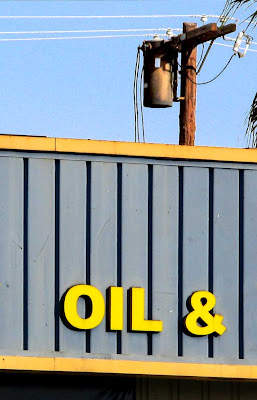

Earlier this year I heard a radio broadcast of Francis Poulenc's Concerto for Two Pianos, although the announcer called it Ravel's Concerto for the Left Hand. The Poulenc had been a favorite of mine in college days. I hadn't listened to it in a very long time. I enjoyed hearing it again.

Soon afterwards, inspired by the Poulenc, I decided to compose some simple, melodic music filled with lots of tonics and dominants. I wrote one little passage, then another and another, not bothering much with any sense of structure. I called the piece "Not Dissonant and Not Complex". Catchy, huh?

When "Not Dissonant and Not Complex" reached about four minutes I was forced to confront the fact that it wasn't very interesting. I hatched a new plan: I would interpolate bits of a completely different sort of music - random sounding notes - into what I had already written.

Thus the idea of "oil and water" was born: two radically different musical styles, each in turn ignoring the other, then cavorting with the other, then battling for supremacy. One type of music is "oil", the other is "water". You can decide which is which.


The word "mix" gets a lot of use in music. Mostly it refers to the result of audio manipulation of some already recorded tracks. I'm using the word "mix" in more of an active, verbal sense. Think of the sentence "Listen to me make oil and water mix."

The entire piece, both oil and water, is carefully composed. Certain sections sound random because I tried hard to make them that way. I adjusted each pitch, rhythm and dynamic to produce maximum variety. No Cageian chance methods were employed while composing Oil and Water Mix. None were needed.

It has already been remarked several times by people who have heard Oil and Water Mix that it seems to wander aimlessly, pointlessly. I do understand this reaction. But in fact the piece is divided into sections and certain melodies are repeated several times.

If you think that following this "formal structure" might be helpful as you listen I have added an analysis of Oil and Water Mix. You can find this on the playback page. Just click here and then scroll down a bit.

It's hardly a rigorous analysis, completely unworthy of a doctoral student in musicology. I had different choices about how to name things - for example - Section Two might actually be just a coda to Section One and Section Three might merely be a slow prelude to Section Four. You might want to listen for the short silence at 5'22" between sections two and three.



Mixed Meters' Three Readers may remember long ago, when I started posting my own short pieces, I lumped them together into a category called Thirty Second Spots. Later I started writing longer pieces for which I invented a new category, Three Minute Climaxes. Eventually I needed a third name for even longer pieces. I called these Ten Minute Breaks. (Think of the word "break" in the sense of a "coffee break".) The actual lengths vary above and below the stated time limits; please don't let that bother you.

Oil and Water Mix, at eleven minutes and six seconds, qualifies as a Ten Minute Break.

I now have composed five Ten Minute Breaks: They are
  • Thinking With Other People's Words (click here to listen, click here to read the related post)
  • Eating the Desiccant (never posted online because I like it too much)
  • Poof You're A Pimp (click here to listen, click here to read the post)
  • Formal Introduction (this one has been "nearly" finished for almost a year)
  • Oil and Water Mix (click here to listen, you are already reading the related post.)


Of course it should go without saying that I'm not now, nor have I ever been, a doctoral student in musicology.

Oil and Water Tags: . . . . . . . . .

Friday, October 30, 2009

Hidden Meanings

These are carefully cropped pictures of various Pasadena signs. This process reveals secret messages.

Partial Signs, Hidden Meanings - rant
Partial Signs, Hidden Meanings - retch
Partial Signs, Hidden Meanings - lies
Partial Signs, Hidden Meanings - vices
Partial Signs, Hidden Meanings - rapes

And here are two in honor of Halloween.

Partial Signs, Hidden Meanings - hell
Partial Signs, Hidden Meanings - coven
The last is part of a church name. Sorry, no pictures of pumpkins this year. You can find some here. One of MM's earliest posts concerned Halloween movies.

Similar silly MM photo essays:
Crooked
Musical Merchants
Branches Before Blue
Gloves In the Wild
Fence Shadows
Graffiti Animals of California
Buckets for Babies in Pasadena
HALF GRASSED

This one, Taggers With Spellcheck, also deals with words.

Here's a bonus.

Partial Signs, Hidden Meanings - aura

Partial Tags: . . . . . .

Wednesday, October 28, 2009

Hell Mouth

John Adams, the most successful composer, has been my top client for decades. Hey John, thanks for all the work! (I mean, really.)

But he has shown very unusual lack of judgment recently by starting his own blog, Hell Mouth. I think the picture which begat this strange name must have been taken by John's wife, the photographer Deborah O'Grady.

Hell Mouth is starting at a furious pace: he's written five posts, extensive essays, in a little over a week. Here at MM I feel overworked if I do five short posts a month. But I've been at this for a while (4 years last month) and understandably my enthusiasm has waned.

John is a good writer. His skills have been honed recently by his biography Hallelujah Junction. I like his adjectives.

One of John's posts is entitled: On Surviving a First Rehearsal discussing the composition and premier of his most recent work City Noir (actually his third symphony). The public perception of how a piece of music travels from a composer's brain to a concert stage is a complete mystery to nearly everyone - even to some musicians. My job puts me right in the middle of one facet of that process. This explains why a lot of people have no clue about what I do for a living.

John devotes one paragraph to me.
City Noir is so densely layered that I need two full manuscript pages to embrace all the parts. Hell for the copyist, who is nonetheless unfazed, a total pro. David—started out playing clarinet with Frank Zappa. After 24 years knows my intentions nearly well enough to fill out a line that I’ve forgotten to write out.
Very cool.

Bienvenido Gustavo on a newspaper vending machine
Later John mentions the first rehearsal of City Noir led by boy wonder Gustavo Dudamel in Walt Disney Hall. I was one of very few people allowed to listen. The musicians had prepared for the rehearsal but none of them could have much of an inkling how John intended their parts to fit together. Loud things came out soft. Soft things loud. It came apart. It came back together again. Somehow Dudamel kept it all racing along - the entire piece. When he conducts, his hair subdivides the beat.

The composer, conductor and all the players were hard at work. Their job was to make City Noir sound correct; they had a very limited time for this. On the other hand, my job had been completed weeks before. I was just hanging out, listening in a manner none of them could afford, following the score as it whipped past.

And I was blown away. A roller coaster with breakneck twists and turns could never be that much fun. It was a simply amazing, mind-blowing thirty minutes of music, as if the spirit of Charles Mingus had somehow gotten into the souls of the Los Angeles Philharmonic. It was rough. It was raw. It rocked. Most likely I was the only one there enjoying this experience, it was indeed a great time which I shall not soon forget. At the end I just laughed.

Of course, you could never intentionally make an orchestra play like that. You do not tell a symphony orchestra to "Wail". By the second rehearsal the piece was taking its proper shape. Each rehearsal refined the music a bit more. I liked the finished piece as well. It's also a wild ride. But not as wild as that first reading.

Future orchestras, preparing City Noir, will have recordings to refer to so players will know when to project and when to hold back. The one-time unique experience I witnessed, nothing at all like the piece itself, is lost forever.

Ivy the cat behind manuscript and proof copies from John Adams' Doctor Atomic 2006
John also mentions how the players ask him questions - including about the B Double Sharp. I heard a lot about this note before and during the rehearsals. For you non-musicians, a B Double Sharp is a completely theoretical musical notation - it sounds the same as the familiar pitch C sharp. I can't think of a reason it would ever be used legitimately. Any suggestions?

This particular B Double Sharp is played by the Second Violins, Violas and Second Trumpet in measure 183 of movement one of City Noir. I just checked again. It really is in the manuscript - twice. Had I been thinking more clearly, I would have just changed it to a C#. The music would have sounded identical and no one would have noticed. Even the composer himself.

John Adams & David Ocker, at premier of Transmigration of Souls 2002
Read about how I was reduced to tears by a performance of one of John's pieces.
Read any or all of the Mixed Meters posts tagged "John Adams".


Hell Mouth Tags: . . . . . .

Sunday, October 25, 2009

First Sign of the Holidays

Yes, fresh from the land of cryptozoology, it's a Christmas Penguin.


This one was collected by Leslie in Armstrong's Pasadena Garden Center. She reports that they came in many sizes. This is a small specimen.

Read Stalking the Christmas Penguin
Read Stalking the Christmas Penguin 2
Read Christmas in October (it ends up discussing table grapes).


Penguin Tags: . . .

Saturday, October 10, 2009

Million Dollar Sculpture

Wandering around in downtown Los Angeles on Wednesday I noticed some sculptures on a building at 307 South Broadway. You can see four of them in this corner shot.

Million Dollar Theater - South Broadway Los Angeles CA - outdoor sculpture
I snapped close-up pictures of each one. Click them and they get bigger. I wonder why these particular subjects were chosen, although many of them are obviously arts related. The building was built in 1918.

Million Dollar Theater - South Broadway Los Angeles CA - outdoor sculpture
Each of the above sculptures have their own buffalo head.

Million Dollar Theater - South Broadway Los Angeles CA - outdoor sculpture
The building is called the Million Dollar Theater. Here's a Flickr photo-set with good pictures of the building itself. There's a Million Dollar Theater Homepage with some indoor shots. More indoor pictures here. And here's a Wikpedia page which reports the name of the sculptor: Jo Mora. Besides these figurative works there's a lot of very neat decorative sculpture as well.


Million Dollar Tags: . . . . . .