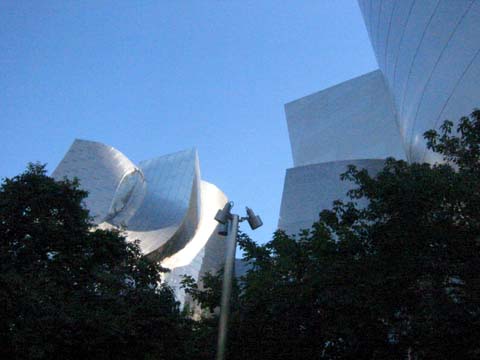
I'd like to thank the Philharmonic, and especially conductor Esa-Pekka Salonen and also Chad Smith, Philharmonic VP for Artistic Planning who shepherded this project from the beginning, for allowing me to observe all the orchestra rehearsals. Remarkably, there were only three. It was a wonderful thing to see this music prepared and performed with such precision and positive professionalism - qualities often missing in large orchestra productions during Frank's lifetime. Watching this production come together prompted a lot of thoughts and emotions in me.
Gail Zappa, Frank's widow, and her team, also deserve thanks for putting Frank's music into a performable format. They chose the name "200 Motels - The Suites". There are 13 suites, played continuously, some of which are further divided into smaller sections. They selected an order for the suites which is reminiscent of the movie. There's only a faint semblance of story line.
I haven't been so excited about a live music event in a very long time. I found the execution and performance of 200 Motels - The Suites thrilling. It was a performance to remember.

The action is seen through the eyes of a touring rock band. Frank seemed to think that everyone would be interested in the grueling aspects of his life on the road. He toured a lot, traveling from town to town, each night searching out decent food, a clean shower and, apparently, someone to screw. He cast himself and his fellow band members as characters in the story and assembled his loose libretto around the tribulations of touring: clueless interviewers, hostile local residents and bad drug trips.
In "I'm Stealing the Room" (Suite X). band member Mark (or is it Howard) wants to bring Jeff, the bass player, down from a bad trip caused by sniffing a mildewed bath towel. Zappa wrote this dialogue:
We gotta get him back to normal before Zappa finds out and steals it and makes him do it in the movie.Yes, the action in 200 Motels is completely self-referential.
Frank uses the unlikely medium of symphonic composition to complain about the tribulations of being a rock star. It's hard to feel too sorry for him. I wonder if he ever gave a second thought to the notion that almost no one else in the universe could relate to his life. A lot of people were probably downright jealous of him for exactly the things he was complaining about.
Could he have come up with better subject matter? Maybe there is no better subject for an evening of musical entertainment than the life of the composer. Frank's creative output almost never touches on the eternal verities. He liked to use the small realities of life for his inspiration - for example, the cleanliness of his kitchen or the stupid things Jimmy Swaggart did.
I feel that lyrics and plots were not Zappa's creative strength. What he did best was turn out a stream of exceptional music, much of it very advanced and challenging. His bands were monumentally tight. He knew how to craft first-rate albums. He managed to do these things in many different musical styles during his career. He was a great musician. A genius.

As you know, most rock stars have not been inspired to the life of orchestral composition by the music of Edgar Varese. And of those that have been so inspired, apparently only Frank Zappa spent his free time while on tour writing gargantuan orchestra pieces. Frank used his on-the-road compositional activities as the premise for the introduction to "The Pleated Gazelle" (Suite IX).
"The Pleated Gazelle" begins with a spoken narrative by the character called Frank (or is it Larry the Dwarf, the two looked identical) :
One night I couldn't get any action after the concert. I went back to the hotel by myself. I made some instant coffee and I took out the music I'd been working on, a piece for voice and small ensemble. It was called "I Have Seen the Pleated Gazelle". Some people might wonder why a person might want to write something like this. It's not pretty and I don't think that it's sensible. But that didn't matter to me while I was writing it. I just wrote down whatever came to mind. I figured I'd never get to hear it anyway. It occurred to me that night that if the piece was ever performed the audience might like it better if it had a story. So I made up a story.Here Frank is painting a clever portrait of how he composed. He starts by implying that he only wrote music when he couldn't get laid. He then tells us that this music was not for everyone and that he knew he was asking for impractical resources and stratospheric levels of musicianship. Only later did he add plot lines, however surreal, in hope of giving more people a chance to relate. I saw this happen directly in the music of A Zappa Affair, the large puppet and orchestra production produced by the Berkeley Symphony in 1984.
It's important to remember that all the music of 200 Motels - The Suites (and much more) was composed before Frank turned 30. Also that he was largely self taught. Also that these scores performed last week reflect exactly what he wrote back then, still very much a young inexperienced composer.
The performances of this music which he heard in the seventies were nowhere near as good as the one I heard in Disney Hall. The orchestras back then had neither the resources nor the musicianship of today's Los Angeles Philharmonic. They also lacked the positive attitude. If by some chance Frank had gotten a performance this good, he might have grown as an orchestra composer in a way we can only imagine.

Frank follows the compositional confessional in The Pleated Gazelle with a story about a girl who falls in love with a newt rancher. Her love, alas, is unrequited because he is attracted to an industrial vacuum cleaner. I can imagine that story is something you might find in, say, a surreal opera. In fact Schott, the publisher of this music, lists 200 Motels - The Suites as an opera.
200 Motels? An opera? That must annoy "real" opera fans, the ones who repeatedly attend Ring Cycles and Rigolettos.
There had been some question of how regular Green Umbrella subscribers would react to this production of 200 Motels - what with all the absurdity and profanity. I did see only a handful of people walking out mid-Suite.
When he composed this music Frank certainly was not writing for opera devotees or for symphony fanatics. He never showed much respect for the long classical tradition which weighs on contemporary composers these days. The traditions which force composers to share programs with the masterpieces by revered icons of classical music did not mean much to him. Frank, after all, was an iconoclast. He was good at breaking icons. Very good.
In the blue-hair department, I found one reviewer who vented his unhappiness with this production, someone named Rodney Punt. Here's a sample bit of screed from that online review.
I thought the work a pretentious, puerile, extravagant bore. The libretto (too kind a word) was wretched and trite but it thought itself clever and witty. The music was gauche, boring, and proceeded from one unmerited climax to another. Zappa certainly had ambition and all the documentary evidence suggests he worked hard on this work. But inherent musical value? Not there. I don't see creative or organizational talent in this score.On the road Frank certainly encountered people who didn't like his music. We know this because he added such a character to 200 Motels. In this production Lonesome Cowboy Burt was portrayed as a gun-totin' blusterin' bully who terrorized the band members and dumped a wheelbarrow of faux shit on the stage. The wheelbarrow had the logo of the LA Phil on it.
Later Burt meandered through the orchestra improvising insults. "You donated money for THIS?" he asked the audience. Burt ends up center stage pointing his pistols at the unflappable Esa-Pekka Salonen with the demand "Hey Twerp, why can't you play something I can enjoy?"
Since 200 Motels comes with its own built-in unhappy critic, it needs no more. Superfluous unhappy critics might have done a good deed by giving up their tickets to some eager Zappa fan.

A much better online review by Richard S. Ginell has this description of the problems Zappa's music encounters in the classical music world.
What makes Zappa’s unique world as a whole so difficult for some to accept is that you have to buy the entire package – the salacious along with the serious; the relentless political, religious, and social satire; the musical references to his heroes in the classical and rock worlds; the cynicism and ultimately encouraging humanism – in order to get the message. It’s all of one piece, one vision, and you can take it or leave it.That struck me as a fine summation of the problems facing a classical music fan sitting through an evening of Zappa for the first time. I suspect Frank wasn't really expressing "encouraging humanism" in the finale "Strictly Genteel" (Suite XIII). I've always felt that the message of that tune was "everyone should get laid". That notion is less humanistic and more Zappaistic.
In Disney Hall in 2013 at the end of this particular Green Umbrella concert, however, even the smallest droplet of humanism was grasped at and probably much appreciated by many in the audience.

That Schott web site link I mentioned will also let you read the complete instrumentation list of 200 Motels - The Suites. Frank asks for a lot of instruments.
The principal percussionist of the Philharmonic, Raynor Carroll, told me that this piece required him to provide the longest list of percussion instruments he had ever seen. I learned elsewhere that there were 164 performers in total. This figure would have been hard to verify independently because they were packed so tightly onto the stage. And because there wasn't enough light on them.
To accommodate such a huge orchestra, the stage was completely flat instead of slightly raked. This, along with the amplification of chorus and soloists, plus the mighty sound of all the percussion, made orchestra balances problematical. In Strictly Genteel (Suite XIII) I noticed one familiar spot where 9 French horns and 4 trombones had trouble being heard. It was a noisy evening.
There were plenty of quiet moments - for example music passages for three classical guitars. Unfortunately, in both dress rehearsal and performance I found it was often hard to concentrate on the music because of the staging. I felt that the music was often "covered" by the visuals.
Huge amounts of talent went into this production. The most dazzling of all was that of Esa-Pekka Salonen who showed great courage by stepping outside his standard area of expertise in agreeing to conduct 200 Motels. He kept things moving along and tightly focused far beyond what might have been expected. He was almost too cool about it. I hope he can conduct this piece again someday under conditions which will allow him to shape the music more carefully. Curiously, at one of the rehearsals, he seemed to have trouble saying the name of Suite XII out loud.

The concert was obsessively recorded on audio but not video. Each string player had an individual microphone. We are told it will be for iTunes release. I hope that does happen.
The Philharmonic, to their credit, provided every performer Frank asked for in his score except for one small group of boy sopranos. They are marked "optional". Their part was sung by actual adult sopranos. I remember, when I worked for Frank, asking him whether he thought he'd get an orchestra to bring in children for so small part. His memorable reply "It doesn't hurt to ask".
It's fair for us to wonder what Frank was thinking when he dared to write for such an impractical ensemble. My guess is that he was thinking of all these instruments as a very large rock band.
In a 1966 interview (later published in the magazine Hit Parader) Frank described his perfect rock band.
The instrumentation of the ideal Mothers rock and roll band is two piccolos, two flutes, two bass flutes, two oboes, English horn, three bassoons, a contrabassoon, four clarinets (with the fourth player doubling on alto clarinet), bass clarinet, contrabass clarinet, soprano, alto, tenor, baritone and bass saxophones, four trumpets, four French horns, three trombones, one bass trombone, one tuba, one contrabass tuba, two harps, two keyboard men playing piano, electric piano, electric harpsichord, electric clavichord, Hammond organ, celeste, and piano bass, ten first violins, ten second violins, eight violas, six cellos, four string bass, four percussionists playing twelve timpani, chimes, gongs, field drums, bass drums, snare drums, woodblocks lion's roar, vibes, xylophone and marimba three electric guitars, one electric 12-string guitar, electric bass and electric bass guitar and two drummers at sets, plus vocalists who play tambourines. And I won't be happy until I have it.I was impressed that Frank's humongous rock and roll band functioned really well. That was not so during his lifetime. I've been told many times that at the infamous 1970 Pauley Pavilion concert and at the recording of 200 Motels - the Movie in England the moods were tense and the music imprecise.
In 2013 the LA Philharmonic players' mood was quite good and the musical precision was damn close to what the composer intended. If Frank had witnessed something similar, especially in 1970, he might have mitigated his well known dislike of orchestra players.
These musicians actually did the crazy stage antics Frank wrote into the score (sadly these were hard to see because of the lighting). They shouted out every last "blorp". They also clowned around onstage before the music started, taking to heart their instruction to dress in concert black but with a disheveled look. They did The Wave onstage. When was the last time you saw that? To be fair, many of them were probably quite relieved to see standard repertoire pieces on their music stands later in the week.

Anyway, Frank wrote his music for his own fans. He had plenty of fans. And he had a good idea of what they liked. The 1966 quote above continues:
I think people are entitled to hear that kind of music live. Kids would go to concerts if they could hear music that knocked them out. If the concert halls would change to a more modern programming, they would find the place crawling with kids. Something like this won't happen overnight and I know it. But I've studied my audiences carefully enough to see that we're making some headway in that direction.Today Frank's audience remembers and misses him. They knew the significance of this event not as the tenth anniversary of a concert hall, but as the long overdue realization of an important work by a toweringly creative artist who has been dead for nearly 20 years. The Zappa fans filled every available seat of Disney Hall for this event and they were loud and noisy. Before the music started I found myself wondering if someone would shout out "What's the secret word for tonight?" or maybe start a pile of panties on a corner of the stage. These fans went home happy.
It's too late to develop the sort of orchestra music for the "kids" which Frank dreamed about in 1966. Those kids were part of the baby boom generation. Boomers, like me and presumably Rodney Punt, are all grown up now and we are set in our musical tastes.
It was fun to witness this concert and wonder what might have been. I found the evening quite touching because, had Frank lived to see this (and had he stayed relaxed enough to let everyone do their jobs), he would have loved it. At least I think he would; it was always impossible to predict what he might think about anything.
And so, at the end of 200 Motels - The Suites I found myself with tears in my eyes. Not just at the concert but also at the dress rehearsal. Not because this is emotional music (which it absolutely isn't) but because I was able to witness the work of someone I consider to be a great composer and creative spirit, someone I knew and respected and feel privileged to have worked for, finally taken seriously and performed with great precision by one of the foremost musical ensembles of our time.
One of the few rewards of getting old is the ability to see how history turns out. I personally am interested in tracking how music history gets written, how it develops a cultural memory of some of the people, like Frank, whom I have known.
Frank Zappa created his own unique music, sometimes baffling and bizarre, other times exciting and electrifying. This event is a major milestone in our collective efforts to place him and his music in the ongoing chronicle of music. It was an honor to witness this concert.

Yet more comments which I couldn't work into the above essay:
200 Motels - The Suites was performed a few days later with different forces, without the staging, at the Royal Festival Hall in London. Frank had wanted to perform 200 Motels in 1971 at the Royal Albert Hall, but the concert was canceled by authorities because it was thought to be "about sex". That was pretty much true. On November 9, 2013, the RFH concert will be broadcast online. (Try this link.)
Also this week, another piece of Franks, Bogus Pomp, which is derived from some of the 200 Motels music, received a rare performance. The Montreal Symphony Orchestra was led by Kent Nagano who led the premiere in England in 1983. Here's a review. That was one of the pieces I worked on during the years I was employed by Frank.
Hila Plitmann was the soprano in the L.A. performance and she stood out by a mile. Frank, I think, would have loved her because she sang the music exceptionally well and she can act. And also because she took off most of her clothes on stage.
Morris Robinson, the bass soloist, had a wonderful voice but a much smaller part. His part cracked me up when in Penis Dimension (Suite XII) he sang a very low, slow rendition of the theme from Lumpy Gravy. The old black and white picture of Frank Zappa is, I think, from the Lumpy Gravy sessions in 1967 at which point he must have been working on 200 Motels music. The pianist in that picture is Mike Lang, who I saw at the 200 Motels concert.
"You donated money for THIS?" The concert program had this line: This evening's performance is supported in part by a generous gift from Christian and Sutton Stracke. Let's all give those two a big round of thanks.
The two actors who were identically made up to look like Frank really did remind me of him. They were skinny enough (i.e. very skinny) and their hair looked just right. However, when sitting onstage watching quietly, something Frank really did during rock concerts, he would have been smoking a cigarette. The actors should have been sucking on a glowing e-cigarette. The Mark character (or was it Howard) did that at one point. Frank should have also. Then again, that might have been just too eerie.
Thanks to Charles Ulrich for locating the "ideal Mothers rock and roll band" quote.
The LA Philharmonic Facebook page is the source of most of these pictures. The picture of the score of Tuna Sandwich Ballet came from here.
ADDENDA
At the end of the 1960's interview quoted above, Frank talked about how the Mothers created their musical sets:
Each set that we do is conceived of as one continuous piece of music, like an opera. Even the dialogue between numbers is part of it. Some of our sets run an hour and a half, when we get carried away. That's about opera length.Kent Nagano said (from here):
History will be kind to Frank Zappa.
Did you skip to the end? Here's a selection of other Mixed Meters posts you may not have time to read either.
About Frank Zappa:
Zappa Symphonies (that would be Francesco Zappa, mostly)
Frank Zappa and Alcohol (Zappa beer and orchestra musicians who drank)
Frank Zappa's Jukebox (not a great compilation)
Out To Lunch (aka Ben Watson)
Paradise, Pomp and Puppets - Performing Zappa's Orchestra Music (a long one)
Lower Case Zappa (a short one)
Varese, Zappa and Slonimsky (an early one)
(all MM posts tagged "Frank Zappa" - click here)
About Music Critics
David Ocker, Boy Music Critic (mostly about Domenico Scarlatti)
Combining Four Letter Words: Oboe + Blog
Rich Critic, Poor Critic (that would have been Alan Rich)
Two Marks of Good Music Criticism (one Mark would be Swed)
Who is Philip Hensher Anyway? (he's English, I know that)
30 Second Spots - The Manuscripts Ends Abruptly, Scherzo for Danny Cariaga
(all MM posts tagged "reviewers" - click here)