Thursday, January 27, 2011

Arthur Jarvinen's Birthday

Art Jarvinen's birthday was January 27. He would have been 55 this year. I once mentioned to him that he shared his birthday with Wolfgang Amadeus Mozart, a fact which impressed me more than it did him.  More interestingly, he shared his birthday with his wife, Lynn Angebranndt.

This is a three part post.  Each part is Jarvinen-related. The first is about a concert of Art's music given recently by students at Cal Arts. The second is about a radio show featuring Art's music. You can listen to that online. Finally, I have news of an upcoming live concert performance of While You Were Art, the infamous synthesizer track Frank Zappa named after Art Jarvinen.


Arthur taught composition at Cal Arts for many years.  He was also an alumnus.  So it makes sense that Cal Arts would present one of the first concerts of his music after his death.  Last Sunday, January 23,  an ensemble of students lead by Amy Knoles performed a dozen works by Art Jarvinen.  They named their concert The Art of Art.

They framed the event with instrumental chamber music - opening with Egyptian Two-Step (which features antiphonal spray cans as part of the rhythm section) and ending with White Lights Lead to Red.   Solo pieces included The Door That Doesn't Open (for marimba and amplified heartbeat) and Carbon (for solo bass clarinet).

There was a tango setting of a poem by Charles Bukowski (Art wrote a number of tangos) plus selections from Arthur's album Edible Black Ink for guitar and bass.  And there were several of his performance pieces which Art called "physical poetry".  One of them was Pop Tarts in which the performer fires a dart gun at an airborne strawberry pop tart as it is expelled from a toaster. 

The enthusiasm and talent of the ensemble was impressive.  Some of the music is fiendishly difficult.  The less technical pieces made me reflect on how Art's own persona contributed to his music.  He was direct, focused and unwaveringly intent as a performer.  Time and again I can remember him performing his musical rituals, riveted to the task.  And, for a few moments, he could share this mental concentration with his audience.  New performers of his music have the task of finding that same concentration in future performances.

 
(You can read a remembrance of Art by Zona Hostetler, the mother of a colleague of Art's, Randy Hostetler, who passed away at a very young age here.  She describes a performance of Pop Tarts by Arthur himself.)


Jack Vees was a close friend of Art. They met as students at CalArts.  Last December Jack visited radio station WRIU at the University of Rhode Island and played several hours of Arthur's music on a show called Music For Internets.  Better yet, the show is archived online if you want to listen.  Here's a direct link to the audio file.  (The show begins at about three and a half minutes.)

Throughout the show Jack paints a portrait of Arthur through his personal reminiscences and by choosing two different kinds of Art's music. 

On one hand he picks chamber music - Murphy Nights,  The Vulture's Garden and  Goldbeaters Skin. He also plays selections from Art's string quartet 100 Cadences which was written in memory of Art's teacher Lucky Mosko.  There are also excerpts of keyboard works including Queen of Spain (based on music by Domenico Scarlatti) and Serious Immobilities (yes, it's a 24 hour solo piano piece based on Vexations by Erik Satie).

On the other hand there are pieces by several of Art's more (or less) popular music-influenced groups.  Two hysterical tunes by The Mope (“Five Ugly Guys With No Record Interest”)  are Agent Jerry (a spy surf tune like Art's Invisible Guy series) and Drunk Poets Die Young.  Another group, Some Over History is represented Erase the Fake and Cheap Suit Tango.  And there's a cut from Art's Beatles parody: Sgt. Pekker.

Jack also throws in two cuts by Captain Beefheart whose music was a strong influence on Art.  Of course Art had far more influences than you can grasp from just a few minutes of Beefheart.  All together, the show makes a fine introduction to the music of Arthur Jarvinen.

("Blue" Gene Tyranny's review of the album Erase the Fake by Art's group Some Over History can be found here.)


Another oft-mentioned influence on Arthur Jarvinen was Frank Zappa.  Art was employed by Frank for a few years doing work similar to that which I did.  The best known moment of Art's time with Frank was the infamous While You Were Art "performance". 

That was when the California EAR Unit, including Art on marimba, pantomimed to a recorded synthesizer performance of a transcription of a live Zappa guitar solo called While You Were Out.  It was renamed While You Were Art for that occasion. The Unit did this at the "prestigious" Monday Evening Concerts and no one in the audience noticed that they hadn't actually played the piece.  An awful lot of bad feelings were generated afterwards.  Art himself, after investing much hard work to get Zappa to write a piece for the EAR Unit, keenly regretted the results.

You can read my own telling of what happened and why it was important to me personally in the While You Were Art section of Bill Lantz's monumental David Ocker Internet Interview.  Be sure to click on the white buttons marked Art's Comment! to read the amendations which Arthur added later.  Since Art didn't like talking about this episode during his lifetime, these comments are all the more valuable now.

This coming February 5th (that's a Saturday), at Pomona College there will be a live performance of While You Were Out/Art.  The electric guitarist will be Pomona music professor Joti Rockwell who will play the original guitar transcription (While You Were Out) to the accompaniment of Zappa's later commercial release of the synthesizer tracks (While You Were Art).  The version of the piece played at the Monday Evening event was later suppressed by Zappa.


Here's information about the concert.  It's part of a yearly concert series of electronic music called the Ussachevsky Memorial Festival organized by yet another Pomona prof. Tom Flaherty.  There's a flyer to download here.  (In the 1960s the ersatz college student Frank Zappa briefly studied composition with music professor Karl Kohn at Pomona College.  Kohn is still professor emeritus there.)

Joti Rockwell kindly shared his notes for the concert with me.  He discusses why this piece and the event associated with it is important for academic study.  Here's an exerpt:
By musically comparing the two versions at the historical edges (1981 and 1986), one cannot help but imagine what might have resulted had the collaboration for the 1984 concert gone more smoothly.  Reflection and examination of this sort was the hope of Art Jarvinen, the piece’s namesake, and it will perhaps lead to a better understanding of Frank Zappa, electronic music, the history of music in Los Angeles, and the meanings of contemporary music.


Art's Music Tags: . . . . . . . . .

Thursday, January 20, 2011

In Which David Writes New Notes For A John Adams Piece

Last summer I wrote my own program notes for Short Ride In A Fast Machine.  The notes explain why.  Afterwards there's a short Q&A with the composer.


The goal of this little essay is to tell you about John Adams' Short Ride In A Fast Machine and to include tips on what to listen for during a performance and also to explain why my own name appears on the final page of the orchestra member's parts and how that led to my writing this essay for the Portsmouth Symphony Orchestra performance. The real trick will be to keep it short enough so that reading these program notes takes less time than listening to the piece itself, just over 4 minutes.


Short Ride In A Fast Machine was composed in 1986 for the Great Woods Music Festival in Massachusetts where it was played by the Pittsburg Symphony conducted by Michael Tilson Thomas. It is subtitled "Fanfare for Great Woods" but Short Ride is really too long for use as an actual fanfare, a ceremonial introductory piece. In 1985 John wrote a companion fanfare called Tromba Lontana. That is as quiet as Short Ride is exuberant.

John explained the title: “You know how it is when someone asks you to ride in a terrific sports car, and then you wish you hadn’t?”  (Yes, I certainly remember riding in my brother-in-law's Corvette and swearing never to do it again.) Unlike the famous 1923 musical depiction of a short ride on a steam train, Pacific 231 by Arthur Honegger, Short Ride In A Fast Machine isn't really a tone painting. John Adams' machine is pure musical adrenaline. There are plenty of twists and turns. It starts out a full speed and never even thinks of slowing down. By the end the chances are good you'll want to hear this ride again.

Short Ride is constructed on a rock steady beat played by the lowly woodblock. The other instruments, mostly, try to distract you from this solid foundation. The snare drum is one of the first offenders and then the low brass insist on playing four notes while the woodblock plays only three. My best advice: If you lose track of what's going on, keep listening for that woodblock. Eventually all the brass play longer notes over the charging rhythm and the piece ends with a short recap of the opening.

Short Ride may have a steady tempo but it doesn't have a perceptible meter, the regular alternation of strong and weak musical beats. If you watch the conductor, of course, you can see the meter, but you can't hear it. Short Ride is not in two like a march, or in three like a waltz, or in any meter. Instead there is a constant unfolding of rhythm without obvious downbeats. This feature has become a hallmark of John Adams' musical style.


Short Ride In A Fast Machine is early John Adams. It was composed at the same time he was working on his breakthrough opera, Nixon in China. Just one year earlier, in 1985, John had finished his first large symphony called Harmonielehre. I was asked to help prepare the performance materials, the parts, for Harmonielehre. The job is called "music copying". It's certainly more technical than it is artistic and most concert audiences know nothing about it. The task is to put the information each player needs into their individual parts as clearly as possible. Of course these days it's all computerized but back then everything was done by hand, using fountain pens and straight edges and translucent paper called vellum. The vellums were reproduced in small quantities by an ozalid machine, an ancient beast mainly used for blueprints. Ozalid prints smelled strongly of ammonia.

After I had finished my graduate music studies I managed to support myself as a freelance music copyist. I never suspected it would actually become my career. Because of my work on Harmonielehre John asked me to be his regular copyist, a job I still hold. "What's wrong with you?" he said back then, "You don't make mistakes." (If only.) But being John's copyist was never a full time gig and I felt the need to advertise my talents to other potential clients. In my imagination a good way to do this was directly on the music itself. So I wrote "Copied by David Ocker" at the bottom of the last page of each part. Sometimes I even added my phone number. No extra work ever came my way because of this. Eventually I wised up.

Surprisingly, the parts I copied in 1986 for Short Ride In A Fast Machine appear to still be in use today and my name survives on the last pages. I learned this from Janet Polasky, bassoonist in the Portsmouth Symphony. Janet and I knew each during a previous millennium as undergraduates at Carleton College. We played in a woodwind quintet together. Today we've re-established our friendship, at least in the Facebook sense, and she suggested I write these program notes. I'm happy to oblige. I'll probably reproduce them in my egocentric blog at mixedmeters.com, which - like this essay - is mostly about me.


MIXED METERS INTERVIEWS JOHN ADAMS (June 2010)

MM:  Way back then, how did you feel about my advertising myself at the end of the parts?

JA: I never had a problem with your "advertising." You worked hard and always delivered on time, and if you got some extra jobs as a result, all the better.

MM: Do you remember saying "What's wrong with you, you don't make mistakes."? (it was an answering machine message)

JA: I don't remember anything I said into an answering machine ever---other than "Are you there? I know you're there! Please pick up!!"

MM: Do you agree with Leslie that the first sentence of my program notes was way too long?

JA: No, not too long. I'm the one who writes things that are too long.

Remember that "Short Ride in a Fast Machine" first had the horrible title "Fanfare for Great Woods." I was obliged to use that title for the first performances because it was a request from MTT to compose a piece for him to conduct to celebrate the very first concert ever at a new outdoor pavilion called "Great Woods" in a town about an hour south of Boston. The only thing I recall about the premiere is that the grounds weren't yet finished, that there were Porta-potties in the parking lot, and that the night before there had been a horrific June rainstorm, causing floods of water to muddy up the still unplanted grounds surrounding the auditorium.

And, oh yeah: "Lincoln Portrait" was narrated by Michael Dukakis, then still governor of Massachusetts. He delivered the lines with all the dramatic thrust of someone ordering plumbing fixtures at Home Depot.


We Get Emails:

(Jan. 5, 2011)

Hi David,  Just wanted to let you know what a great laugh I had today whilst practising “short ride in a fast machine” when at the end of the piece I read “David Ocker: Tired Music Copyist”.

All the best from Hamburg, Graham Cox (Keyboards, Bamberger Symphoniker)


The Portsmouth Symphony is NOT the Portsmouth Sinfonia.

John Adams, on his blog Hell Mouth, writes about what really happened when preparing the parts to Harmonielehre.  (Note: I am NOT any of the copyists John mentions nor was I even aware of most of his story - although I did recently leave a supposedly tongue-in-cheek blog comment - for which I apologize.) 


Fast Machine Tags: . . . . . . . . .

Wednesday, January 12, 2011

Ten Most Influential Classical Composers

A New York Times music critic is spending his time picking the "ten top Classical composers of all time."  He's seeking the "greatest" composers.  The essential criterion will be, I suppose, the opinions of classical audiences.  After all, composers become great because people keep listening to their music. 

This idea got me thinking about which classical composers have the most influence on living composers.   When living composers are lucky enough to get performed they often must share the bill with the honored dead ones.  Those dead composers bring us musical ideas from the past.  Some of those ideas, but not all, still have life to them. Presumably living composers are commenting, in some fashion, on what has come before.

I suspect there are plenty of contemporary composers like myself who were inspired to take up the craft by the musical classics.  Most likely we still feel the weight of that tradition, along with other influences, when we sit down to write.  This is true even if we are not as interested in classical music now as we once may have been. 

Please note that the reasons I'm about to give for including these particular names won't seem particularly positive.  Regular readers of Mixed Meters will not be too surprised by this.  If you happen to be a composer (and who isn't) I'm sure your opinions will differ.  If you're not a composer, this might make no sense at all.  There's a comment form where good natured responses will be published.

Here's my list.  The links all lead to earlier Mixed Meters articles.

Johann Sebastian Bach   Finding a balance between beauty and technique, between inspiration and academicism is always an issue for composers.  It's a matter of simplicity versus complexity, freedom versus control.  Bach used dry, complicated musical rules and produced perfect elegance with them.  It's an unattainable standard.  How depressing.

Wolfgang Amadeus Mozart  Yes, he wrote some of the greatest pieces ever.  He's possibly my favorite composer.  But the real burden of Mozart for modern composers is that he was so blasted young.  The cult of the young genius lives on strongly.  These days a 30-year old composer who hasn't made it yet, won't.  We may well ask whatever happened to Jay Greenberg (who isn't even 20 yet.)
x

Ludwig van Beethoven He wrote some great music.  But he did two things wrong.  First, he invented the tormented composer, the Great Artiste who pours out his stormy inner life through music.  These days that idea seems really old.   Second, he went deaf - which by rights ought to be a compositional kiss of death - but Ludwig wouldn't stop writing.  Worse yet, once deaf, he wrote an unendurably grandiose symphony with one hummable tune and a few lyrics of desperate hope.  Modern audiences still can't get enough of that one.  How's a modern composer going to compete?

Richard Wagner  Mixed Meters has been bashing Wagner for over a year now.  He deserves it for the villainous political ideas which have so easily shackled themselves to his work.  But his musical innovations, possibly the most influential ever, still cloud contemporary music.  And the vast scope of some of his works, especially the Ring, ought to provoke us into keeping our music on a more human scale.     

Pyotr Ilyich Tchaikovsky  Maybe a surprising choice.  He's never been one of my favorites, but he has symphonies, concertos and ballets that audiences can't get enough of.  It's not just about shooting off canons.  I think it's about his melodies.  Contemporary composers don't seem to write melodies.  We might have lost the ability.  More likely, however, we know that if we try to compose hummable tunes, the audience will reject them in favor of ones they already know and love.

Claude Debussy and Maurice Ravel  These two count as one.  (They both wrote the same string quartet.)  Audiences have come to love their lush sound worlds.  Some contemporary orchestra composers  have recognized that they can't go far wrong by imitating the colors and textures of Impressionism.  In other words, when a new piece restricts itself to musical techniques at least 100 years old, ones that Ravel and Debussy would have understood, the audiences will go home happy.  

Arnold Schoenberg Audiences still revile Schoenberg's music.  I don't blame them.  But as the spirtual inspiration behind the serial tradition and the technique of pre-composition and the emancipation of the dissonance and the notion of "composer as professor", he's still a potent nagging voice inside any composer's head.  Also, it never hurts to reflect on how Schoenberg's career (but not his influence) was ruined by the politics of his countrymen.

George Gershwin Along with Sondheim and Ellington, Gershwin was specifically disqualified from the New York Times ten greatest competition.  While the first two don't seem like classical composers to me, George most certainly does.  Think about the popularity of his rhapsody, his concerto and his opera in concert halls.  This popularity manifests itself in ever so many pleasantly upbeat Pops concerts.  The notion of harnessing vernacular music to make a serious piece more accessible is very alluring to any composer.

John Cage His music is a long long way from the standard repertory.  Infinitely far away.  He has absolutely no chance of getting on the New York Times list.  But a serious composer has to come to terms with Cage's ideas.  And that's what his music was about: ideas.  Ideas and not much else - in my opinion.  A decent composer's education should fry the brain with Cagian philosophy.  After that you can ignore him, but he won't really go away.

Philip Glass  He's also disqualified from the Times list because he's still alive.  But I think many other composers look at him with a combination of awe and disgust.  Awe because he's so successful - with a steady string of commissions for symphonies, operas and film scores.  Disgust because we can't find a simple compositional style of our own, the way he has, one that's both direct and elegant and will bring some of our own listeners into the concert hall so we don't have to worry so much about what the Beethoven and Tchaikovsky fans think.

Don't be fooled into the notion that the great classical composers are the only influences on us lesser lights.  There are hundreds of semi-greats who can also look over a composer's shoulder if we let them.  Composition is an old art, highly developed.  There have been countless branches and offshoots.  The heavy weight of this past can be stifling if it is taken too seriously.

And any half-way decent composer is also influenced by many other types of music besides classical.  But this article was inspired by a purely "classical music" project - a futile effort to quantitatively rank composers on what must be, in the end, purely subjective judgements.  To me it sounds like a fools errand.


ADDENDUM:

Due to multiple comments I'm adding a bonus selection, a runner up.

Igor Stravinsky  He made it clear that staying current and staying famous is the most important thing for a composer.  During his career he was three different composers,  radically changing his musical style twice, both times taking ideas from others.  It would have been a gracious gesture on his part to adopt serialism before his neighbor Schoenberg died.   But had he been a really nice guy he would have stopped composing in the 1920s and given two other composers a chance to be famous in his place.

Ten Greatest Tags: . . . . . .

Monday, January 03, 2011

Burn in Hell? Rose Parade 2011

Mixed Meters has documented some aspects of Pasadena's own Rose Parade which you're not likely to see on television.  You won't find pictures of floats or marching bands or equestrians here.

In the past I've given you pictures of trash, beach blankets and sun umbrellas, this post (including pictures of part of a horse and part of a band, plus a video of noisy tow trucks) and pictures of photographers at the Doo Dah Parade.  You can see more of my Rose Parade pictures on Flickr.

Here's a picture of the snow-capped Mount Something, in the distance, as seen from Colorado Boulevard.   Note the sponsorship on the banner.  For your enjoyment I photoshopped a number of light poles out of this picture.


This year I present pictures of
  • high tech amusement before the parade (I saw several desktop computers, one of which had 2 computers.  There were also xbox setups powered by generators.)
  • some of the omnipresent temporary fencing used to control the crowds (the Do Not Enter sign is year round.)
  • an empty bottle of cheap vodka (I'm sure public drinking is discouraged but I doubt this was the first time it has ever happened)
  • a team of horse shit removal engineers (there were 22 equestrian units in the  parade, hence 22 similar trios of sweeper, shoveler and can pusher.  I wonder what happened to the 22 buckets of shit afterwards.)
  • sign carriers who follow the parade (mostly exhorting the crowds to fear eternal damnation - I guess they regard Pasadena as an awfully sinful place and the parade as some sort of pagan ritual.)


The pictures will enlarge if you click them.

Here's a video of post-2010 Rose Parade preachers with megaphones. "Will you be saved, older man? Will you be saved, older woman?" 

Burn in Hell Tags:

Tuesday, December 28, 2010

Christmas Zoology

Mixed Meters is surprised to find himself once again documenting the ascendance of a new cute and cuddly animal into the pantheon of Christmas zoology.


A few years ago I noticed for the first time that penguins were being used as Christmas ornaments. I'd never seen that before. This year I found new examples. (Click on them to enlarge.)


This subject has come up before:
2006 (in which I ask how the Los Angeles Zoo put penguins into the wrong hemisphere)
2007 (which also deals with Halloween snowmen and frankengrapes)
2008 (where you can watch a video of 49 microwave ovens playing Jingle Bells)
2009 (one lonely picture: the Christmas penguin which adorns my desk year round)

Many more pictures can be found on my Flickr Christmas penguin page.


The animals most associated with the Christmas story ought to be camels, donkeys, sheep, goats and wise men.  All of those are on the Chistmas endangered species list.  Especially wise men.

Instead, most decorations include very different animals - Santas, reindeer and sometimes polar bears.  All of these are reminders of the north pole, suitable for a solstice celebration.


Penguins remind us of cold weather in a pleasant way, but they do not come from the northern hemisphere.  No one seems to be bothered by this.  I wonder how many people assume that penguins and polar bears actually do live together in the wild because they now see so many penguins at Christmas time.

Snowmen, of course, are common Christmas animals as well.  I suppose you can find snowmen in either hemisphere - but never in the wild.


Our friend Vasily Radashevsky asked me recently "Would a polar bear eat a penguin?"  A trick question.  The answer is "probably, if it had the chance."  The chance is remote.  One of them would have had to travel almost half way round the world first.  Or maybe they both escaped from the same zoo on the same night.


To be fair, none of this years pictures show penguins with igloos, or standing at the north pole or meeting polar bears over soft drinks.  Maybe the fad is passing.


Even so, when I see a Christmas penguin, I sill can't stop myself from snapping a picture.  When Leslie sees one she always points it out to me.  I wonder if there are any Christmas songs about penguins yet.


This year's LA Philharmonic online holiday greeting features penguins, Petroushka, snow in downtown Los Angeles and a new aisle in the center of Disney concert hall.

And here's visual proof that tiny polar bears and line dancing penguins can love one another if they have sugar water and Beach Boys.


Cute and Cuddly Tags: . . . . . .

Sunday, December 19, 2010

Starbucks Music Mask

(A link at the end of this post allows you to hear and download an mp3 called Starbucks Music Mask.  It's a sound file designed to mask the music and extraneous sound of Starbucks and elsewhere.)

I walk lots. I often walk to local coffee shops where I spend time reading before I walk home.  I call it exercise.  Since Starbucks has many convenient locations in Pasadena, a large percentage of my coffee shop reading goes on there.  Apparently there is no such thing as a Starbucks where they don't play continuous background music.

I like music.  I listen to music lots.  I think about and create music.  My life has been pretty much devoted to it.  I have strong opinions about music.  I can be very distracted by music which I don't like.

Careful readers of Mixed Meters will remember that I keep a list of my all-time least favorite music.  This list includes the music of Richard Wagner, La Monte Young, Elliott Carter and Joni Mitchell.  (No, I don't think they have anything in common besides earning my personal distaste.)

Most Starbucks locations play music too loudly for me and they seem to choose only music from a certain narrow palette.  That's infuriating.  Rarely someone forgets to turn the music on.  I like that.  One local location does not broadcast music on their outside patio area.  I find this space rather pleasant in spite of the fact that it faces a busy intersection.

Shadows of table and chair at a Starbucks patio where they play no music


One day I walked into my local Starbucks to discover that they were blasting a tune by one of my least favorite composers.  No, it wasn't anything by Wagner, Young or Carter.  Can you imagine a world where Starbucks played those guys?  I can't.  Of course it was Joni Mitchell.

I casually told a Barista "Joni Mitchell is on my list of least favorite musicians."  He smiled broadly,  saying "Me, too" he gave me a high five and abruptly walked away.  A moment later Joni was cut off in mid-parking lot and some reggae came on.  I was much happier with reggae and so was he.  Apparently they're allowed to adjust the music only if a customer complains.  I didn't feel that I had actually complained, but my remark sufficed.  Later he asked "Is Barbra Striesand on your list too?".  I told him no.  I didn't mention Wagner, Young or Carter.

Most everyone really likes some music and really hates other music and doesn't care one way or another about the rest.  I also figure that literally everyone is a potential Starbucks customer.  For years I've felt alienated by Starbucks' music selection and I suspect that many others feel the same way.  Or maybe I'm the only one listening.


Three and a half years ago, in this Mixed Meters article, I described why I purchased my first iPod.  In short, I needed an alternative to the music at Starbucks.  In specific: Willie Nelson.  To my surprise today, in 2007 I wrote:
Over the years I've had surprisingly few issues with the music selection in my local Starbucks. Except at Christmas time, of course.
Starbucks' philosophy of music changed several times since then.  For a while, faced with competing coffee from McDonalds and Dunkin' Donuts, Starbucks tried to morph into a music store.  They prominently displayed big racks of CDs on their own label and played the same tunes in the stores.  Their all-time marketing low point was a Paul McCartney album repeated continuously in every store for an entire day. 

A recent New York Times story (Some Venti Tunes to Go With That Latte) put a face to the Starbucks music monster.  The face belongs to Timothy Jones, executive in charge of music for Starbucks.  He got the job by owning a record store across the street from the original Starbucks in Seattle.  Here's a quote:
The coffeehouse seems to beckon to singer-songwriters, Chicago blues, Ella and Miles, soul, the blues and reggae. When selecting music, we use a coffeehouse filter.
Fascinating.  A "coffeehouse filter" goes a long way to explaining my problem with Starbucks' narrow musical palette.  Apparently Starbucks thinks of itself, at least musically, as a throwback to some idealized fifties coffee house, the sort of smoky venue where a skinny singer with long hair sings her own songs (or those of Joan Baez) and strums guitar while Maynard G. Krebs plays bongos and the audience, sipping espresso, attentively hangs on every bloody word.  Hey, man.  Cool.

My absolute worst real-life Starbucks music experiences involved live in-store performances.  One was another singer-songwriter with a guitar - Joan couldn't make it.   Who can forget the out of tune Christmas carolers singing to a tape.  I composed this 30 Second Spot while they were singing.

Of course, there are other kinds of coffee houses besides the folk-music revival coffeehouse image.  Read about the history of coffee houses.   Coffee houses have existed in many cultures and eras, presumably each incarnation was associated with some sort of music at the time.  In 17th century England, I wonder, was Samuel Pepys distracted by Henry Purcell's music on the PA system of his local coffee house?

As revealed by Mr. Jones' quote, Starbucks has added more kinds of music to the idea of "coffeehouse".   Historically these other musics are associated with different types of commercial establishments where you get other drugs besides caffeine.  At a blues club most people will not be drinking coffee.  Reggae is associated with a drug which is smoked.  Miles' favorite drug was something he snorted. 

This all suggests a new field of academic study - pharmamusicology: the study of how drugs are associated with music.  I think it might be interesting to investigate the ways social drugs have interacted with popular music over the centuries.  Caffeine, nicotine, alcohol, marijuana, cocaine, heroin and hallucinogens all come to mind as having strong musical associations with various musical styles.  The worst that could happen from such a study would be to make Acid Rock even more boring than it already is.


Starbucks is far from the ideal place for music, even if they happen to play something interesting.  It's hard - sometimes almost impossible - to pay attention to the music in Starbucks.  Their stores feature countless aural annoyances - espresso machines hiss,  Frappacino blenders whizz even from within their special sound baffles, cabinets slam and people insist on talking in loud annoying voices.  Why make it even noisier by adding a continuous stream of semi-audible music to this mix?

It's not surprising to see Starbucks customers wearing earphones - presumably they've chosen favorite music in hopes of avoiding the sound distractions around them.  Maybe they're just using the headphones as ear plugs. 

I discovered that listening to music on an iPod in Starbucks doesn't always help.  If my music is less aggressive than the music on their PA system, the iPod will lose the battle.  Imagine how much amplification a Scarlatti harpsichord sonata needs to make it overpower some other piece of popular music.  The volume would need be beyond the comfort level, into the realm of hearing loss.

Of course, while I'm at Starbucks, I could set my iPod at a reasonable level and listen to my selection and their selection simultaneously.  Very John Cage.   Sometimes that even works.  I am someone who has been known to listen to two radio stations simultaneously - although for the result to be interesting the stations must be carefully selected.  

Sadly, my iPod playlist and Starbucks' playlist do not blend well.  But the act of trying to listen to  music at Starbucks gave me an idea:  I could listen to sounds in my earphones which would neutralize the sound environment of Starbucks.  Like the notion that matter and antimatter can collide and extinguish one another, I needed "antimusic" to cancel out the "music" which I didn't care to hear.   Someday, maybe an unimaginably powerful super-computer will do such massively complex noise cancellation in real time.  The result would be perfect silence.  Until then my solution is much lower tech.

I tried this first in late 2007.  On my laptop, right in Starbucks, I generated ten minutes of white noise, just a steady hiss, and saved it to my iPod.  It was soothing.  Well, sort of soothing.  But it had no effect; the distractions of Starbucks were still distracting.

I began to identify the components of the sonic environment of Starbucks, for example conversation, music and noise.  If I added random bits of these components to my white noise track and balanced the level with the "natural" conversation, music and noise in Starbucks, maybe I wouldn't be able to tell which sounds were recorded on the iPod and which were happening live.

I've worked on this idea sporadically for three years.   For some reason I took it up again in recent months and come up with a version which works for me.  Sitting in a noisy coffee house environment, I put this track on and adjust the volume.  In my experience the sound distractions are reduced considerably.  The track is not terribly interesting by itself.  That is not the intention.  But it is relaxing and has become a familiar sonic environment I can use anywhere.

The components of the current version of Starbucks Music Mask are:
  • White Noise - now randomly filtered and amplified to create variety
  • Conversation - which might have been recorded at Starbucks except I needed a recording of people talking with no background music
  • Various bumps, hits, scrapes etc - these noises came from sound effects recordings
  • Traffic Noise - not that one hears much traffic at Starbucks, but this blends well with the white noise
  • Musical Tones - various notes, long and short, mostly in the low register, some glissando slowly, some are bell-like.  I tried to limit the quantity of these sounds so they didn't start to combine into their own musical piece.
  • Birds Singing - actually mockingbirds recorded at my home.  I've never heard a mockingbird at Starbucks.  I like the singing of mockingbirds and their songs seem to fit in to this piece. 
Wow.  If you've read this far I'm definitely impressed .  All that remains is for you to get the file and try it yourself.  I've developed a kind of protocol for using Starbucks Music Mask which I've outlined on the download page in some detail.  Of course you may think of other ways to use it.  Please leave a comment.

Here's the link: Starbucks Music Mask  © 2010 David Ocker


A Mixed Meters article about David Hockney's opinion of the iPod.

Mask Tags: . . . . . . . . . . . .

Sunday, November 14, 2010

Going Coastal by David Ocker

Yesterday (Saturday, Nov. 13) Leslie and I along with our friends Larry, Jan and Vasily did touristy things down near Santa Monica bay. We visited three different locations in three different cities.

I took a lot of pictures and video using the Point'n'Shoot in my pocket.  This in itself is not unusual.  I resolved to make some sort of edited video out of the raw footage.  Such resolutions are not unusual either.  But yesterday I said to myself "David, either you go right home and edit some video tonight or you'll never do it."

Apparently I believed what I told myself because I did go home and I actually made the video.  I rationalized the time as good experience using Final Cut Express - which I'm trying to learn.  At 6 a.m. this morning, after nine hours of increasingly blurry-eyed video editing and musical composition (using old 30 Second Spots that no one but me has ever heard as musical source material), I completed a six-minute video.  It has three sections - one for each of the stops we made during the day.

If you've ever wondered what I did Saturday, this is definitely the video for you.  Enjoy.   If you've never wondered about my doings yesterday, you can still watch. Just don't expect much.


Going Coastal © 2010 by David Ocker - 362 seconds.

Previous pieces of my music with my video which you might not wonder about:
Our friend and houseguest Vasily Rasaschevsky has appeared in a previous MM post about the song Pasadena by the group Maywood.


Coastal Tags: . . . . . .

Friday, November 12, 2010

Desktop Stilllife

In the early days of 30 Second Spots, back when I composed mostly on a laptop at Starbucks, I would use "found titles" for my pieces. These were usually snippets of conversation overheard sometime before or during the composing time. I needed a title before the first save of the computer file. No attempt was made to find titles relevant to the content of the music.


These days I'm composing at home on my iMac, not at Starbucks. Mozart watches from the wall.  Cats lounge about.  Snippets of overheard conversation are scarce.

So I've hit on a new title picking scheme: I've been naming my spots after objects sitting on one of my desks. 

There are lots of things on my desks.  Clutter rules.  The items I selected for names are mostly paperweights. These are made from various minerals.  Some have simple geometric shapes; others have animalian form. One was a wedding gift to Leslie and myself. One was actually a found object. As in the coffee-shop old days, the title/object and the music itself bear absolutely no relationship to one another.


I've elected to combine five 30 Second Spots (average length: about 90 seconds) into a single larger work.  Multiple short musical movements might suggest historical forms such as a suite to the classically inclined.  Instead, I've used a visual metaphor - the still life.

Once I completed the five musical pieces and selected an order for them I then created a video which introduces each object together with the music it names.  Just like a painted still life, nothing much happens in the video.  To find out what the objects are and eventually see/hear the complete still life, you'll have to watch the entire video.  Here it is:


Desktop Stilllife © 2010 by David Ocker - 407 seconds.  (I've opted to write "still life" as a single word in the title because I like seeing three ells in a row.)

Here's a photo I took in 2004.  I called it "Still Life in our Kitchen".  I could write more 30 Second  Spots and call them after fruits and vegetables. 


You can watch other 30 Second Spots which come with video:

Desktop Tags: . . . . . . . . .

Sunday, November 07, 2010

And So On And So On

Listen to a Thirty Second Spot entitled And So On And So On


Copyright © November 7, 2010 by David Ocker - 30 seconds
(Yes, it's a Thirty Second Spot which is exactly 30 seconds long.)
Read about Thirty Second Spots.


And So On Tags: . . . . . .

Friday, November 05, 2010

Arthur Jarvinen Memorial

On October 30, 2010, a memorial was held for my friend Arthur Jarvinen.  The well-attended service was led by Martin Mosko, a Zen abbot and elder brother of Art's composition teacher Lucky Mosko.  Before his death Art had been studying with Martin with the intention of becoming a Zen Buddhist himself.

At the service Art's music was played, rituals were performed and people had the opportunity to share their memories of Art.  Art's Mother and older brother were among those who talked, along with a number of Art's friends.

In this post you'll find the eulogies given by Jim Rohrig and myself.  Jim at various times was a classmate, a housemate and a bandmate of Art Jarvinen. Jim and his wife Dee McMillan were among those who helped Art's wife Lynn through this difficult time.

You can view a pdf of the program from the service.  It details the pieces, the performers and the chant used in the memorial.  The program also included this excerpt from Art's own writing:
A teacher of mine once said to me "You don't ask enough questions."  Ever since then, I have been trying to come up with the question worth asking.  Most of what I was taught were "answers" to "questions" that I didn't have.  Giving up the answer was hard.  Finding the question worth asking is even harder.  The answers are all pretty much there.  You just have to ask the right question.  What is the right question? You tell me! I just know it has to be MY question, or all the answers are wrong.  (from Arthur's last notebook).


My name is Jim Rohrig, and I’ve known Art since my first semester at CalArts. That was a while ago.

For those of you who may not have known Art, he was a complicated guy. He loved surf music, and he loved the music of John Cage. He loved camping out in the desert, and he enjoyed making Christmas gifts for his friends. He had a deep interest in mummies and Egyptian hieroglyphics, and he always had a bunch of cats running around the house. He liked listening to Frank Zappa and Captain Beefheart, and he thought the Carpenters had written some great songs. And he loved composing music, making drawings, building model train layouts and creating Christmas villages full of miniature zombies. He was a complicated guy

Art and I and Toby Holmes and Miroslav Tadic and Leonice Shinneman used to play together in an “alternative rock” band called The Mope, “Five Ugly Guys With No Record Interest,” although it probably wasn’t “alternative” in quite the way you might think. It was five guys with Masters degrees in music rehearsing up in the office space Leonice used to live in in a business park out in Canyon Country. We used to call it the most over-educated rock band in history.

I remember how Art used to talk about the idea of “Serious Fun,” and just about everything I ever saw Art do or create had large helpings of both of those two things, fun and seriousness. The Invisible Guy, Sgt. Pekker, Egyptian Two-Step, the Physical Poetry. There always seemed to be some spirit of whimsy or maybe just a twinkle in the eye in serious projects. Chris Garcia was telling me recently about the time he and Art and M.B. Gordy were about to perform a piece of Art’s called "Zone" down at LACC.  It consisted entirely of slowly scraping large metal gongs, creating something akin to the sound of fingernails on a blackboard. Only louder. And when Chris asked Art how long he wanted the piece to last, Art said, “Until the audience can’t take it any more.” He was a complicated guy.

Now it was always my experience that Art wasn’t shy about telling you exactly what he thought. He had a gift for being “direct.” Some might call it “blunt.” A little bit of an “acid tongue.” Maybe some of you here today can recall being on the receiving end of that “directness.” In fact, I remember one time somebody told me that Art had “the manner of an automobile mechanic”…although those weren't the exact words that she used, and I always thought that was a little unfair to mechanics.

But Art also had a gift for engaging with people. Back when Dee worked at CalArts we used to have these big Thanksgiving dinners. And she would invite all the foreign students over who didn't have any place to go, and they'd get to be the "Indians" and the rest of us would get to be the "Pilgrims." One year we were joined by Dee's sister and brother-in-law and their eight year-old daughter Rachael, the only child there that day. And as it turned out, in a crowd of 20 or 25 people, this eight year-old girl ended up sitting at the table next to Art. Now you can probably imagine what it's like to be the only child at Thanksgiving dinner with a bunch of grown-ups that you’ve never met. And on top of that, she ends up sitting next to Art for the entire meal. This just didn’t seem like it was going to go well. But actually it did.

Art spent much of his Thanksgiving dinner that year entertaining eight year-old Rachael. He started telling her a tongue-twister he’d come up with called "The Seven Swarmy Swamis," and he told it to her over and over again. It just fascinated her. He’d tell it to her, and she’d start to repeat it until she stumbled over some word. And then she’d laugh. And Art would correct her and then say the whole tongue-twister again. So Art sat there telling her “The Seven Swarmy Swamis” over and over until slowly Rachael finally got the hang of repeating it back to him word for word.

When I first moved in with Art into the house on the 8th Street back in 1982, I didn’t have a clue about cooking. So Art started teaching me. In those days Art pretty much exclusively ate Thai food, so that’s what he taught me to cook. Now those of you who used come over to the house for dinner in those days will remember that Art had a particularly high tolerance for spicy food. In fact, he could eat food that was so hot it was thermonuclear. He didn’t eat any kind of dessert or anything that tasted sweet. At all. But he was all about eating food so hot and spicy it would cauterize your throat on the way down. And he loved cooking with these little green pieces of napalm called serrano chilies. They’re so nasty that once you touch them, you have to be extremely careful about what parts of your body you touch.

Art once explained to me that his recipe for Garlic Chile Chicken was a simple matter of ratios. First you cut up your chicken into little pieces and put that all in one pile. Then you mince enough garlic to make a second pile the same size. Then you chop up enough serrano chilies to make a third pile the same size as each of the other two. So the ratio was one-to-one-to-one.

I worked on a couple of collaborative projects with Art: the performance group Le Momo that he and Dee and I formed, and typopera, a sound/text piece that we created with Eve Beglarian. And the way the process worked was that Art would announce what his parts of the show would be, and then it was up to the rest of us to do whatever it was that we were going to do. By the time Art told you about any of his ideas, they were already thought out. He didn’t “spitball” ideas or talk them to death. That just wasn’t the kind of guy Art was.

Of course, there are as many different creative processes as there are creative people. When you look at Beethoven’s sketchbooks, for example, you see revisions piled upon revisions between initial concept and the finished composition, while Mozart’s scores show hardly any places where he’s crossed something out or changed his mind. By the time he put his music on paper, it was finished. So Art was a lot more like Mozart than Beethoven, although if you listen carefully to their music, you’ll be able to tell the difference.

I've celebrated just about every Christmas since 1982 with Art. Sometimes there were family obligations that caused Christmas to get postponed a little, but I think that's right around 28 Christmases we spent together, which is a pretty large percentage of all the Christmases I've been around for.

That first Christmas didn’t exactly get off to a great start, though. We were living together in Newhall, and I mentioned to Art that with Christmas coming up I was thinking about getting a tree for the living room. So Art responded that he would prefer that we not have any Christmas trees at all whatsoever in the house, although I don't think that was exactly the way he phrased it. But I went ahead and got a tree anyway. The next year I think we even had a few presents.

Between Dee & I and Art & Lynn and Miroslav, we didn't have much money for presents in those days. Usually we’d give each other things like silly glasses or plastic ears or simple toys or some kind of globby stuff that stuck to the wall when you threw it there. But to make up for it we had contests to see who could come up with the most creative wrapping. A lot of times the wrapping was a whole lot more interesting than what was inside. And of course, Art had some of the all time great packaging ideas. Now, his ideas tended more toward the "sculptural." And some times it was hard to tell whether the wrapping itself was the gift, or whether there might actually be something inside the sculpture. There were even times when the wrapping on his present was so soundly structural that he had to include tools for taking the wrapping apart.

I’ve got a lot of memories of Art. The time he started burning dried red chilies at my recital reception and released enough noxious gas to chase all the guests outside onto the lawn. The time we decided to have a beach party in February at our house up in Newhall, and Erika painted a huge picture of the ocean and some seagulls that we put on the wall just above the sand we spread out on the living room floor. Of rooming together on the road with the EAR Unit, and how we’d always be on the lookout for some good food when we were on tour. The Bad Poetry Soirees, and the Fourth of July pig roasts. Bruce the cat, and the big plans for the house in Vermont. All the fun we had living together on the 8th Street, and the time the S.W.A.T. team showed up in our driveway because the guy next door was running a meth lab in his garage.

One of my favorite memories of Art was from Christmas this past year. I’d bought a new DVD of a log burning in a fireplace to replace the old VHS tape that I’d somehow lost. So we had that playing on the TV while we opened presents. An old tradition of ours. I don’t remember if we made his mother’s Finn Pancake recipe—the one that Art liked so much—for breakfast, or not. But after we got done opening all the presents, we just sat in the living room and talked, Art and I and Dee and Lynn. We laughed about the Christmas that Susan and Harold were down, the time we had the bacon tasting. We talked about how many Christmases we’d celebrated together, the four of us. And about the year we’d all independently come up with a “food theme” for wrapping presents, and Miroslav had won the prize for wrapping something in a hollowed-out loaf of bread. We caught up on where Nate—the brother Art thought so much of—was spending his Christmas. And his mother. And the rest of the family. But mostly we just talked for hour after hour until it was late in the afternoon. I don’t even remember what it was that we talked about. I just remember that it was the best talk we’d had in a long, long time.

Art and I used to go out to the desert and stay with a friend of mine who had a cabin out near Joshua Tree. We’d play desert croquet and go hiking and sit up late at night. And I remember one time in particular when we went out hiking. It was the year that it snowed out in the monument, and the little pond behind Barker Dam had frozen over. It doesn’t snow very often out in the desert, and when it does, it’s magical. Having grown up in a number of little Midwestern towns, all of them really cold in the winter, Art was no stranger to snow. And so when we got out to Barker Dam, Art started making snowballs and heaving them out into the middle of the pond. Now since this was the desert and not the Midwest, the ice on the pond that day wasn't very thick. So the snowballs would actually break a little hole in the ice when they landed, and then the water underneath would make the ice above it "undulate" up and down in concentric circles slowly spreading out from where the snowball had landed. Art threw snowball after snowball out into the middle of that pond, each one making a small hole in the ice, and the ice slowly rippling outward. The rest of us just stood there watching. Art throwing snowball after snowball. And the rest of us watching. The ice rippling outward. I don’t know if they do this all the time back in the Midwest where Art grew up, or not. But it was pretty magical to us. So we decided to call it the "Jarvinen Effect."


My name is David Ocker. I don't remember exactly when I met Art Jarvinen, only that it was about 30 years ago. Most of our many interactions over the years have been about music. Art got a lot of sustenance from music. Music had great power for him.

He was a composer of great creativity. Of course, we expect all composers to be creative. He was also a unique composer. These days there are fewer unique composers than we might wish.

You could call Art a musical explorer. If you imagine all the music that has ever been heard by everyone - sort of the 'known world' of music - you could say that Art was more interested in the unknown music, beyond the edge.  Like 'terra incognita' on old maps, Art was interested in searching out 'musica incognita'.

Art Jarvinen was a multi-faceted musician. He had many musical influences and he wrote music in different styles. If you knew one of his pieces, you couldn't predict what another of his works might sound like. Even if you knew every piece he had ever written, the next one might be completely different.

And Art was a very talented performer. He could play music of the highest difficulty.  He did it very well.  And he knew how to write  challenging parts for other people to play.

But Art's greatest musical quality was enthusiasm.  He had so much enthusiasm that there was enough to share.  He gave away his excess enthusiasm. I'm sure there are others here today who, like me, were the recipients of Art's enthusiasm for our creative endeavors. I'll always be grateful to him for that.

Here's one example of how Art supported me. About 5 years ago I started a blog - and Art was an early regular reader, one of a very small handful. Often he would send comments about the things I wrote.  These comments always came by private email.  When I asked him why he didn't publish directly on the blog, he said that wasn't interested in a public discourse.

After a couple years of this, he sent me a very clever short comment about composing.  The first line was:
I like best the notes I could have written but didn't.

And at the end he added "And you can quote me."

I immediately asked him if I could post this message online and give him credit as "guest blogger".  He agreed as long as he remained anonymous.  He chose a pseudonym, his non de plume: Mister Composer Head.

Mister Composer Head started sending me more articles and for a while they came very quickly.  It's easy to start a new blog so I created one just for him.  It is called Mister Composer Head.  I listed myself as "Mister Composer Head's Amanuensis".  He would write the articles and I would post them.

After a few months Art stopped doing this.  But everything he wrote is still online and you can still read it.  It's easy to find with Google.  (Or click here.)

This month I went back to re-read what he wrote.  One story seemed appropriate to share today.

Here's the setup:  Art was writing about a party held in honor of his mother's 80th birthday.  At this party Art's wife Lynn and his niece, who he doesn't name, performed some spirituals.  They chose the music because it held particular meaning for Art's mother.    

Art first discusses his religious upbringing and his own level of belief.  I thought a lot about the right word to describe Art's belief.  The best I could come up with was "slight" -- but the fact is that Art reflected on the issue of belief quite a lot.  And he liked ritual.  He liked to create ritual.  He would have loved a service like this.

Art finishes the story like this:
So the cello and piano duo start up Swing Low, Sweet Chariot. One of my brothers, who does believe, just jumped up and went over by my wife and started singing. He was just moved by the spirit to burst out in song. I was so moved by how moved he was that I went and stood next to him, singing in full voice. Then my oldest brother came and joined us. Three brothers, not much faith among them, singing as one, a song that means a lot to one of them, maybe a bit more to the oldest, and very very precious little to me.

But it was the first and only time I have ever raised my voice in song with my two brothers. And you can't buy that kind of experience. Music that just happens, in a moment unplanned, for no real reason except I am not going to miss the chance to sing with my brothers! Hell, we didn't even harmonize. We just sang in unison. And we didn't really know the words, so we just recycled the first verse.

Then we sang Amazing Grace. I hate that song, and I hate what it means. But God, please give me one more chance to sing like that with my brothers. I still won't believe, but I will give thanks.

That was a blessing, and my mom was filled with joy. Not such a bad thing for music to do to a person, or family.


Other Mixed Meters Memorials to Art Jarvinen:
Arthur Jarvinen 1956-2010
Arthur Jarvinen - Carbon for Bass Clarinet Solo

The needle and toothbrush drawing is by Art Jarvinen.  It was the cover of the memorial program.

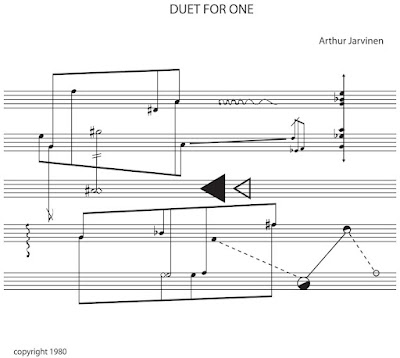
Art's graphical score Duet For One was sent to me by Alan Zychek, who created the computer engraving from Art's hand manuscript.  It comes from Art's book Experimental Etudes.

Robert Jacobson, guitarist on Art's "real soundtrack for an imaginary spy film" The Invisible Guy, took the picture of Art at a USC ceramics class about two weeks before he died.

Click on pictures for enlargements.


Memorial Tags: