Every December the media is filled with "Best of..." articles, helping readers sort through an entire year's deluge of news, promotions, advertisements and click bait.
I'm suspicious, however, that because these articles are easy to prepare in advance their real purpose is to allow the harried media professional to knock off work early during the holiday season.
We here, in the Mixed Meters newsroom, want to do year-end "Best of..." lists as much as the next blog because we like quitting work early too.
We've done such lists before. Last year had an exceptionally negative tone. The 2012 entry was very misleading. In 2008 I listed things I had genuinely liked during that year . . . that was boring!
Now consider the human hand. What an amazing tool the hand is. Civilization would lack so much without the help of hands: typing, sign language, wind instruments.
Our hands are very delicate and easy to damage. They are a complicated array of bones, muscles and nerves - all designed for touching and manipulating the world around us.
Sometimes we need to protect our hands from things that are too hot or too cold, too rough, too sharp or too infectious. We do this by covering our hands.
That protective thing we wear on a hand is called a glove. Since our hands come in pairs so do our gloves (except for baseball gloves).
Disposable gloves have become very common. Workers at the deli counter put on gloves before they touch my food. Then they throw them away unless they forget. I can't decide if the glove is to protect them or me.
Humans also have feet. Our feet are no less complex than our hands but they serve completely different purposes. We use feet to walk and run, to kick soccer balls, to play the pedals on a pipe organ.
Every day I use my own feet to walk at least 10,000 steps; that's a little over 3 miles. In one year I walk about 1000 miles.
All that walking can get a little boring. To give me something to think about while I walk I carry a camera. I take pictures of the strangest stuff.
Among my favorite photo subjects are abandoned gloves. I usually don't bother to take pictures of shoes or socks or any other articles of clothing I encounter. I find gloves far more interesting; they twist themselves into the most interesting shapes.
And that's the story behind this blog post, David's Best of 2014, These are my best "lost glove" pictures for the entire year. I wonder what lost gloves 2015 will bring.
Be honest. Have you been ignoring the pictures as you scrolled through this blog post? Hands up if you've only been reading the words. Now you can go back and click on any picture for an enlargement.
The short history of previous Mixed Meters posts about Gloves:
Thirteen Ways of Looking at a Blue Glove
Gloves in the Wild
Showing posts with label walking. Show all posts
Tuesday, December 30, 2014
David's Best of 2014
Labels:
Best of
,
David's Pictures (4 or more)
,
walking
Thursday, October 17, 2013
Where you find it
While walking at night I've noticed this bus stop advertisement twice. Both times I saw it indistinctly from some distance.
Each time I thought to myself "that reminds me of a Mark Rothko painting." Here's a real Rothko for comparison.
Alas, when I got close enough to distinguish the details I was disappointed to discover that I was not looking at excellent modern art. Or even a knock-off modern art. Instead I was looking at a picture of a newfangled tablet computer. And not just any computer, but one sold by Microsoft, a company I've resolved never to patronize ever again. (I'll spare you the rant.)
My point is that for a few moments, before I learned the truth, I enjoyed thoughts about the art of Mark Rothko. Walking down the street I took pleasure in the memory of Rothko's works. I've found his work meaningful since I first encountered it in the 70s. I offer thanks to the advertising executives of the Microsoft Corporation for triggering these positive experiences in my mind right there on a Pasadena street. I'm sure that's what they had in mind all along.
My point here is that the experience of art is where you find it. It could happen any old place.
One thing I saw online recently was Seat Assignment, a series of pictures by artist Nina Katchadourian. Apparently she was bored on a long airplane flight and began excusing herself to the toilet to take selfies with her cellphone in the style of old Flemish portraits using items from the plane as costume materials. For example:
Here's an actual 15th-century painting for comparison:
Katchadourian has taken my Rothko experience up a step. She imitated an ancient artistic portrait style using materials that existed where she happened to be at that moment, in a bathroom 5 miles high.
Occasionally I pick up random pieces of paper on my walks. Often it turns out to be just trash (which, in a small gesture of civic-mindedness, I carry to a proper receptacle.) Being near a high school I find a lot of discarded school work this way.
One day I noticed a folded piece of paper which I assumed was going to be more high school homework. I was surprised to find a printed poem on it.
Gloves Off
Today I will have salsa
and wear loud socks.
My tie will clash, a bit,
with my shirt,
and the watch I choose
will be seven minutes slow.
One of my pencils
will be shorter than the others.
I will say "Hello"
in a louder tone of voice,
read the second section
of the newspaper first,
and, tonight, approach you
from the other side,
do that
before this,
for today
I have finally discovered
how the mime
gets out
of that box.
Pretty obviously not high school level work. A surprisingly good poem for a piece of trash. It seems to be in the voice of a young man making his first very very tentative forays into non-conformity. Maybe not so young, since the third paragraph reveals him speaking to a significant other and suggests that their lovemaking has been very repetitive. There was no author mentioned or copyright asserted. No Google hits.
Later I figured out the source of this poem.
I remembered that several blocks away, on a fence in front of a house, is a small box offering free poetry. I checked the current offering. I found the identical page, albeit uncrumpled, with the identical poem.
POETRY
Is Good For You
Fresh Every Friday.
I'm not too happy with being told that poetry is good for me. That's a bit too preachy for my tastes. (I'll spare you the rant.) What I do like is living in a neighborhood where any little piece of paper I find on the ground might turn out to be a thought-provoking work of art.
Noticing "art" in unexpected places happens to me quite a lot. I'll often stop to take a picture of whatever catches my eye, often because it reminds me of painting. I post these shots on my photo blog Mixed Messages.
Rothko paintings have come up in this Mixed Meters post: Cool and Warm, Dylan and Waldo at SFMOMA (the Rothko is in an animated GIF)
An imitation Rothko came up in this post: The New Yorker and the Hero Composer in Los Angeles (there's also an imitation Jackson Pollock)
MM post: The Plastic Bag as Hat - another modern take on medieval portraiture.
Found objects come up a lot on Mixed Meters - you will see many glove pictures.
Here are some posts which feature found pieces of paper:
Found Cartoon - It Looks at the Atom
Found Cartoon - Fink
Found Cartoon - She's Not a Christian
Old Medical Catalog Scrap
30 Second Spots - A Newspaper in Traffic
Click any picture in this post for an enlargement.
Each time I thought to myself "that reminds me of a Mark Rothko painting." Here's a real Rothko for comparison.
Alas, when I got close enough to distinguish the details I was disappointed to discover that I was not looking at excellent modern art. Or even a knock-off modern art. Instead I was looking at a picture of a newfangled tablet computer. And not just any computer, but one sold by Microsoft, a company I've resolved never to patronize ever again. (I'll spare you the rant.)
My point is that for a few moments, before I learned the truth, I enjoyed thoughts about the art of Mark Rothko. Walking down the street I took pleasure in the memory of Rothko's works. I've found his work meaningful since I first encountered it in the 70s. I offer thanks to the advertising executives of the Microsoft Corporation for triggering these positive experiences in my mind right there on a Pasadena street. I'm sure that's what they had in mind all along.
My point here is that the experience of art is where you find it. It could happen any old place.
One thing I saw online recently was Seat Assignment, a series of pictures by artist Nina Katchadourian. Apparently she was bored on a long airplane flight and began excusing herself to the toilet to take selfies with her cellphone in the style of old Flemish portraits using items from the plane as costume materials. For example:
Here's an actual 15th-century painting for comparison:
Katchadourian has taken my Rothko experience up a step. She imitated an ancient artistic portrait style using materials that existed where she happened to be at that moment, in a bathroom 5 miles high.
Occasionally I pick up random pieces of paper on my walks. Often it turns out to be just trash (which, in a small gesture of civic-mindedness, I carry to a proper receptacle.) Being near a high school I find a lot of discarded school work this way.
One day I noticed a folded piece of paper which I assumed was going to be more high school homework. I was surprised to find a printed poem on it.
Gloves Off
Today I will have salsa
and wear loud socks.
My tie will clash, a bit,
with my shirt,
and the watch I choose
will be seven minutes slow.
One of my pencils
will be shorter than the others.
I will say "Hello"
in a louder tone of voice,
read the second section
of the newspaper first,
and, tonight, approach you
from the other side,
do that
before this,
for today
I have finally discovered
how the mime
gets out
of that box.
Pretty obviously not high school level work. A surprisingly good poem for a piece of trash. It seems to be in the voice of a young man making his first very very tentative forays into non-conformity. Maybe not so young, since the third paragraph reveals him speaking to a significant other and suggests that their lovemaking has been very repetitive. There was no author mentioned or copyright asserted. No Google hits.
Later I figured out the source of this poem.
I remembered that several blocks away, on a fence in front of a house, is a small box offering free poetry. I checked the current offering. I found the identical page, albeit uncrumpled, with the identical poem.
POETRY
Is Good For You
Fresh Every Friday.
I'm not too happy with being told that poetry is good for me. That's a bit too preachy for my tastes. (I'll spare you the rant.) What I do like is living in a neighborhood where any little piece of paper I find on the ground might turn out to be a thought-provoking work of art.
Noticing "art" in unexpected places happens to me quite a lot. I'll often stop to take a picture of whatever catches my eye, often because it reminds me of painting. I post these shots on my photo blog Mixed Messages.
Rothko paintings have come up in this Mixed Meters post: Cool and Warm, Dylan and Waldo at SFMOMA (the Rothko is in an animated GIF)
An imitation Rothko came up in this post: The New Yorker and the Hero Composer in Los Angeles (there's also an imitation Jackson Pollock)
MM post: The Plastic Bag as Hat - another modern take on medieval portraiture.
Found objects come up a lot on Mixed Meters - you will see many glove pictures.
Here are some posts which feature found pieces of paper:
Found Cartoon - It Looks at the Atom
Found Cartoon - Fink
Found Cartoon - She's Not a Christian
Old Medical Catalog Scrap
30 Second Spots - A Newspaper in Traffic
Click any picture in this post for an enlargement.
Monday, February 15, 2010
The Walking Fool Takes A Journey of One Thousand Miles
I know you've heard the phrase. Someone with good intentions has probably said it to you. You might have even offered it as motivation to get a friend up and off their ass. What advice? This:
Of course it's a true statement. Trite. A logical tautology. The proper response when someone says it is to roll your eyes.
But have you ever considered this question: How many more steps, after that first step, will it take for you to traverse one thousand miles? I'm here to answer that question. To learn the answer all you have to do is keep reading.
My story begins in January 2008 when I received this free pedometer from my doctors office.
My doctor wanted me to walk 10,000 steps per day. This is apparently because "they" say 10,000 steps is enough exercise to provoke weight loss and prevent disease. The actual number was probably not selected by a double-blind research study but more because it's a round, easy-to-remember high number. I decided to try it out. The Novo Nordisk unit worked just as well as you might expect a free pedometer to work: Not At All. It recorded 24 steps, then it stopped.
But something clicked in my brain. I thought "maybe a pedometer would spur me get more exercise". I remembered a review I'd read in Wired Magazine about a spiffy modern high-tech pedometer made by a company called Omron - just the sort of filler article that might set a Wired editor's pulse a-racing. Importantly, you could carry this Omron unit in a pocket or bag instead of being required to follow exacting restrictions on how to position it - like attaching it to your belt. I ordered one. (Buy your own at Amazon. Right now they cost $23.08.)
My Omron pedometer worked wonderfully. Bouncing around in my pocket it still seemed to count every step. Well, it claimed accuracy only within 5% - but that's still pretty good.
Within a couple of weeks I had gotten into the swing of the thing. So much walking requires a lot of energy and time. More time if, like me, you walk to Starbucks where you sit and read for a while before walking home. But the good news is that I have kept to my regimen ever since - well over two full years. I've missed my goal less than one day a month. Really.
In the beginning it was a numbers game. How many steps was it from here to the end of the block? (300) How many steps to the nearest Starbucks? (1600) If I had gone only 9999 steps at the end of the day then I had failed. If I had 10,000 I was good.
Gradually I noticed other, more important, reasons for my daily walk:
Besides reporting the total number of steps, the Omron pedometer also measures "aerobic steps". You must walk steadily for a certain period of time (I think it's twenty minutes) before it starts counting aerobic steps. If you stop too long you must walk for that period again before the count resumes. This picture shows that I'd walked 8513 aerobic steps and that they took me 76 minutes. On the same day I walked 11,826 regular steps, so about 70% of my steps were actual exercise. Of course on other days I might go for an "amble" instead a walk - walking more slowly and stopping more. That makes the resultant number of aerobic steps much lower.
Another screen estimates the number of calories burned. This number comes out dreadfully low. I haven't lost any weight from all my walking because I still like to eat like an idiot. But my Doctor is thrilled with my lower blood test numbers.
Finally, the pedometer measures distance covered based on an approximation of the length of my stride. It tells me that 10,000 steps represents over 3 miles per day. In this picture you can see that I walked 3.71 miles (and that the picture was taken at 11:22 P.M.)
So now I'm ready to answer the question I posed at the beginning: How many total steps does it take to walk one thousand miles? The answer naturally varies according how long your step is. If you're 6'9" or 5'2 the number will be different. But for me I need roughly three and a quarter million steps to cover a thousand miles. This takes me a little less than one year of walking.
Remember that figure the next time someone tells you how beginning the long journey of one thousand miles requires only a mere, simple, single step. Pop their meddlesome balloon, they deserve it.
It's hardest for me to do my walk on rainy days. Fortunately we don't have many such days here in sunny SoCal. But last week we had a corker - pouring rain with thunder and lightning. Much to Leslie's amusement I drove several miles through the maelstrom to the Santa Anita Mall where I managed to put in all my steps. The mall was dry and it was boring. One round trip from Macy's to Penny's and back was only a thousand steps. And I had to avoid all those slow moving shoppers as I zipped along. To amuse myself I took a few pictures. Here's one which seems like a good ending twist for this post:
An L.A. Times article about pedometer use.
Wikipedia's Pedometer Entry
Read about how buying an iPod at the Apple Store required fewer questions from the clerk than buying an ice coffee at Starbucks.
Pedometer Tags: pedometer. . . Omron. . . walking. . . 10000 steps
(Here's a Google search for the phrase. It gets almost 2 million hits.)The journey of a thousand miles begins with a single step.
Of course it's a true statement. Trite. A logical tautology. The proper response when someone says it is to roll your eyes.
But have you ever considered this question: How many more steps, after that first step, will it take for you to traverse one thousand miles? I'm here to answer that question. To learn the answer all you have to do is keep reading.
My story begins in January 2008 when I received this free pedometer from my doctors office.
My doctor wanted me to walk 10,000 steps per day. This is apparently because "they" say 10,000 steps is enough exercise to provoke weight loss and prevent disease. The actual number was probably not selected by a double-blind research study but more because it's a round, easy-to-remember high number. I decided to try it out. The Novo Nordisk unit worked just as well as you might expect a free pedometer to work: Not At All. It recorded 24 steps, then it stopped.
But something clicked in my brain. I thought "maybe a pedometer would spur me get more exercise". I remembered a review I'd read in Wired Magazine about a spiffy modern high-tech pedometer made by a company called Omron - just the sort of filler article that might set a Wired editor's pulse a-racing. Importantly, you could carry this Omron unit in a pocket or bag instead of being required to follow exacting restrictions on how to position it - like attaching it to your belt. I ordered one. (Buy your own at Amazon. Right now they cost $23.08.)
My Omron pedometer worked wonderfully. Bouncing around in my pocket it still seemed to count every step. Well, it claimed accuracy only within 5% - but that's still pretty good.
Within a couple of weeks I had gotten into the swing of the thing. So much walking requires a lot of energy and time. More time if, like me, you walk to Starbucks where you sit and read for a while before walking home. But the good news is that I have kept to my regimen ever since - well over two full years. I've missed my goal less than one day a month. Really.
In the beginning it was a numbers game. How many steps was it from here to the end of the block? (300) How many steps to the nearest Starbucks? (1600) If I had gone only 9999 steps at the end of the day then I had failed. If I had 10,000 I was good.
Gradually I noticed other, more important, reasons for my daily walk:
- Walking became my preferred time for listening to music on my iPod. Of course some music is not appropriate for walking down a noisy street. But mostly I find it easier to concentrate on music while I'm walking than at any other time, even when I'm at a concert.
- Walking is also a good way to come across some unexpected photo opportunities that I share here or at Mixed Messages. Very few of these opportunities have resulted in my getting sworn at by unstable individuals. The general mental health of Pasadena is exemplary.
- Walking is a very meditative activity for me. When pressed I do admit to having meditated informally for many years. I think the mental relaxation aspect of 10,000 steps per day is what has turned my walk from mere exercise into the most important part of my day.
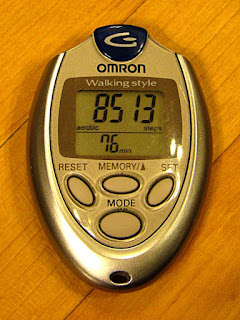
Besides reporting the total number of steps, the Omron pedometer also measures "aerobic steps". You must walk steadily for a certain period of time (I think it's twenty minutes) before it starts counting aerobic steps. If you stop too long you must walk for that period again before the count resumes. This picture shows that I'd walked 8513 aerobic steps and that they took me 76 minutes. On the same day I walked 11,826 regular steps, so about 70% of my steps were actual exercise. Of course on other days I might go for an "amble" instead a walk - walking more slowly and stopping more. That makes the resultant number of aerobic steps much lower.
Another screen estimates the number of calories burned. This number comes out dreadfully low. I haven't lost any weight from all my walking because I still like to eat like an idiot. But my Doctor is thrilled with my lower blood test numbers.
Finally, the pedometer measures distance covered based on an approximation of the length of my stride. It tells me that 10,000 steps represents over 3 miles per day. In this picture you can see that I walked 3.71 miles (and that the picture was taken at 11:22 P.M.)
So now I'm ready to answer the question I posed at the beginning: How many total steps does it take to walk one thousand miles? The answer naturally varies according how long your step is. If you're 6'9" or 5'2 the number will be different. But for me I need roughly three and a quarter million steps to cover a thousand miles. This takes me a little less than one year of walking.
Remember that figure the next time someone tells you how beginning the long journey of one thousand miles requires only a mere, simple, single step. Pop their meddlesome balloon, they deserve it.
It's hardest for me to do my walk on rainy days. Fortunately we don't have many such days here in sunny SoCal. But last week we had a corker - pouring rain with thunder and lightning. Much to Leslie's amusement I drove several miles through the maelstrom to the Santa Anita Mall where I managed to put in all my steps. The mall was dry and it was boring. One round trip from Macy's to Penny's and back was only a thousand steps. And I had to avoid all those slow moving shoppers as I zipped along. To amuse myself I took a few pictures. Here's one which seems like a good ending twist for this post:
An L.A. Times article about pedometer use.
Wikipedia's Pedometer Entry
Read about how buying an iPod at the Apple Store required fewer questions from the clerk than buying an ice coffee at Starbucks.
Pedometer Tags: pedometer. . . Omron. . . walking. . . 10000 steps
Subscribe to:
Posts
(
Atom
)


