Showing posts with label sciencefiction. Show all posts

Sunday, May 25, 2014

Towel Day

Today is Towel Day.   As literary holidays go celebrating the works of author Douglas Adams isn't quite yet in the league of Bloomsday.  That's because Joyce had a head start.

I'm not dorky enough to actually carry a towel in public on Towel Day.  Instead I will mark the occasion by posting some quotes from the later books of the Hitchhiker's Guide to the Galaxy.  I marked these the last time I read through the canon.

Many of Adams' quotes are well known.  What other author can claim to have invented a whole new meaning for a single number?  (You know which one I mean.)   Some of his quotes have become life principles for me.  For example
"Anyone who is capable of getting themselves made President should on no account be allowed to do the job." 
pretty much defines my attitude towards national politics these days.

The following quotes may not always be his greatest or most universal.  Instead, these are the ones that jumped out at me because of who I am, because I'm a musician, because I live in Los Angeles or just because I thought they were wry or twisted or funny.  Or some other reason.


From Life, The Universe and Everything (book three of the trilogy)

Prove it to me and I still won't believe it.  (Chapter 10)

He had been planning to learn to play the octaventral heebiephone, a pleasantly futile task, he knew, because he had the wrong number of mouths.  (Chapter 14)

He had returned to his own ship, the Bistromath, had a furious row with the waiter and disappeared off into an entirely subjective idea of what space was.  (Chapter 32)

In Relativity, Matter tells Space how to curve, and Space tells Matter how to move.  (Chapter 34)


from So Long, and Thanks For All the Fish  (book four of the trilogy)

They've discovered how to turn excess body fat into gold.  (Chapter 9, referring to Californians.)

Being like several thousand square miles of American Express junk mail, but without the same sense of moral depth.  (Chapter 15, a description of Los Angeles)

They agreed that the sense of dazzle stopped immediately at the back of their eyes and didn't touch any other part of them and came away strangely unsatisfied by the spectacle.  As dramatic seas of light went, it was fine, but light is meant to illuminate something, and having driven through what this particularly dramatic sea of light was illuminating they didn't think much of it.  (Chapter 30, describing the San Fernando Valley)

Their mood gradually lifted as they walked along the beach in Malibu and watched all the millionaires in their chic shanty huts carefully keeping an eye on one another to check how rich they were getting. (Chapter 30)

They were suddenly feeling astonishingly and irrationally happy and didn't even mind that the terrible old car radio would only play two stations, and those simultaneously.  So what, they were both playing good rock and roll.  (Chapter 30)

But the reason I call myself by my childhood name is to remind myself that a scientist must also be absolutely like a child.  If he sees a thing, he must say that he sees it, whether it was what he thought he was going to see or not.  See first, think later, then test.  But always see first.  Otherwise you will only see what you were expecting.  Most scientists forget that.  (Chapter 31)

If we find something we can't understand we like to call it something you can't understand.  (Chapter 31)


from Mostly Harmless (book five of the trilogy)

The last time anybody made a list of the top hundred character attributes of New Yorkers, common sense snuck in at number 79.  (Chapter 2)

When it's fall in New York, the air smells as if someone's been frying goats in it, and if you are keen to breathe, the best plan is to open a window and stick your head in a building. (Chapter 2)

Nobody likes a whistler, particularly not the divinity that shapes our ends.  (Chapter 8)

Being virtually killed by virtual laser in virtual space is just as effective as the real thing, because you are as dead as you think you are.  (Chapter 8)

Most of the ascetics, it turned out, had not known about chocolate before they took up asceticism. (Chapter 9)

"Oh, all right," said the old man.  "Here's a prayer for you.  Got a pencil?"
"Yes," said Arthur.
"It goes like this.  Let's see now: 'Protect me from knowing what I don't need to know.  Protect me from even knowing that there are things to know that I don't know.  Protect me from knowing that I decided not to know about the things that I decided not to know about.  Amen.'  That's it.  It what you pray silently inside yourself anyway, so you may as well have it out in the open."
"Hmmm," said Arthur.  "Well, thank you-"
"There's another prayer that goes with it that's very important," continued the old man, "so you'd better jot this down, too."
"Okay."
"It goes, 'Lord, lord, lord . . . ' It's best to put that bit in, just in case.  You can never be too sure.  'Lord, lord, lord.  Protect me from the consequences of the above prayer. Amen.' And that's it.  Most of the trouble people people get into in life comes from leaving out that last part."  (Chapter 9)

The major difference between a thing that might go wrong and a thing that cannot possibly go wrong is that when a thing that cannot possibly go wrong goes wrong it usually turns out to be impossible to get at or repair.  (Chapter 12)

All you really need to know for the moment is that the universe is a lot more complicated than you might think, even if you start from a position of thinking it's pretty damn complicated in the first place. (Chapter 17)

Old Thrashbarg had said on one occasion that sometimes if you received an answer, the question might be taken away.  (Chapter 19)


Other Mixed Meters' name checks of Douglas Adams can be found in these posts:

Floating Rocks ("What keeps it there?"  "Art.")

Unqualified for President (contains the full quote referred to above about being president)

In which a Docker Award goes to Oolong Colluphid (the 8th MM post ever)

Floor Shows (specifically the Shoe Event Horizon)

Making the Scene with the New Classic L.A. Blog   (expanding the body-fat-into-gold quote)

Sunday, January 22, 2012

Star Wars Uncut

Not a Star Wars fan? I suggest that you skip this post.

This is about Star Wars Uncut, Director's Cut.  It's a remake of Star Wars, A New Hope, which (chronologically, at least) was the first Star Wars movie.  Star Wars, of course, is the saga that made George Lucas into a billionaire, made Harrison Ford into such a big star he never had to learn another part, and ended the career of Mark Hamill.

This version was produced by crowdsourcing.  Someone split the original movie into 15-second long segments. Then they let just anyone pick a segment and film it again, using any style, any technique, any actors, any props, any reference, anything they could think of.  All the segments were then reassembled into the full movie.  And you can watch it on the web. 

The final result probably won't make a lick of sense if you aren't familiar with the original.  But if you are a fan and you enjoy pop culture mashups which are so intensely mashed that they border on chaos, then you will love watching this.  I did.  I even burned it onto a DVD and inflicted it on Leslie. (Sadly, she was not impressed.)


In this era of SOPA and PIPA (along with other past and future attempts by a few big corporations to own all of popular culture for the purpose of maximizing their own profits), this movie is an object lesson of how the widely available inexpensive technologies (like video and Internet which have transformed our lives since Star Wars appeared in 1977) let people take their favorite stories and make them grow.  Okay, maybe "grow" is not the right word.  "Mutate" would a better description.

Lots of people spent a lot of time doing this because they love this story.  Star Wars owes a large part of its popularity to the fact that it deals human-scale themes like adventure, honor, religion and love.  It paints these onto a vast galaxy-sized canvas of space travel, alien cultures and high technology.  Throw in revolution and politics, pitting a few good people against evil corporate governments.  Like Lord of the Rings, it is a Ring Cycle of our times, one with actual inspiration for living humans. 

John William's music is in evidence throughout this movie.  In fact, it forms a familiar touchpoint that glues this mess together.  Only few sections parody the music one way or another.

To give you a flavor of just how diverse the art direction of this movie is, I've assembled a few random screen grabs of the two droids - R2D2 and C3PO - into this photomontage.  It's a small sampling of the vast visual variation to which every character is subjected.


(click the picture for an enlargement)

To reference another science fiction classic (that would be The Hitchiker's Guide to the Galaxy) when watching this you should Expect the Unexpected.  Check out variety of methods used to recreate Princess Leia's hair buns.  Or Obiwon's beard.

Here's a picture of the initial entrance of Darth Vader with her four sexy storm troopers as they strut and pose high fashion style onto the captured rebel vessel.  (Notice that their blasters are really hair dryers.)


(don't waste your time clicking this one)

That's enough movie review for now.  Go ahead - watch it!


Or go to Vimeo or YouTube to watch.


If you have ever considered recreating the Star Wars movie using animated ASCII characters ... Sorry, someone has beaten you to it. Visit ASCIIMATION. (Only half the movie, but still an impressive waste of time.)

A previous MM article about Space Opera.

Uncut Tags: . . . . . .

Friday, September 30, 2011

The Preserving Machine by Philip K. Dick

I've been enjoying a book of early short stories by Philip K. Dick, master science fiction author. These stories, from the early fifties, are filled with mind-bending ideas and less than stellar prose.

The Preserving Machine was published in June 1953. Besides a narrator, the main character is named Doc Labyrinth. The action takes place in Los Angeles.  Dick opens with a description of suburban L.A.
I was standing by the barbecue pit, warming my hands.  It was a clear cold day.  The sunny Los Angeles sky was almost cloud-free.  Beyond Labyrinth's modest house a gently undulating expanse of green stretched off until it reached the mountains - a small forest that gave the illusion of wilderness within the very limits of the city.  "Well?" I said. "Then the Machine did work the way you expected?"
This Machine, the Preserving Machine, is pretty amazing.  It preserves sheet music in a most remarkable manner.  And not just any sheet music, but classical music in particular. 
This is how he came to think of the Preserving Machine.  One evening as he sat in his living room in his deep chair, the gramophone on low, a vision came to him.  He perceived in his mind a strange sight, the last score of a Schubert trio, the last copy, dog-eared, well-thumbed, lying on the floor of some gutted place, probably a museum.

A bomber moved overhead.  Bombs fell, bursting the museum to fragments, bringing the walls down in a roar of rubble and plaster.  In the debris the last score disappeared, lost in the rubbish, to rot and mold.

And then, in Doc Labyrinth's vision, he saw the score come burrowing out, like some buried mole.  Quick like a mole, in fact, with claws and sharp teeth and a furious energy.

If music had that faculty, the ordinary, everyday instinct of survival which every worm and mole has, how different it would be!  If music could be transformed into living creatures, animals with claws and teeth, then music might survive.  If only a Machine could be built, a Machine to process musical scores into living forms.
This being a Science Fiction story, you know that the machine gets built - and in due course music animals are created.  The above quote might lead you to expect animals based on particular works, like a Schubert trio.  Instead, Dick gives us composer animals.  For example:
After that came the schubert animal.  The schubert animal was silly, an adolescent sheep-creature that ran this way and that, foolish and wanting to play.
Once they become animals, their name is no longer capitalized.  The mozart animal is a bird, beethoven a beetle, brahms an insect, stravinsky another bird.
The wagner animal was large and splashed with deep colors.  It seemed to have quite a temper, and Doc Labyrinth was a little afraid of it, as were the bach bugs, the round ball-like creatures, a whole flock of them, some large, some small, that had been obtained for the Forty-Eight Preludes and Fugues.
Of course, all these critters escape into the nearby forest and begin to evolve and compete.  Some survive, others succumb.  The Doc feeds an evolved bach bug back into the machine, reconverting it into sheet music which he then performs at the piano.
I listened to the music.  It was hideous.  I have never heard anything like it.  It was distorted, diabolical, without sense or meaning, except, perhaps, an alien, disconcerting meaning that should never have been there.  I could believe only with the greatest effort that it had once been a Bach Fugue, part of a most orderly and respected work.
Had I been writing this story, instead of Philip K. Dick,  the reconverted music would have been very strange but not hideous.  Music as it grows and evolves should try new, unfamiliar ideas, some of which will survive, others not.  Survival of the fittest?  Eventually the musical unfamiliarity ought to fade in our ears, allowing new species to contribute to our enjoyment.  Adaptation and evolution, either of music or animals, ought to be the real reason that they flourish and reproduce.  Of course pieces of music which you never hear will not survive or procreate.

These days classical music already has a fully functional, well-oiled preserving machine - in the form of symphony orchestras and opera companies and classical radio stations only too happy to reproduce the same limited number of works over and over again for audiences eager to hear their favorites one more time.  This machine discourages adaptation but it does a good job of preserving any piece which can claw its way into the repertory.  A new work, which at first might sound hideous, diabolical or alien, will never find an audience if it has to compete against the well-entrenched, machine-preserved herds of beethoven, schubert and wagner animals roaming our cultural landscape.

Animal Tags: . . . . . . . . .

Thursday, February 05, 2009

Who Says I'm Never Interested In Opera?


Other opera related videos posted to Mixed Meters are here and here (Both of them are the Queen of the Night aria.)

Space Opera?

Sunday, July 30, 2006

In which David finishes a Space Opera

No, nothing that I wrote - especially not any music. It's about a book - my most recent soporific and a very exciting soporific too.

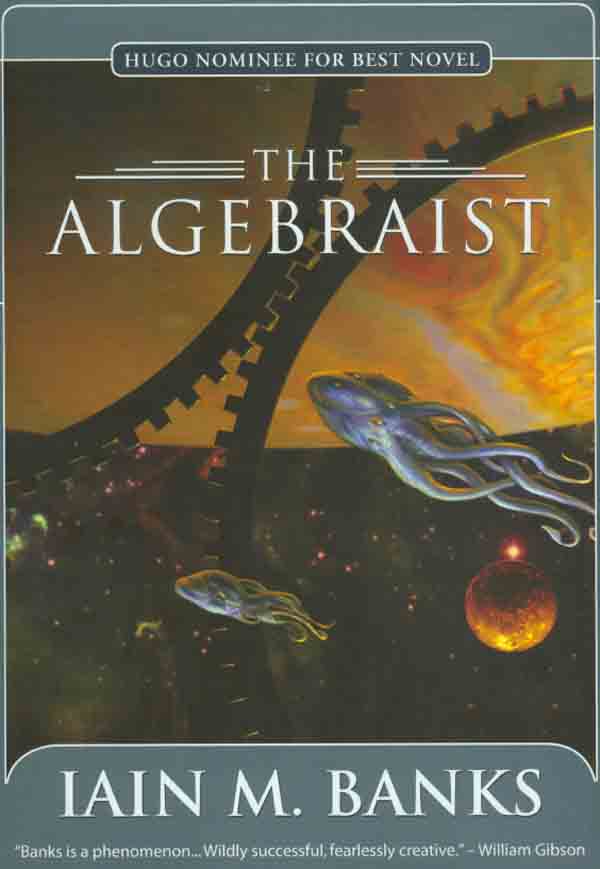
The Algebraist by one of my very favorite authors Iain Banks. (click the picture for larger size)

Or is he called Iain M. Banks? Yep, he publishes under two names - with the middle M. and without - to denote whether he's writing science fiction or not. Here's his home page. Let him explain it.

A few years ago Leslie brought home one of Banks' science fiction works, Excession, which I devoured. It's about a world where machines are very intelligent and powerful, a common Banksian theme.

Since then I've read every one of his books that I know of (except the newest Dead Air). I have an entire shelf devoted only to his novels. Banks is a versatile and capable author, pretty much unknown in the U.S.

The Algebraist takes place mostly in Ulubis, a distant planetary system, which faces invasion by a horrendously evil villain with a fleet of deadly space ships. Hoping for some inside information that will save them, the inept, bureaucratic rulers of Ulubis send the bookish hero on a quest to find . . . a book (what else).
He goes to a large gas planet (think of Jupiter) which is populated by Dwellers, an ancient species with a billion year life span. Our hero spends most of the story traveling about in a one-person space ship (think of a high tech mobile coffin with mechanical arms). Dwellers don't organize their libraries very well (think of my CD collection) and the critical information has been misplaced.
Yes, that is the exciting premise of The Algebraist.

I couldn't put it down.


SCIENCE FICTION LINKS

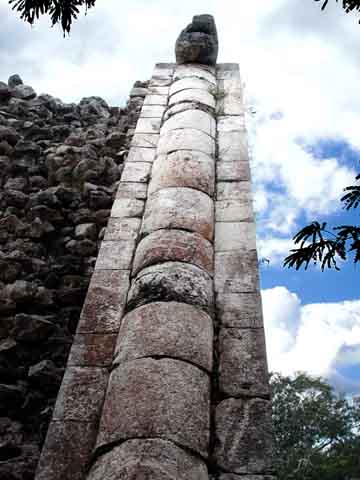
von Daniken Chichen Itza stone rocketship (c) 2004 David OckerA picture I took of the Rocket Ship of the Gods at Chichen Itza Mexico.

Van Daniken has a Theme Park (in English via BabelFish or in German)

For more information about the science fiction genre called Space Opera click here for Wikipedia.

A composer named David Bass has written an actual musical "Space Opera" based on the first Star Wars movie, (known as "Episode Four, the New Math.") Click to see the cast in costume. Cute.

L. Ron Hubbard, the science fiction author who could have become a God, made the term Space Opera into a religious tenet. Click here.

SCIENCE FICTION VIDEO

Short commercials for the Sci-Fi network: a Superhero Grandmother and a balloon dog.
Here is another balloon video (not science fiction but most men will enjoy it.)
Here is a German commercial (not science fiction and most men will be disappointed)
Here is Stunt City 7:45 a.m. (very highly recommended if you like action movies)

A Star Trek parody (in Finnish): Star Wreck, In the Pirkinning (click here) which "... begins with Captain James B. Pirk of the starship Kickstart shipwrecked on the 21st century Earth with his crew ..." (I've only watched the trailer, no time for the full length movie yet.)

A Star Wars Fan Movie, IMPS: The Relentless (click here). Imagine COPS, the television show, on the planet Tatooine following a squad of Imperial Storm Troopers as they work an average day on the job.

truck with Ice-9 sign Vonnegut Cats Cradle (c) 2006 David OckerClick on the Ice-Nine truck (seen in Alhambra CA) for a larger picture. An ice-related Sci-Fi Network commercial.

Want more MIXED METERS POSTS?

STAR WARS: The IPO (Imperial Philharmonic Orchestra, Darth Vader music director) in concert.

DAVID'S RECENT SOPORIFICS ("books read before bed")
The Merchant of Prato - (click here or here. )
Umberto Eco - Baudolino (click here)
One Market Under God (click here)
50's Japanese Murder Mystery with electronic music (click here)