Showing posts with label opera. Show all posts

Thursday, June 07, 2012

LA Opera's Ring Festival LA - two years later

It's been two years since I devoted Mixed Meters to the subject of Ring Festival Los Angeles.  Hardly anyone seemed to notice but I learned a lot about myself.

I'd like to stay in the top Google search results for the term "Ring Festival LA".  To that end an occasional extra post on the subject couldn't hurt - like once a year - because someone might still notice.

Two years later there doesn't seem to be much more to say about the subject.  Los Angeles has moved on from its semi-close encounter with Richard Wagner's endless magnum opus, the Ring of the Nibelungs.

In the last year Los Angeles Opera has begun paying back the $14 million loan which I and my fellow Los Angeles County residents cosigned (via our elected representativs) when the ring cycle production soared WAY over budget.  We in the 99% don't get the interest from the payback - a private bank gets all the profit.

Here's a cute cartoon which the New Yorker ran late last year.


There is Ring Festival LA news of a sort from Europe.  It appears that Achim Freyer, artistic doyen of LA's comic book Ring production, one which many Ringnuts hated, is directing another Ring cycle in a similar style (to judge from the pictures) in the German city of Mannheim.  The opera company over there is certainly not touting the Los Angeles connection.  Why should they?  Mannheim first became a world-class capital of music more than a quarter millenium ago well before the first Spanish mission was ever built in Southern California.

You can read about the Mannheim Achim Freyer production in a pdf document entitled The New Mannheim Ring.  Statements from German politicians remind me of our own politicos quoted in LA Opera's early press releases.

Mannheim has plans to release a DVD of their production.  Had the LA Opera gone into a bit more debt to fund documentation of their accomplishment the lasting benefits of the Los Angeles Achim Freyer Ring might have increased.  That was an opportunity lost, in my opinion.  I'm sure our county Supervisors would have been glad to add an extra 3 or 4 mil to their loan guarantee to fund a DVD.  All the Opera had to do was ask.


Finally, there's a recent development in the unofficial Israeli ban on performances of the music of Wagner.  Here's an article from the newspaper Haaretz entitled Tel Aviv University cancels Wagner concert after angry protests.  (The Guardian has this article on the subject.)

Tel Aviv University says that the Israel Wagner Society booked their concert hall without mentioning what was on the program.  One might wonder what else the "Israel Wagner Society" might perform if not Wagner.  Mendelssohn?  Somehow the news got out.  Haaretz quotes a spokesman for the University
You deliberately concealed this basic fact from us...We received angry protests calling to call off the controversial event...[which] would deeply offend the Israeli public in general and Holocaust survivors in particular.
Uri Chanoch, described as deputy chairman of the Holocaust Survivors Center (I can't find any information about that group), is quoted
This is emotional torture for Holocaust survivors and the wider public in the state of Israel. 
Wagner provided inspiration for the Nazis, and there is a direct link between him and the Holocaust. The fact that Wagner's music will be played in public and the fact that the concert was being advertised, are hurtful and damaging.
Even now Jewish survivors of World War II associate Wagner's music with the persecution and destruction they endured under the Nazis.  Their emotions inform my belief that we must stay aware of how Richard Wagner's operas and antisemitism inspired Hitler towards execrable discrimination and mass murder.

Someday soon there will be no more surviving Holocaust survivors.  Later generations will need to remember on our own how the Nazis used Wagner.  The Nazis proved that music can serve evil in our modern world.  If such massive misuse of music happened once it could happen again in another place and another time using someone else's music.

By remembering Hitler when we perform Wagner, we give ourselves the best chance for preventing recurrences of such despicable and immoral behavior.


Here's an article about the formation of the Israel Wagner Society.

The Mixed Meters post LA Opera's ring Festival LA - one year later includes a list of all Wagner, Hitler and Ring Festival related posts.

Cartoons by Kaamran Hafeez

Still Angry Two Years Later Tags: . . . . . . . . .

Saturday, July 16, 2011

Music for a Horned Helmet

Recently I was surprised to hear operatic singing from a television commercial.  There was even a bass voice. You never hear basses sing on television. The ad was for a big financial firm which has figured out how to make money from people who can't wait to be paid. On YouTube I discovered three such opera-mercials - all with the same music but different voices.

The first commercial spoofs an actual opera on stage:


The second focuses on the uses of cash now - like home repair, car repair, newborn quintuplets:


And the third is everyone's favorite setting for opera music - a city bus:


Watching all three of these, I was struck by the recurring use of one particular image: the horned helmet - sometimes called a Viking Helmet. I guess nothing says "Opera" like a metal hat with horns on it.

If you really care whether the Vikings wore Viking helmets and how this particular headgear got to be associated with opera, this Straight Dope article Did Vikings Really Wear Horns On Their Helmets? is for you.

If you think there might be a better music/horned-helmet association, you'd be correct. Here's a picture of Moondog:


The Moondog picture came from here - where you'll find a link to some radio interviews on WBAI.  For a while - a few years ago - certain of Moondog's compositions were being used in automobile advertisements.  (Couldn't find those on YouTube.)

Do yourself a favor. Listen to some Moondog.


Previous MM posts about classical music in television commercials:
Selling With Vivaldi "These four uses of Vivaldi are all pretty standard capitalist realism - art in the service of profit."

Advertising with Disney Hall  "It would be a much better world if you were reminded of classical music each time you saw the bank's stagecoach, rather than being reminded of a bank each time you saw the concert stage."

In Which David Is Confused by The Second Coming  "Does this, I wonder, sell shoes or religion?"

Who is Weiden & Kennedy Anyway  "A dark story of crushing defeat as the home team loses by one point in the last second because an opponent is wearing better shoes. Life is like that, huh?"

Horned Tags: . . . . . . . . . . . .

Monday, May 30, 2011

LA Opera's Ring Festival LA - one year later

I stumbled across an events list for the San Francisco Opera's Ring Festival and I was reminded that just one year ago Los Angeles was in the throes of a similar event.

Apparently San Francisco, much more savvy about the place of opera in our culture, has avoided some of LA's sillier Festival features:
I wonder if San Francisco Opera has opened a beer garden outside War Memorial Opera House like the one last year outside the Music Center?  Endless operas can make a guy thirsty.

Westminster Gold album Die Walkure by Wagner - naked woman with VW hubcaps

As better and better topics kept presenting themselves, I devoted nearly every Mixed Meters post for about three months to various aspects of Ring Festival LA and Wagner's legacy.  (See the end of this post for a complete list.)  Readership dropped as a result.  Apparently opera fans are not interested in contrarian views about their sacred music.  And non-opera fans are not interested in anything about opera. 

But, as it says prominently on Mixed Meters, this is a blog about me, David Ocker.  Even I wondered why I spent so much time obsessing about an event that was terribly easy to ignore.  And, if nothing else has changed in Los Angeles because of the LA Opera Ring, at least I gained some insight into my own emotional responses.  Unless you're my personal friend there's no reason you should care.  Even then, it doesn't much matter.

My motivations for all that effort can be sorted into three categories: my musical background, my Jewish background and my Los Angeles background. 

My Musical Background

My musical education - formal and otherwise - was always focused on the future of music, music as a forward looking thing.  I have always been intrigued by novelty, by the desire to know what happens next.  Even in high school I was constantly looking for new and wild things to listen to.   Eventually new music became my career - even if it wasn't my own music.  While I agree that there is much classical music that is beautiful, I recoil at the notion that it is somehow intrinsically superior music.

Unsurprisingly, there's an awful lot of music which I don't like.  I have strong opinions about music.  In particular I dislike a host of 19th century music and an awful lot of opera.  As such, Wagner is the quintessential music I would like to avoid.   In the context of my musical background, Wagner, probably the most unavoidable historical composer ever, is the prototypical example of everything I hate about music - endlessly long, crude-oil thick, college-lecture boring, evangelically sermonistic, narcotizingly stupefyingly heavy and musically irrelevant to the future.

My Jewish Background

I'm not a religious Jew but I am Jewish both socially and culturally - my parents got that much through to me.   When I was a kid the Holocaust was not particularly a big deal in our family.  Still, the incredible importance of the subject was somehow hammered home to me.  It was something that we were supposed to remember, "never forget".  "Who could forget?" I wondered.  I concluded that forgetting during my lifetime was not possible.

While my parents strongly encouraged my musical interests, they pointedly didn't listen to Wagner.  They told me that Jews didn't "do" Wagner.  The one time in my life when I saw my parents protest anything politically was at a symphony performance.  I was about 10 or 11.  They got up, along with other Jewish people, and left the concert to avoid hearing a Wagner overture.  Besides this one event I never once saw them attend a protest meeting, write a letter to the editor or get upset about politics.

Holocaust survivors in Israel didn't want to listen to Wagner.  They had good reasons.  Whatever those reasons were, they are the same reasons my parents taught me about Wagner's music.  In my opinion a County-endorsed public Wagner festival starkly represents the very act of forgetting the things which should not be forgotten.

My Los Angeles Background

While I still regard graduate school advice that I should move to New York as misguided, it would have been useful for me to experience an actual, intense creative new music scene someplace while I was still young.   But I had the notion that such a community could be created right here in Los Angeles.  After all, this town is big and has musical talent and media and patrons and foundations up the wazoo and it has had periods of intense creative activity in other fields - for example modern art or pop music.  I spent a lot of my youthful energy trying to make new music in Los Angeles happen.

Over the decades I've concluded that I was wrong: a Los Angeles new music scene patterned after my own dreams just isn't possible.   Sorry, it won't happen in LA.  (Please, prove me wrong before I die.)  The serious new music that Los Angeles wants to focus its attention on is almost always created elsewhere.  "Elsewhere" in this context mostly means Europe.  This pattern began even before Stravinsky and Schoenberg and continues to this day.  Sometimes audiences are happy with East coast music.  "Elsewhere", "Europe" "East Coast" all begin with E.  What does that mean?  

The Los Angeles of 2010 Ring Festival did not turn out like the one I imagined in 1976 when I took up residence in Los Angeles.   In November 2008 I was surprised by just how badly things had turned out in this regard when I read Plácido Domingo's announcement that

"Ring Festival LA will be a defining moment in the cultural history of Los Angeles."

Can you imagine my disappointment?  Not only was a forward-looking music scene not going to happen here, but Domingo, an icon of music from Elsewhere, was announcing that we would henceforth define Los Angeles musical life around four boring operas based on medieval German mythology composed by a self-promoting anti-Semite who died more than 125 years ago.  What has that got to do with the future of any thing?  I can't think of anything less representative of Los Angeles.


Here's Plácido's quote in context:

More than a century ago, composer Richard Wagner conceived his epic four-opera cycle Der Ring des Nibelungen as a festival event that completely engaged the city of Bayreuth, Germany. In 2010, LA Opera will join forces with more than 50 cultural and educational institutions in Los Angeles to stage Ring Festival LA.  “Ring Festival LA will be a defining moment in the cultural history of Los Angeles,” said Plácido Domingo, LA Opera’s Eli and Edythe Broad General Director. “The presence of so many of LA’s cultural, educational and civic leaders clearly demonstrates that the city’s creative forces can be brought together through a cultural festival — in this case, a festival based on LA Opera’s production of Richard Wagner’s Ring cycle.

Can Plácido really have thought that a festival centered on the Ring could define the cultural history of Los Angeles?  Not even all of Los Angeles - could he have possibly thought that the Ring would define the history just of music in Los Angeles?  Even just serious music?  Apparently so.  I am still infuriated by the thought.

Aside from my distaste for Wagner's music and Hitler's complicity in Wagner's legacy, the idea that music in Los Angeles - where I've lived well over half my life and don't expect ever to leave - could be defined by Wagner and his music is simply despicable.  Domingo was talking long term - he used the word 'history' after all - not just for the few weeks of the festival itself. 

Reading that quote was maddening, exasperating.  I wondered how could they could have the gall to even think thoughts like that.  While it's true that opera is relatively unimportant in Los Angeles, let me remind everyone that he was also suggesting that RFLA would be the biggest thing since the 1984 Olympic Arts Festival - which was a massively big deal.  Fortunately that part of his plan turned out to be purely hot air.

I assume that Plácido is paid an awful lot of money to guide Los Angeles Opera.  Local opera fans seem to adore him.  He draws extra paying customers when he sings.  Moreover, the patrons of the opera must trust his judgement because they take his advice.  Indeed, part of his job is to help define what serious music in Los Angeles will become over time.  And the vision he brought us was "Bayreuth on the Pacific!"  It's simply shameful.

Compare his vision of Los Angeles - supported by millions upon zillions of dollars - with the vision I thought I might have a chance of creating back in the Los Angeles of the 70s and 80s.  Do you think that confronting the disparity of those images might still make me upset?  Don't bother to answer, I'll just tell you ... yes, it did.  A lot.  

And, frankly, there was nothing I could do about it except bitch.  So what did I do?  I bitched.


As a final wrap-up of the subject, here's a list of the articles (plus teaser quotes) in which I bitched about Ring Festival LA:

  1. November 21, 2008 Ring Festival L.A. - Wrong Festival L.A. "this festival, as it was announced, will be far from representative of the arts community as a whole. In fact it is elitist in the extreme." 
  2. July 16, 2009 Mike Antonovich and Ring Festival L.A.  "requesting that the “Ring Festival LA” shift the focus from honoring composer Richard Wagner, to featuring other composers as headliners, to provide balance, historical perspective and a true sampling of operatic and musical talent."
  3. July 21, 2009 Wagner with an Asterisk "This suggestion will in no way impede efforts by our local oligarchy to get Los Angeles recognized as a great European city by producing their very own Ring."
  4. February 17, 2010 A Windfall of Musicians "The combination of some of Europe's greatest musicians with two local music enthusiasts, Peter Yates and Lawrence Morton, turned L.A. into the bloodiest cutting-edge music scene anywhere for many years."
  5. March 24, 2010 Wolfgang Wagner (1919-2010) "'Once we have rid the world of the Bolshevik-Jewish conspirators, then you, Wieland, will run the theater of the West and you, Wolfgang, the theater of the East."
  6. April 5, 2010 Ring Festival L.A. Begins  "If you really speak about the festival's significance to the culture of Los Angeles, I'm afraid Plácido's statement has The Big Lie feeling about it"
  7. April 20, 2010 Ring Festival L.A. Meets Hitler's Birthday  "Has no one at Ring Festival LA noticed that this is one small step in the exculpation of Adolph Hitler?  Maybe they don't care about this aspect as long as the event involves Wagner in some way.  Maybe there's been drinking at RFLA as well.  Maybe they're ROFL."
  8. May 29, 2010 Listen to Wagner's Entire Ring Cycle In One Second  "the work of one California composer who, almost 50 years ago, dealt conceptually with the problem of Wagner's Ring."
  9. June 9, 2010 Composers of the Nazi Era "And if some music is good, I suppose it follows that some other music is bad, degenerate.  This attitude is the beginning of a slippery slope.  At the bottom of that slope you will find the story of how the Nazis used and abused music. "
  10. June 16, 2010 Kenton Wagner "If there is a Hell (which I personally doubt) Richard Wagner is there being forced to hear this album over and over for all eternity."
  11. June 17, 2010 Wagner Inspires Pop Music "Apparently, someone, somewhere thinks every popular musician in the whole world during the last 150 years somehow owes their musical style to Richard Wagner.  What a sad world it would be if that were true."
  12. June 20, 2010 Wagner Invades Poland "The comparison of Wagner's Ring to an opiate is apt."
  13. June 26, 2010 Suppose Wagner Had Been Jewish "as Ring Festival LA "leader" Barry Sanders said "We're not putting lipstick on a pig in this thing.""
  14. July 9, 2010 Suppose Wagner Had Been a Nazi "Wagner fans do not want to talk about that elephant.  The elephant is Adolf Hitler."
  15. July 18, 2010 Hitlerdammerung "Hitler actually got to perform his part from a Wagnerian plot and recreate a bit of German mythology at the same time, spilling real blood and burning real cities."
  16. August 15, 2010 A Modest Proposal For Replacing Placido Domingo at LA Opera "With the Ring in its rear view mirror Los Angeles Opera could decide to now set itself the goal of really creating a defining moment in Los Angeles culture.  The first thing it would need to do is thank Plácido for his services and send him packing. "
  17. April 8, 2011 Eli Broad: Masterpieces, Money and Monuments "Many Los Angeles arts institutions have gratefully endured the sting of Eli Broad's money."
  18. June 7, 2012 LA Opera's Ring Festival LA - two years later  "By remembering Hitler when we perform Wagner, we give ourselves the best chance for preventing recurrences of such despicable and immoral behavior."


A good deal of this post was reworked from private email correspondence with my friend John Steinmetz, who prompted me to explore the reasons for my emotional reaction to Ring Festival L.A. Thanks, John.

Still Angry One Year Later Tags: . . . . . . . . .

Sunday, May 08, 2011

Bernie Madoff's Golden Parachute

Bernie Madoff's Golden Parachute is a piece of my music.  You don't have to read about it.  Just click here to listen to Bernie Madoff's Golden Parachute right now.


Bernie Madoff might be the biggest crook in the history of the world. He created a ponzi scheme masquerading as a Wall Street brokerage house which stole as much as $20 Billion and might have been going on nearly 40 years. He was arrested in 2008 when the recent "George Bush" recession made it impossible for him to keep robbing Peter to pay Paul. Madoff realized that the jig was up and confessed to his sons.  They turned him in.  Six prior investigations by the SEC had failed to notice that anything was wrong.

A Golden Parachute is severance pay for corporate executives.  When a CEO is fired they often receive such a payout.  This is irrespective of how well they did their job.   Here's a list of the largest-ever golden parachutes.  It includes Angelo Mozilo (who was accused of insider trading during the recent mortgage bubble; he got $44 million), Michael Ovitz ($130 million for working just a few months) and Michael Eisner (who collected a $1 Billion bonus for making Disney strong enough to control U.S. copyright legislation.)

I don't know whether Bernie Madoff had a formal golden parachute agreement with his company.  If he did it wasn't worth the paper it was written on because after his conviction he had to forfeit all his  wealth.  Since he knew full well that what he was doing was illegal it's doubtful that he expected to retire with the same level of comfort and splendor in which he lived.

Still, Bernie Madoff lived the good life while he could.  I've seen estimates that his fortune was around $800 million.  He lived in a New York penthouse.  He created a philanthropic family foundation and gave money away to charities.  After his conviction he was sent to prison in North Carolina.  He'll be eligible for parole in 2139 (when he's 201 years old).

America likes its criminals.  We often celebrate their stories with works of art - mostly movies and television shows these days.  Jesse James, Al Capone, Bonnie and Clyde - the list of hero/crooks is a long one.  Makers of such entertainment must cover their ass morally by making sure the bad guys die at the end (or at least go to prison).  Of course to be popular these stories must have a great deal of action including chases, gunplay, daring heists and sanitized love-making.

In comparison, Bernie Madoff's story is a yawn.  In this age, when the "greed is good" philosophy is no longer even slightly controversial, the tale of how one boring guy in a suit sat in an office and quietly stole a pile money beyond the dreams of even the most avaricious thief, might actually sell lots of movie tickets.  Bernie Madoff Gets Rich could be just as popular as the movie about Facebook.

The plot of the Bernie Madoff story will seem familiar to opera fans.  It's Faust by Charles Gounod.  Bernie plays the part of Faust himself (although his victims might think of him more as the Devil).  In the beginning Bernie/Faust, of his own free will, makes a deal with Mephistopheles and is rewarded with riches and other perqs.  But the deal is good only for a limited time only.  After that, the devil claims the hero's soul and sends him to Hell. 

Being sent to Hell is Faust's own golden parachute.  And Bernie's too.  These days many of us don't believe in a actual physical post-death fire and brimstone eternal torment.  Being sent to prison in North Carolina for the rest of our natural lives, however, is a pretty darn good substitute. 

I wonder how many Americans would make the same deal with the Devil that Bernie made: trading a few years in prison for decades of wealth, influence and notoriety.

Listen to Bernie Madoff's Golden Parachute © 2011 David Ocker - 149 seconds

Here's a WSJ article about what Bernie's life is like in prison.  He is Inmate No. 61727-054 at Butner Federal Prison

There are many variations of the Faust legend - not just operas. Read more about them here.

Madoff Tags: . . . . . .

Sunday, August 15, 2010

A Modest Proposal for Replacing Placido Domingo at LA Opera

In a November 2008 press release Placido Domingo, Los Angeles Opera's leader, optimistically announced  
Ring Festival LA will be a defining moment in the cultural history of Los Angeles.
A year later, in another press release, RFLA's Leader Barry Sanders predicted 
Ring Festival LA will be the most significant arts festival since the 1984 Olympic Arts Festival.
At RFLA's website, Sanders, apparently with a straight face, referred to the festival as
the most interdisciplinary, cross-cultural, collaborative artistic and cultural event to occur anywhere.
By the time Ring Festival LA ended, about six weeks ago, anyone could see that it had not lived up to this hype.  Not even close.  I suppose we have to cut Placido and Barry some slack.  I'm sure they had the best of intentions.

Oscar Wilde said
It is always with the best intentions that the worst work is done.
Here's the RFLA street flag on Riverside Drive together with an ad for another Los Angeles event, ExxxoticaExpo.  (Click the picture to enlarge.)


Of course festivals and hype are the stock and trade of Richard Wagner whose music inspired Ring Festival LA.  Wagner's own festival, Bayreuth, has repeatedly presented the exact same ten operas for well over a century.  Such a festival exudes the feeling of a religious ceremony.  "John Marcher" (an anonymous San Francisco blogger and opera fan) recently mentioned that he was looking forward to his first visit to Bayreuth.  He called it his "Bayreuth baptism".

Of course festivals and hype are the stock and trade of Los Angeles which always has a lot of arts festivals.  Here's a list.  There are even more film festivals in LA including many ethnic ones: African-American, British, Iranian, Chinese, Chicano, Italian, Croatian, Danish, Filipino,  etc. etc.  On the radar screen of all local fesivals, Ring Festival LA was barely a blip.

And of all the festivals which Los Angeles has ever seen come and go, only one ever reached the level of "a defining moment in the cultural history of Los Angeles".  That was the wildly successful 1984 Olympic Arts Festival.  It had a huge budget, adjusted for inflation, worth $24 million today.  After barely a decade, the positive effects disappeared, swallowed by an era of recession and riots.

The Olympic Festival, and the equally successful 1987 Los Angeles Festival, were led by Robert J. Fitzpatrick, then President of CalArts.  With money to spend and the support of city leaders, the festivals included the widest possible variety of dance, opera, jazz, music, theater, art, and film - from all over the world and from right here in Los Angeles.

One uniquely Los Angeles component of the festival was a Freeway Mural Project - in which sections of local freeways were turned into art galleries visible to people as they drove past.  Some of those murals are still slightly visible through a 25-year patina of gang graffiti.  (Again, click to enlarge.)


Eventually Fitzpatrick got a job offer he couldn't refuse - to become head of Euro Disneyland.  It would turn out to be a bad career move for him.  As a result a new head of the Los Angeles Festival was needed for the next event scheduled for 1989.   In a 1987 LA Times article Fitzpatrick touches on who his replacement should be:
Conversation skips to Festival 1989, which he hopes will focus on Latino and Asian culture. He suggests picking as his successor "someone who has the ability to stage a festival, to get a fresher perspective."
The person chosen was theater director Peter Sellers.  For that festival - postponed a year until 1990 - Sellars took the idea of "Latino and Asian culture" and ran with it.  The 1990 Festival became a Pacific Rim festival.  This is from a 1989 LA Times article:
Declaring flatly that there would be "no European works at all" at the 1990 Los Angeles Festival, Peter Sellars said Tuesday that he hoped the three-week September event would prove to traditional arts patrons that the kind of work "previously considered the margin was, in fact, the center."
"I would like the festival to do for this city things that none of the (existing) institutions in this city can do," he said. "Collective power is what I hope the L.A. Festival will be about."

All this is my way of introducing a fascinating review of the 1990 Los Angeles Festival.  Since these festivals were all pre-Internet, there is not much information about any of them online.  This particular piece, entitled HIDDEN IN PLAIN SIGHT: Los Angeles Festival 1990, was posted by the author Don Shewey to his own website.  Here are some quotes - but if you're really interested in this pinnacle of a local arts festival I suggest you read the entire article.
"I was all ready to bring a bolt of my Mozart opera productions and whatnot," Sellars has said. Then he took a good look at Los Angeles, noticed that the population was dominated by Asian and Latin American people whose cultural traditions had nothing to do with Mozart or Europe, and changed his mind.
Shewey discusses the spiritual aspect of many of the performances he witnessed.  Remember that this was the controversial era of Jesse Helms, Robert Maplethorpe and Andre Serrano's Piss Christ.

That's right, it was a religious festival, a celebration of spirituality. Of course, selling the Los Angeles Festival that way would probably have caused no less of an uproar than if it had been billed as a celebration of babykilling. That's why you never heard the words "religious" and "spirituality" officially attached to the festival -- in the cultural climate we live in, those words are taboo, especially within the arts community, which feels itself to be under attack by the religious Right.
And later:
And yes, the Los Angeles Festival was a political festival as well -- another no-no and another attribute that somehow Peter Sellars found it convenient (and probably wise) not to trumpet too loudly in the press. In fact, you could say that the festival took place at the intersection of religion and politics. I was going to say that the Asians supplied the religion for the most part and the Latin Americans the politics, but I realize those are cultural cliches -- the spiritual Orient and the fiery Latin rebel. The fact is that the intersection of religion and politics takes place at the center of virtually all Pacific cultures (Korean, Mexican, Polynesian Chilean, Filipino, etc.). That's exactly what makes those cultures profoundly alien to American mainstream culture, which is so eager to avoid religion and politics that it will climb mountains of junk and swim through oceans of trivia to get away from them.

The Los Angeles Festival was ingeniously designed as a corrective to this American attitude. Ingenious because it sold itself neither as exotica (an array of dazzling freak shows) nor as medication (a bitter potion to choke down because it's good for you). In fact, it sold itself pretty much the same way its two predecessors did, as a celebration of world culture, without the slightest hint of apology for the omission of international superstars along the lines of Peter Brook, the Royal Shakespeare Company, Pina Bausch or Ariane Mnouchkine.
One of the international superstars of the 1984 festival which Shewey doesn't list was the Royal Opera of Covent Garden which brought works by Mozart, Puccini and Britten to LA.  Placido Domingo sang the lead in Turandot.  Those performances inspired the elite of Los Angeles to form their own opera company.  Apparently they were embarrassed to admit to their equally over-rich friends from other cities that Los Angeles had no opera company to call its own.  Such, I suppose, are the tribulations of too much money.


Placido Domingo was artistic advisor and board member for LA Opera from the very beginning.  Later he became General Director.  He has guided the company in one way or another for over 25 years.  And today, of course, Los Angeles does have an opera company that our elite can boast about to their friends.  It has proved its technical, musical and artistic prowess by producing a complete Ring cycle.

But it is also now burdened by a huge deficit and a huge debt, the result of a perfect storm of over-reaching, bad management decisions and a collapsing economy.  It certainly failed to define anything about the cultural history of Los Angeles, except possibly that it's out of touch.  It even failed to satisfy traditional Wagner fans.  It made barely a dent on the consciousness of Angelenos via marketing and community outreach. 

With the Ring in its rear view mirror Los Angeles Opera could decide to now set itself the goal of really creating a defining moment in Los Angeles culture.  The first thing it would need to do is thank Placido for his services and send him packing.  His contract has only one more year to run.  At least Placido has not left LA Opera in as bad a situation as his other opera company in Washington D.C.

Any new leader must be intimately familiar both with the traditional European art form called opera and also with the incredibly multi-cultural place called Los Angeles.  Only half in jest, I'd like to suggest that Peter Sellars be considered for the post.  He's uniquely qualified, never dull, always thought provoking and lives right here already.  He even won something called the Erasmus Prize for contributions to European culture.

Peter probably can't raise money the way Domingo's star power can nor is his track record as an administrator particularly stellar.  But others can count beans and stand as figureheads.  Sellars is an idea man.  I guarantee any ideas Sellars comes up with will be better for LA than trying to create Bayreuth on the PacificLA Opera needs a good idea or two to explain why the rest of the community should care about it. 

The company needs to preserve those aspects of opera that keep the current fans buying tickets while convincing even a sliver of the rest of the population to give it a chance.  The good news is that opera shares many things with popular storytelling - movies, television, novels and opera are all filled with love, romance, intrigue and death.  People like that.  The bad news is explaining why opera seems so foreign, so formal, so habitual, so burdened by tradition, so old fashioned.   

Opera is never going to shed its European heritage completely, nor should it.  But if it really wants to be some sort of defining force in Los Angeles, a metropolitan area of 15 million people from all over the world, the European model needs to change.  That a local organization like LA Opera can spend so much time, resources and energy recreating old world models is the real reason why all of us, not just the wealthy elite, should feel embarassed about opera in Los Angeles.  Recreating what goes on in Europe is what makes Los Angeles a profoundly provincial place.  Of course the opera's board of directors may be quite happy living in the provinces.

Los Angeles is a big city and our own opera company is now officially world-class.  Now someone needs to ask "what is an opera company for?"  I think it's time to start imaging how to make better use of it.  You won't be too surprised to learn that I've got some other ideas about how to do that.  If I can get my energy and indignation levels back up, it's pretty certain that I'll share those ideas here.


Los Angeles is an intensely multi-ethnic place.  Last January LA's mayor - speaking at the opening of LA Arts Month - said that 46% of Angelenos are foreign born and 67% are people of color.  He also said they speak 224 languages and represent 37 national groups which are the largest outside their home countries.
We come from every part of the world.  And we come with our culture.  We come with our music.  We come with our traditions, our food, and we bring all of those here to this great city.  And I think that's where the spirit of LA arts scene lies.  It's where the soul of the city (is).  It's what makes us different - with all respect to the ex-New Yorkers here.
You can watch him ramble here.


Surprisingly, Los Angeles County already has an opera company with a much better idea of how to exist in modern California society than LA Opera.  It's in Long Beach.

Here's a short history of LA Opera.

Here's a fascinating article by Ivan Katz called How Do You Lose $5,960,000 on an Opera?  Here's a quote:
$30,000,000 should buy you more than a Wagner comic book larger than life. Hell, $30,000,000 ought to buy you three first-class new Ring productions.


Peter Sellars once said:

There are a lot of parallels between Jimmy Swaggart and (Richard) Wagner -- both were cult figures who cloaked themselves in public religiosity and promoted themselves shamelessly.
Of course he said that back when people would have understood what an incredible hypocrite Jimmy Swaggart actually was.  I suppose you can't be a hypocrite without lots of hype.


Here's a 1990 article from a Seattle newspaper about the Olympic and Los Angeles festivals.


Read about the current state of the freeway murals here.

Peter Sellars' picture, taken in 1991, came from here. (Check out the pictures of composers.)
Placido's picture came from here.

Read the MM post Placido Domingo: High Culture Meets Pop Culture


Idea Tags: . . . . . . . . . . . . . . . . . . . . . . . . . . .

Sunday, July 18, 2010

Hitlerdammerung

Recently I wrote about Composers of the Nazi Era by Michael Kater the third book in a fascinating trilogy about Nazis and music.   I've also finished reading another third book in another fascinating trilogy.  This one, published last year, is called The Third Reich at War by Richard J. Evans.


The first two books of Evans' trilogy are called The Coming of the Third Reich (ending with Hitler becoming chancellor) and The Third Reich in Power (ending just before the outbreak of war).  Evans deals with a comprehensive list of political, economic, cultural and social issues on both homefront and warfront.  Together the three books tell how and why the Nazis rose to power, how they prepared German society for war and then how they set out to conquer Europe or die trying.  The subject is vast and complex, but the writing is clear and well organized.

I started this trilogy back in the days of George II, the U.S. President known for WMDs in Iraq, "faith based" intelligence, and Guantanamo Bay.  For his efforts Bush was regularly compared with Adolf Hitler.  "Could that be true?" I wondered.   

The Coming of the Third Reich, which only dealt with Hitler's rise to power, made it clear how patently absurd a Bush/Hitler comparison was -- on any level.  Since then, the details I've learned about Nazi history, filled as it is with vicious, immoral, absurd and obscene behavior, have made me more proud to be an American citizen (and, coincidentally, less tolerant of Ring Festival L.A.)


This is a picture of dead bodies collected after the firebombing of DresdenThe Third Reich at War is filled with death.  People die on nearly every page.  On many pages hundreds die, or thousands, or even tens of thousands.  Much of the slaughter was directly from combat or mass extermination.  Countless military prisoners on forced death marches and slave laborers in work camps died from starvation, disease and exposure.

At certain points in the book Evans reveals the number of calories provided daily by German food rationing.  On page 43 he reports:
The rations allotted to Poles in Warsaw were down to 669 calories a day by 1941, in comparison to 2,613 for the Germans (and a mere 184 for the Jews.)
Just imagine doing backbreaking work on 184 calories per day.  No doubt Jews who complained were told that they were lucky to get that much.

Beyond mere death, The Third Reich at War contains countless stories of brutal, vicious savagery.   In the preface Evans describes his subject matter as "shocking and depressing almost beyond belief."  While one might sympathize with an historian, it is impossible for us to comprehend how people actually endured such conditions - sometimes for years on end.

Beyond the stories of politicians, generals and armies, Evans also draws on memoirs, diaries and letters of average people caught up in events.  These perspectives give the book some of its most vivid and personal moments.  In the following excerpt (page 217), he quotes a German Lieutenant-Colonel who investigates a cheering crowd of people in Lithuania where women are holding up their children to get a better view of what is going on.
On the concrete forecourt of the petrol station a blond man of medium height, aged about twenty-five, stood leaning on a wooden club, resting.  The club was as thick as his arm and came up to his chest.  At his feet lay about fifteen to twenty dead and dying people.  Water flowed continuously from a hose washing blood away into the drainage gully.  Just a few steps behind this man some twenty men, guarded by armed civilians, stood waiting for their cruel execution in silent submission.  In response to a cursory wave the next man stepped forward silently and was then beaten to death with the wood club in the most bestial manner, each blow accompanied by enthusiastic shouts from the audience.


The complete tale of the Nazis has an aura of inevitability about it.  Today, of course, we know how the war turned out.  But as early as 1941, even before Pearl Harbor, Nazi military planners realized that Russia and England (with U.S. help) could produce enough military equipment to win the war.  At some point even Adolf Hitler must have realized that Germany would inevitably lose.  What did he decide to do when faced with this situation?  Rather than concede defeat, he decided to take Germany down in flames.

Since I was reading all this during Ring Festival L.A. I laughed with the realization that the story of Adolf Hitler's destruction might make a good opera.  But such an opera already exists.  It is Gotterdammerung, the conclusion of The Ring of the Nibelungs, by Richard Wagner, Hitler's musical muse.  Instead of "Twilight of the Gods" this real-life story becomes "Twilight of Hitler".

Yes, Hitler actually got to perform his part from a Wagnerian plot and recreate a bit of German mythology at the same time, spilling real blood and burning real cities.  Hitler's military code name was "Wolf" - the Wagner family called him "Uncle Wolf".  The god Wotan uses the name Wolf in Die Walkure while slumming with mortals.  Wotan eventually goes down in flames as Valhalla falls in ruins.  Hitler's body is cremated outside his bunker in a bombed out Berlin.

I wonder if the Ring has ever been produced that way - with swastika-wearing Valkyries riding motorcycles and Wotan with a little toothbrush mustache in a snappy military outfit.     Over the last year or so I've gathered that Wagner's fans don't much like being reminded of Hitler's fondness for Wagner - so I'm guessing such a production has yet to be mounted.


"The Stab in the Back" is an interesting point of correlation between Nazi history, German mythology and Wagner's Ring.  Hitler and indeed any German who had endured the loss of World War I understood the phrase "the Stab in the Back" - blaming loss of the war not on military defeats but on internal sabotage, especially by Jews and socialists.   There was no truth to it but it served as a rationale for violent suppression of internal dissent and resistance.  Here is a 1919 political cartoon showing the Stab in the back.


Evans writes how the Stab in the Back motivated Hitler near the end of the war (on page 687)
[Field Marshall] Model's murderous actions paralleled those of Hitler himself and reflected a similar mentality.  The more desperate the military situation became, the more vital it seemed to such men to eliminate anyone who might threaten the regime from within.  Obsessed to the end with the imaginary precedent of 1918, Hitler did not want another 'stab in the back'.
The Stab in the Back would have been a familiar concept to all Germans from centuries of folklore.  It can be found in the Niebelunglied, a 12th century epic, where the hero Siegfried, whose body is impervious except for one spot on his back, is killed by Hagen who has tricked Siegfried's wife Kriemhild into revealing the location of that spot.

Wagner's Stab in the Back happens in Act 3 of Gotterdammerung when Siegfried is murdered by Hagen.   Siegfried, Brunhilde's lover, is given a magic potion to make him forget about her and then, disguised as Gunther, seduces her for him as a favor.  When Brunhilde discovers she's been duped she accuses him but he swears that it didn't happen.  Later, given the antidote to the potion, he admits to the seduction and is killed for lying about it.  Or something like that.  (I don't think this aspect of the plot is reflected in Third Reich history.  Maybe someone will suggest a connection.)

This picture shows the moment of the Stab in the Back from the Metropolitan Opera production (watch this bit on YouTube).


William L. Shirer, in his 1959 The Rise and Fall of the Third Reich, writes specifically about how The Ring of the Nibelungs and especially Gotterdammerung is reflected in the course of Nazi history (page 102):
It is the stupendous Nibelungen Ring, a series of four operas which was inspired by the great German epic myth, Nibelungenlied, and on which the composer worked for the better part of twenty-five years, that gave Germany and especially the Third Reich so much of its primitive mythos.  Often a people's myths are the highest and truest expression of its spirit and culture, and nowhere is this more true than in Germany.  ...  Siegfried and Kriemhild, Brunhild and Hagen -- these are the ancient heroes and heroines with whom so many modern Germans liked to identify themselves.  With them, and with the world of the barbaric, pagan Nibelungs -- an irrational, heroic, mystic world, beset by treachery, overwhelmed by violence, drowned in blood, and culminating in the Goetterdaemmerung, the twilight of the gods, as Valhalla, set on fire by Wotan after all his vicissitudes, goes up in flames in an orgy of self-willed annihilation which has always fascinated the German mind and answered some terrible longing in the German soul. ...  It is not at all surprising that Hitler tried to emulate Wotan when in 1945 he willed the destruction of Germany so that it might go down in flames with him


I'm not sure how historian Richard Evans would react to journalist Shirer's notion of the mythic precedents for Nazi behavior.  In The Third Reich at War Evans does tell us about Hitler's relationship to Wagner during the war years.  After discussing Hitler's love of Anton Bruckner's music, he writes (page 579):
Despite all this, there was ultimately, in Hitler's view, still no substitute for Wagner.  In 1940, on his way back from his brief visit to Paris, he called in at Bayreuth to attend a performance of Twilight of the Gods.  It was to be his last.  Immersed in the conduct of the war, and increasingly reluctant to appear in public, he went to no more live musical performances after this.  Yet he never lost his belief in the power of music.
In 1943 Hitler must have decided that Gotterdammerung was too close to real life because he canceled performances at Bayreuth.  After the loss at Stalingrad, the bloody turning point of the war in which as many as two million people died, he stopped listening to Wagner entirely.

In 1945, for the last concert by the Berlin Philharmonic before evacuating the city, they performed the final immolation scene - that's where Brunhilde, riding her horse, carries the ring onto the funeral pyre and perishes in the flames.  With the city soon to be overrun by Soviets, do you think anyone could miss the connection between opera and real life?

In private, Hitler, under intense pressure from the war, started listening to more escapist fare.  His favorite operetta was The Merry Widow by Franz Lehar, a work filled with lovers who attend parties.   The sheer power of this light-hearted music apparently overcame Hitler's essential anti-Semitism since he must have known that the libretto was written by two Jews and that Lehar himself was married to one.  Recently the record collection from Hitler's Berlin bunker has surfaced.  Remarkably, it contains recordings of performances by Jewish musicians such as Artur Schnabel and Bronislaw Huberman. 

It's amazing that the Fuhrer himself could not avoid personally enjoying certain Jewish music.    His rise to power had been based on the premise that anything Jewish was bad.  He had commanded all traces of Jewishness in Germany to be wiped away.  Anti-semitism was the one essential, non-negotiable Nazi dogma.  But if those Mozart librettos which were created by a Jew had to be rewritten, why not Lehar's?   One can only wonder how Hitler rationalized such contradictions to himself.

Chances are that he tried not to think about any of this.  Guilt was not something anyone accuses Hitler of being riddled with.  We'll never know how well he succeeded in avoiding these subjects.  Probably quite well.  I suspect he could enjoy The Merry Widow without ever once being bothered by the fact that it was a partly Jewish creation.  Faced with loss of the war, a few Jews probably didn't seem relevant.  And he was The Fuhrer - no one would dare criticize him for his listening choices.  He never had to make the excuse "But I can separate the Jew from the music."

Just as Hitler could ignore a Jewish librettist or pianist, today's Wagner fans can enjoy The Ring of the Nibelungs without ever once being bothered by an anti-Semitic composer.  The quality common to the most zealous, most impassioned fans of opera is an ability to be completely absorbed in the music.  Rochus Misch, a survivor of Hitler's bunker, described how Hitler listened to music during his last days:
He just sat there, completely sunk in the music. The Fuhrer needed distraction.
In this year of 2010, the year of the Los Angeles Ring cycle and County-sanctioned Ring Festival LA, our musical and political leaders have shown real talent for avoiding the subject of Hitler's connection to Wagner.  Faced with a smattering of dissent, they chose to argue that Wagner's personal anti-Semitism is no longer relevant.

L.A. Opera offered the reward of an evening of musical escapism at the opera for those who wanted it, an evening of separating the anti-Semite from the music.  Decades earlier, at the opposite end of the spectrum, Hitler used music the same way when he needed to cope with bad news from the front, except that he spent his evenings separating the Semite from the music


How about a cartoon where Bugs Bunny meets both Goring and Hitler.  The music, by Carl Stalling, has a few good Wagner references. It's called Herr Meets Hare - you can watch it here, but here are some stills.


The painting of the horny, hairy Nazi arm holding a score marked Nibelungenring is by Arthur Szyk from United States Holocaust Memorial Museum website.   Thanks to my buddy Kubilay Uner for the George Grosz drawing called "Memory of Wagner".

What would Hitler be listening to if he were still alive?

Here's a Timewatch episode (in 5 parts) about Hitler's last days and what most likely happened to his body.


This post is a loose sequel to Suppose Wagner Had Been a Nazi

Other Mixed Meters posts which flog a dead composer or a dead dictator or a local opera company:


Saturday, May 29, 2010

Listen to Wagner's Entire Ring Cycle in One Second

Today is the first performance of L.A. Opera's complete production of Richard Wagner's endless four-opera cycle The Ring of the Nibelung.

Yesterday L.A. Opera announced that ticket sales for the Ring cycles are not meeting expectations. Their overall budget is falling another million dollars short.  Maybe a million and a half.  Their excuses include the volcano in Iceland.  Personally I think the Gods must be angry.  (Read the financial story at the L.A. Times)

The Opera is also holding Ring Festival L.A., a favorite topic at Mixed Meters. You can read about it here and here and here and here and here.  Or not.

This post is my contribution to Ring Festival L.A.  They're not likely to be thrilled.  It is inspired by the work of one California composer who, almost 50 years ago, dealt conceptually with the problem of Wagner's Ring.  I gather that his idea was never completely realized in sound. Maybe this is the first time.


BACKGROUND

From 1962 through 1966 there was a flowering of avant garde music right here in California at a place called the San Francisco Tape Music Center.   It was a labor of love by a small group of young composers who existed in the vortex of counter-culture energy and revolution which, only a few years later, would give us Flower Power, the Summer of Love and the Grateful Dead.

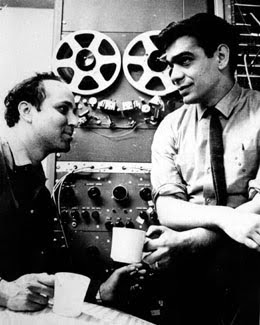
One of the founders of the SFTMC was Ramon Sender.  As a student I remember reading how Sender had used a tape recorder to reduce all of Wagner's Ring to four short clicks.  I assumed he would have done this by recording at a very slow speed and playing the tape back very fast.  Unfortunately, I don't remember where I read this; it was just a short reference.  Clearly the idea stuck in my brain.  (Update: See note from Sept. 2012 below.)

Recently I discovered a fascinating book called The San Francisco Tape Music Center, 1960s Counterculture and the Avant-Garde edited by David W. Bernstein.  It includes interviews with the principals of SFTMC:  composers, performers, equipment designers, dancers and light show artists.  Here's part of the interview with Ramon Sender.  He is discussing a very early three-head Ampex tape recorder:
I discovered that there was a tension adjustment on the reels.  You could actually put it in "record" mode, not turn on the track to travel, but just put on the tension adjustment, and the tape would creep very slowly.  That was when I started doing things like putting all of a Wagner opera on an eighth of an inch of tape.  I thought, wow I could sell this to conservatory students to help them do their assignments.  You want to listen to the Ring of the Nibelung?  Here, you can do it in a quarter of a second.
Fascinating!  Of course it's not as simple as he makes it seem.    First of all, tape moving that slowly on an analog tape recorder, the equivalent of 1 inch per day, would have no usable signal recorded on it.  When playing it back there would be all noise, a signal to noise ratio of zero.

Given the limited frequency response of his equipment, Sender's comment about helping students is an obvious joke.  In my mind, however, it is an admirable goal.  The students probably didn't really want to listen to the Ring in the first place.  I say hooray for audio Cliff's notes. 

Sender is also careful to say he did this only with "a Wagner opera" not with the entire Ring.   My best guess is that reducing the Ring of the Nibelung to four clicks, as reported in that book I read, was always a concept.  Sender's conceptual piece is easy to imagine and very communicative artistically, but at that time it was probably not worth the energy to turn it into actual audio.

As you can well imagine, I really like Ramon Sender's idea of compressing the Ring until it simply evaporates into a whiff of meaningless noise.  The problem of Wagner's excessively long music is solved.


THE ENTIRE RING IN FOUR CLICKS

In the sixties creative forward-looking musicians worked with early analog tape recorders and even earlier analog synthesizers and dreamed of an entirely new type of music.  In nearly every respect the music they dreamed up was completely unlike Wagner.

They were inspired by the new electronic tools at their disposal.  Maybe in their wildest, wildest dreams they imagined analog equipment would someday be supplanted by digital devices.   Could they have imagined that digital technology would become so ubiquitous and so portable and so powerful that anyone could accomplish the most complex audio editing almost anywhere.  If they did imagine that, then they probably didn't believe they'd live to see the day.  Turns out, they did.

In 2010 speeding up the entire Ring until it becomes four quick clicks is a rather trivial exercise.  I did it - and so could you - using the free program Audacity (highly recommended).  I repeatedly doubled the speed of each opera.  Just as with an analog tape machine, each doubling halves the length of the music and doubles the frequency, raising the pitch by one octave.  After about six octaves all resemblance to the original music disappears and only noise created by the inherent limitations of the equipment remains. 

I repeated this process sixteen times.  The final length is 1/1024th of the original.  Each opera lasts about a quarter of a second.  You'll be able to hear all four clicks in one second.  Theoretically the notes are sixteen octaves higher than the original.  With perfect fidelity the lowest audible frequency would have been transformed to over a half million cycles per second.  That is in the range of AM radio.  In reality nothing of Wagner  remains.  Instead of a time-saving subliminal way listen to Wagner, this process has simply removed all the content from his music.  Another problem solved.

Click here once to hear the entire Ring cycle as four clicks.  It'll only take a second.


THE ENTIRE RING, AT PITCH, IN SEVEN MINUTES

Recreating the tricks of old analog tape equipment is far from the only use for digital audio.  You can also manipulate sounds in ways which were inconceivable with analog equipment.  For instance, with digital audio you can change the pitch of music without changing the duration.  A good example of this, from pop music, would be AutoTune.  You can also change speed without changing pitch.  Making music slower is the idea behind 9 Beet Stretch which turns a seemingly interminable piece into an unbearably interminable one.

And, by making music faster, you can compress all of Wagner's Ring into a few minutes leaving mere hints of the original content.   That's what I've done.  Naturally a tremendous amount of musical information has been lost but you can still hear Wagner in there somewhere. 

For this realization I did seven halvings of the length of the Ring, making it 1/128th the length, keeping the pitches unchanged.  The result remains well within the frequency response of modern technology.  You can identify the occasional tonality, distinguish voices and instruments, hear loud and soft sections and generally get a feel for the flow of the music.   But it remains gobbelty-gook.  No way to solve that problem.

Click here to listen to the entire Ring cycle in seven minutes.


THE PROBLEM OF WAGNER'S RING 

Wagner's Ring is not a "problem" for opera queens and ring nerds.  More power to them.  But it can be a huge issue for an avant garde composer trying to face the unknown future of music who resents being pursued from behind by the continuing popularity and influence of this massive and vicious Romantic era monster.  Not all composers acknowledge the problem; not all composers are interested in the future.  Many are happy to imitate Wagner as best they can in hopes of getting their own operas performed.  Or of getting work writing movie scores.

Actually, I suspect most composers are simply oblivious.  They don't care about Wagner at all.  Much more power to them.

I'd like to end with a quote about Wagner's excessive influence as expressed by a composer who lived much closer to Wagner's time and is now regarded as one of the all-time greatest creative musical minds.  It was a time when Wagner was at the peak of his musical importance and the problem of finding a new non-Wagnerian future was most acute. 
The thing, then, is to find what comes after Wagner's time but not after Wagner's manner. 
Claude Debussy said this in his letters.  I found it quoted in Peter Yates' 1967 book Twentieth Century Music.

=-=-=-=-

After Leslie listened to the four clicks she remarked that some people might find even this version too long.

The transformational idea behind multiple octave changes reminds me of Frank Zappa's Big Note.

My own deconstruction of Wagner - or at least his one and only real contribution to pop culture - is called Wagner and Schubert Have Intercourse

Read about Burlesque of Nibelung which apparently happened a little over a month ago in downtown L.A.  Billed as "a naughty night of mythology, opera and high-brow burlesque hi-jinks", I suspect it's another unauthorized Ring Festival L.A. celebration.

ADDENDUM: I confess, the "Four Clicks" are not so much clicks as bursts of white noise.  But I distinctly remember that early book reference called the sounds "clicks" and I have kept the term.


September, 2012 ADDENDUM:  Thanks to Tom Service of the Guardian for linking to this post.

My original encounter with the idea of reducing Wagner, including the word clicks, is now available online.  It was from an article by Pauline Oliveros entitled Some Sound Observations, published originally in issue 3 of Source: Music of the Avant-Garde, 1966-1973 (page 136 of a 2011 reprint by UC Press and readable on Google.)  Here's what she wrote:
One's ideas about music can change radically after listening to recorded works at fast forward or rewind on a tape recorder. Ramon Sender arranged Wagner's Ring Cycle by a series of re-recordings at fast forward to four successive clicks.

3-Head Tags: . . . . . . . . . . . . . . . . . .