Saturday, June 26, 2010

Suppose Wagner Had Been Jewish

Much to their credit, Ring Festival LA has done a great deal to reinforce the image of Richard Wagner as an anti-Semite. This was probably not their initial intention. More likely they couldn't have cared less about publicizing Wagner's personal failings until their world was rocked by the Antonovich resolution.

Badmouthing their own Festival's artistic hero, Richard Wagner, probably made the job of introducing new listeners to his Ring Cycle more difficult. But as Ring Festival LA "leader" Barry Sanders said "We're not putting lipstick on a pig in this thing."

As a thought experiment, imagine how our contemporary musical world might be different today if Wagner had not hated Jews and instead had been Jewish himself.  Science fiction authors indulge in this sort of imagination all the time.  It's called Alternative History.

Had Wagner been born into a 19th-century German Jewish family he could well have had to convert to Christianity in order to have a successful career as a composer.  After his death he would not have inspired Hitler but instead been rejected by him simply because of his Jewishness.  This would have been true even if Wagner had composed the same identical operas.

Under the Nazis Wagner's music would have inevitably suffered the same fate as that of other Jewish composers.  It would have been completely banned.  It's even possible that today, in 2010, endless Wagnerian potboiling would have come to represent anti-Nazi resistance and maybe even gotten him included in L.A. Opera's now concluded Recovered Voices series which seemed to specialize in certain Jewish composers who wrote like Wagner.


Like all good premises for a book of alternative history this one might begin with a grain of truth.  Wagner himself wondered if he was actually of Jewish ancestry because he suspected that his stepfather, who could have been Jewish, was really his biological father.

Here's a quote from an article by Derek Strahan:
The question arises: was Wagner Jewish ? Or, to be more accurate in terms of the facts, did Wagner think he might be Jewish? Or, to be even more specific, did Wagner think he might be of Jewish descent? From which arises the even more germane question, was Wagner afraid that he might be thought to be Jewish? While the probable answer to the latter question is "yes", a definite answer to questions relating to his parentage could only be provided by conducting a DNA testing
We may well believe that Richard Wagner, author of self-serving diatribes against Jewish composers of his time, poster boy for German music under the Nazis, poster boy for anti-Semitism-forgiven by people who like his music in contemporary Los Angeles, might have believed that he himself was actually a Jew.  He certainly would not have wanted that to become public knowledge.

Such self-doubt must have been unbearable for him.  Did he live an agonizing double life, constantly in fear that he might be discovered?  Did he rationalize his baser personality traits - for example his adultery - on unavoidable Jewish character flaws?  It must have been hell being Richard Wagner.

You may wonder how a person who imagined he might be Jewish could write such anti-Semitic tracts as Wagner did.  It turns out that even real Jews can be anti-Semitic.   These people are called "Self-Hating Jews".

One notable self-hating Jew was Daniel Burros, a New Yorker who for a time belonged to George Lincoln Rockwell's American Nazi Party.  Later he joined the KKK where he rose to the rank of Kleagle (a more interesting job title than "leader").   In 1964, when Burros was publicly outed as a Jew by the New York Times, he committed suicide.  Reportedly he did this while listening to the music of ... (wait for it) ...  Richard Wagner.  How poetic.


Did Wagner's imagined Jewishness have any effect on his music?  Strahan's article suggests a few Jewish interpretations of Wagner's operas.  These are just as implausible as the endless discussions of anti-Semitic elements in those same operas.  To my ear there is nothing Jewish about Wagner's music itself.  (If you want to imagine Jewish Wagnerian music you could listen to Mahler.)

Much to my surprise the subject of whether Wagner wrote "Jewish music" came up in a Ring Festival L.A. press release earlier this year.  Here is the final paragraph from the release announcing Wagner and Anti-Semitism.  This was a symposium at the Hammer Museum held on Feb. 9, 2010.  No author of the release is mentioned.
Finally, can one venture to speculate about whether Wagner has indeed been, in certain ways, “good for the Jews”? That is, how have Jewish musicians, writers, and artists appropriated and deployed Wagner’s radical innovations for their own purposes, leading to otherwise unavailable transformations? (e.g., Schoenberg, as well as the various “Recovered Voices” composers – Schreker, Zemlinsky, Ullmann, Schulhoff, etc. – many of whom adored Wagner and composed very much in his wake, and used him to create “Jewish” works like Schoenberg’s Moses und Aron). Is there such a thing as a Jewish attraction to Wagner? And if so, how might we account for it? Might we even go so far as to suggest that there is something “Jewish” about his music, despite his own evident anti-semitism?
I confess to being knocked off my chair the first time I read this.  I wondered whether the very suggestion -- that Wagner's music was "Jewish" because several of his imitative followers were Jews -- was slyly anti-Semitic.   In reality those Jewish composers had suffered because they were German Jews not because they imitated Wagner.  Their Jewishness got their Wagnerian music consigned to the very backwaters of music history.

If it can be argued there was "Something 'Jewish'" about Wagner because he influenced Jewish composers, couldn't one argue that there was "Something National Socialist" about Wagner because he influenced Nazis?  

I briefly wondered if Ring Festival LA endorsed this crazy idea from one of their own press releases.  I also wondered if it was a troll intended to provoke an argument.  I concluded that it was just pseudo-academic speculation intended to blur the real issue: whether it's okay for Wagner's fans to ignore his political influence over generations of dangerous anti-Semites.  (my opinion: it's not okay.)

I didn't attend this symposium.  I just discovered that the Hammer museum has provided a nearly two-hour video of the event online. In Kenneth Reinhard's introduction he vaguely echos the bizarre press release.  That makes me wonder if he's the anonymous author who is suggesting that we need to discuss Wagner's Jewish music.  I was happy to discover that the particular subject did not come up.


(I suggest you let the long video download completely before watching.)

I'm also happy to report that I found the seminar fascinating.  The standard tropes about whether the Wagnerian plots or characters are anti-semitic got discussed (my opinion: they're not).  Also much energy was given whether it's time to quit talking about the subject of Wagnerian anti-semitism (my opinion: it's not).

I was extremely impressed with the comments of Leon Botstein.  In the performative sense he stole the show.  Also in the informative sense.  I found myself in complete agreement with a great deal of what he said.  I found more agreement with his notions of Wagner's proper place in modern culture or modern Los Angeles than with anything I've heard or read on the subject for the last year.  Botstein is a respected academic and talented orchestra conductor whose opinions carry a lot more weight than my own.

I'm going to close this post with selections from Botstein's opening remarks.  These begin at the 40 minute mark.  Clearly he was not reading from a prepared script.  You'll find him much more entertaining on video.
First of all, I don't think more productions of the Ring are necessary.  Not because he was an anti-Semite but because it's just boring
I was reminded, genius that Wagner was, I'm tired of this.  And I find its bombast and its inflated character hard to sit through.  And I also think ... there's nothing redeeming about this work and it needs to be put to rest.  There's so much more good music and good opera to be put on the stage.  I don't know why people are doing this any more.  ...
The only thing interesting about Wagner is the capacity to write brilliant musical prose and to repeat himself without musically losing your interest.  The craft of this composer is enormous.  And the innovation that he brought to the writing of music really has very few parallels in the history of music.  You can't avoid him if you're a musician.  But if you're not a musician I don't know what you're doing here.
Hooray for Leon Botstein!  Too bad that his opinions didn't get more widely reported.


You can read a dour review of the seminar here.

Here's an article about Daniel Burros and other similar cases.

A 1998 New York Times article, The Specter of Hitler in the Music of Wagner by Joseph Horowitz, speaks about Wagner's recognition of Jewish traits in himself:
If Wagner relied in practical ways on certain Jewish supporters, he also experienced a psychological dependency: the Jews embodied aspects of Wagner himself, aspects he wished to transcend and could not. The Jew in the mirror was the negative image of an unfulfilled personal identity.

A great alternative history novel -- about European Jews who settle in Alaska when the State of Israel does not survive - is called The Yiddish Policeman's Union by Michael Chabon.  It's a murder mystery.

Some other Mixed Meters writings on why Los Angeles is not a Wagner town.

Botstein Tags: . . . . . . . . . . . . . . . . . .

Sunday, June 20, 2010

Wagner Invades Poland

I've recently read a few descriptions of the music of Richard Wagner which struck me as true. Although these were not actually intended as arguments against Wagner's music, I think they work pretty well in that regard as well.

First is one of several reviews of L.A. Opera's Ring cycle by L.A. Times music critic Mark Swed. The title of this one is Mission Accomplished: L.A. Opera's 'Ring'. 

"Mission Accomplished" itself is arguable.  While the Opera's mission of producing a complete Ring was obviously accomplished, their goal, as stated in an early press release, of creating "a defining moment in the cultural history of Los Angeles" was not.  Los Angeles is no more of a Wagner opera town post-Ring than it was before.

Anyway, here are the first two paragraphs of Swed's review:
Sunday, midnight, Los Angeles Ordinance No. 181069, which is meant to close down numerous medical marijuana dispensaries around town, went into effect. No police, however, needed summoning to the Music Center. Los Angeles Opera shooed away its regulars by 11. Nine days earlier, the company had begun dispensing a drug with the street name of the "Ring" (short for its pharmaceutical appellation, "Der Ring des Nibelungen").

This opiate, invented in the 19th century by one Richard Wagner, is not, strictly speaking, a chemical substance. But it operates on the central nervous system like any other narcotic, altering perception, consciousness and sense of time. And, yes, it is highly addictive.

The comparison of Wagner's Ring to an opiate is apt.  Morphine and codeine are opiates you might have heard of; both are carefully controlled substances, dangerous in the wrong hands.

I've recently watched the effect of morphine on two terminally ill patients.  Although they seemed to feel no pain under its effect, it was not pleasant to observe them as they struggled to breathe their last breaths.  We wondered what dreams could penetrate such a drug haze.  From the objective external evidence it was difficult to convince ourselves that the drug had put these dear people into the pleasant, quiet reverie we wished for them.  It would be easier to imagine those drugged dreams came with a churning Wagnerian sound track.

Judging by stories of Ringnuts who attend uncountable numbers of Ring productions, Richard Wagner's Ring does seem to be "highly addictive".  Maybe the government should consider protecting its citizens from such a dangerous substance.


The Times theater critic Charles McNulty reviewed the Ring as well.  One of his articles was entitled Critic's Notebook: Götterdämmerung’ -- twilight of a hypnotic spectacle.  Here's his first sentence:
The end of the first complete cycle of Achim Freyer’s staging of the “Ring” for the Los Angeles Opera left me simultaneously energized and exhausted late Sunday night, as though I had just undergone intense hours of dreaming without the restorative benefit of sleep.
I wonder about the phrase "without the restorative benefit of sleep".   It makes me think that listening to this Ring was not an entirely pleasant experience for him and that he found himself uncontrollably and unpleasurably bouncing off the walls.

I do think the word "hypnotic" is revealing.  Hypnotism is a state of mind in which a subject is made to strongly focus on outside suggestions.  These suggestions might overwhelm their own  natural protective inhibitions.  Some people are more susceptible than others.  I've always felt that those who enjoy immersion in Wagner's music must be very accepting of his constant stressful flow of suggestive musical tensions and emotions.  Who knows what crazy ideas might come to mind from Wagner's unrelenting stream of innuendo.

I'm reminded of Woody Allen's hysterically immortal line:
I can't listen to that much Wagner. I start getting the urge to conquer Poland.
I'm now going to explain this joke in detail because I suspect some people take Wagner far too seriously to appreciate its humor.

You must first remember that Hitler, who was more strongly influenced by Wagner than any other evil military dictator in history, actually did conquer Poland, committing the most unspeakable atrocities along the way.  But Woody Allen is not Hitler.  He's the poster boy for underweight, meek neurotics everywhere and Jewish to boot.  It's completely impossible for him to invade Poland.  Like the Pope, Woody has no divisions. 

His absurd suggestion that he too might try to overrun Poland simply because he had heard too much Wagner creates a tension in the mind of a person who hears the joke.  Woody juxtaposes the silly with the horrific.  Many people find this jarring - and they spasm involuntarily in response. That strange human spasmodic behavior is called laughter.  Things which produce laughter are called funny, hence this joke is funny.  But it has a tinge of human suffering and catastrophe about it as well.  Laughter seems like a callous response.


I recently found a Facebook page named loosely after Woody's joke.  It's called When I Listen To Wagner, I Get The Sudden Urge To Conquer Poland  It's a public page which anyone can visit - but few people have left comments and as of this writing the last activity was eight months ago. 

There are a number of droll suggestions about using the joke as a motto for German language clubs in high schools.  And several people mention how they use Wagner's only authentic cultural meme, The Ride of the Valkyries, as a highly amplified inspirational soundtrack for driving dangerously.

But one quote struck me as unintentionally revealing of the true nature of the music of Richard Wagner.  In September 2007 someone named Nick Jacobs wrote:
I conducted selections from Der Ring des Nibelungen last semester at my college...you have no idea that power trip I was on at the time. It was wonderful.
A wonderful power trip from conducting Wagner?  Obviously conducting Wagner is an experience I'll never have, but Nick's comment seems quite revealing and believable.  Anyone could test this idea by turning up the volume on a recording of the Ring and pantomiming conductors patterning in front of the speakers.  It must be dangerously thrilling to control such a stream of powerful energy.  I bet James Conlon would understand completely.


To review:
  • Wagner has been described as an opiate.  
  • Wagner is revealed as a source of hypnotic suggestions.  
  • Wagner sends orchestra conductors on a power trip.  
All these notions fit with my own impressions of the music.  None of them would ever make me think producing Wagner's Ring is good for Los Angeles.  Or even that listening to Wagner's Ring is a positive thing to do.

In my wildest imagination Wagner would be regulated.  You would not be allowed access to Wagner without a prescription from a pyschiatrist and a clearance from a Doctor of Music.  Wagner recordings would be locked up behind the counter in record stores (if any record stores survive).  There would be an age limit like for attending certain movies.

None of this is likely to happen because no one pays attention to what I think.  But if they did, I'm sure the people of Poland would be eternally grateful.


Opiated Tags: . . . . . . . . . . . . . . . . . .

Thursday, June 17, 2010

Wagner Inspires Pop Music

This was going to be part of Kenton Wagner, the previous post.  Then I decided that, when speaking of Wagner, brevity is a virtue.  So this became a separate entry.

1. WAGNER INSPIRES PUNK

The Los Angeles Times has been sending various performing arts critics to L.A. Opera's Ring performances. The current pop music critic is named Ann Powers (a name I had never noticed previously.)  She wrote this about the third opera in the cycle, Siegfried.

The blond hair of the title character reminded her of a certain punk rock figure.
Yet the mad twinkle in heldentenor John Treleaven's eyes -- not to mention his neon-yellow wig -- brought Johnny Rotten to mind, as Achim Freyer's reinterpretation of this classic hero's journey did something really unexpected, establishing a link between Richard Wagner and punk.

Her argument is that visual aspects of this particular production of Wagner reminds her of comic book heroes.  And comics were inspiring to the punk generation.  And so I guess she is implying that Wagner must have had this in mind all along.  Or maybe that all punk tunes are based on Wagnerian harmonies and Norse mythology?

Or maybe she just needed to fill out her review with familiar references.

Did you know that Cab Calloway was a great admirer of Wagner's Ring?


2. WAGNER INSPIRES HIP HOP

Ring Festival L.A. has its own original popular music arrangement of Wagner's scores on tap this coming Saturday, a concert by the deKah Hip Hop Orchestra.

This was originally advertised, before the Antonovich resolution, as "a new work inspired by the revolutionary spirit of Wagner".  Now the attitude has apparently been recast with Wagner as less of a hero.   Here's the current description (from the Ring Festival LA brochure):
Double G (daKAH’s co-founder/conductor/composer, Geoff Gallegos) is creating a new sound track, one that acknowledges a more sinister side of the Ring and marries it to distinctly LA flavors. Derived from source material within the Ring, Double G envisions his music will speak, in the most visceral of ways, of contemporary atrocities in LA. If Wagner was alive and writing a score for this city’s brand of “warfare,” this is how it would sound, adrenaline-pumping, fear-inducing and gut-wrenching. Double G’s work will reflect the intensity of both Wagner’s Ring cycle and, appropriately, the West Coast brand of Gangsta Rap.
Edgy. 

I found this video of Double G himself. Some clues as to what he's going to do to Wagner.


3. WAGNER INSPIRES HIP HOP AGAIN

In this short video clip Robin Williams, noted social commentator, speaks to the issues of Wagner and Hip Hop.


Leela, Peela!!


4. WAGNER INSPIRES MILES AND SUN RA

Another Wagner/pop music event, last year in Slovenia, came to my attention via the Internet.   It's called VolksWagner.  Yes, that's Volks as in Volkswagen.  It was created by someone/something called Laibach.

Westminster Gold album Die Walkure by Wagner - naked woman with VW hubcaps
Here's part of the description:
the collaborating artists have decided to seek in Wagner the rudiments of modernism, which first through Mahler, Bruckner, and Debussy, and subsequently through Schöenberg, Berg, and Webern, developed into the core of the jazz music of the sonic experimentalists, such as Miles Davis and Sun Ra, and to upgrade them with the ambient electronic spectrum that has been developing over the last three decades. In addition, the suite will address the history of the 20th century – modernism crossbred with pop art.
Apparently, someone, somewhere thinks every popular musician in the whole world during the last 150 years somehow owes their musical style to Richard Wagner.  What a sad world it would be if that were true.

Look, this picture proves that Louis Armstrong was a big fan of Wagner's Ring. 


The Rheingold ad came from here.

Read the first post about Wagner and popular music: Kenton Wagner

Robin Williams comes from a documentary Chuck Jones, Extremes and Inbetweens  in which Jones says:
I've never met anybody who could sit through the entire Ring of the Nibelung and come out sane.  Or even alive, for that matter.

Pop Wagner Tags: . . . . . . . . . . . . . . . . . . . . . . . . . . .

Wednesday, June 16, 2010

Kenton Wagner

This is the first of two posts about how composer Richard Wagner has inspired popular music.   Jump to the other one.

A few posts back I wrote about composer Ramon Sender and his conceptual reduction of Wagner's Ring down to four quick clicks. You can read that post, Listen To Wagner's Entire Ring Cycle In One Second.   It includes my audio realization of his idea and more.

In the early sixties, about the same time that Sender was working in San Francisco, a certain Southern California composer (and famous big band leader) was working on his own personal spin to Wagner's music.

That would be Stan Kenton (1911-1973), who recorded an album entitled Kenton Wagner (sometimes called "Kenton Plays Wagner"). The subtitle is "From the Creative World of Stan Kenton Come Innovations on Great Wagnerian Themes". There are eight Kenton arrangements of famous Wagnerian moments.


According to this site by Terry Vosbein, the album was recorded during four evening sessions in September 1964, plus a solo piano session in October.  The ensemble was 5 saxes (alto, 2 tenors, bari and bass - someone doubles on piccolo), 5 trumpets, 4 trombones, tuba, piano, bass, drums, percussion - plus 5 French Horns. (How could you do Wagner without horns?)  The album itself does not credit any players, producers, engineers, copyists - no one except the guy who wrote the program notes, Noel Wedder.

Musically, I've always regarded Stan Kenton as part of the problem not part of the solution.   His arrangement style for big band, lush and brash in equal measure, came across as mostly just thick and loud in my ears.  A place where sax vibrato and screech trumpets run riot.  Apparently the Kenton style continues to be very influential in the world of big bands and higher education.

Kenton, like so many other successful popular musicians, apparently thought of himself as a serious composer.  I found this description of him here:
[Kenton] could rhapsodize, in his halting speech pattern, about musical creativity and innovation in a very erudite manner. He always referred to the band as the "orchestra" and to a song as a "composition" or a "theme," never a "tune."
The liner notes to Kenton Wagner describe a formative chance encounter with Maurice Ravel in a Chicago jazz club about 1930.  Then the period after Kenton's early success with the Artistry in Rhythm band is discussed.
Over the next ten years Stan and chief arranger Pete Rugolo became convinced that the only way to make their modern music survive was to experiment with the complex ideas of the classical school and to fuse them along new thematic and harmonic lines.
To that end Kenton created the Innovations in Modern Music Orchestra.  A boring name indeed but it did include 16 string players so the term orchestra was accurate.  His most modern offering was the 1951 album City of Glass, Stan Kenton Plays Bob Graettinger.  Graettinger composed for the Kenton band using the twelve-tone technique. That's a pretty out-there idea for 1951. The album is fascinating and curious.  And WAY ahead of its time.  Graettinger died a few years later, still in his thirties.


While my opinion of Kenton did improve somewhat when I discovered City of Glass, nothing is going to improve my opinion of the album Kenton Wagner.  It's like listening to an automobile accident - you can't stop listening and you just know nothing good is going to happen.

As expected there's a lot of bluster in the brass with occasional piano solos as contrast.  The players show almost no swing feel and get no improvised solos.  Unlike City of Glass, the musical textures are remarkably unvaried throughout.   It's as though Kenton was afraid to really mess with Wagner beyond occasionally adding a latin rhythm or updating a few harmonies.

One cut, the Wedding March, starts out with a kind of funereal drumbeat and distant muted trumpets - some musical marriages are like that, I guess.  I don't see how this album could appeal either to opera fans or jazz fans.

Of course, I'm telling you about Kenton Wagner now because Los Angeles has a mild case of Richard Wagner disease at the moment.   The L.A. Opera is holding a low-budget county-wide Wagner festival to coincide with their performances of the complete Ring.   Shamefully, it was endorsed by the County Supervisors.  This is another of my raspberry contributions to the festival.


Kenton Wagner is not in print.  LP copies seem to be selling for about $65 to $70.   (You could make me an offer for mine.)   I've made it a rule to only post my own music on Mixed Meters, but I'm making an exception of one cut from this album so you can formulate your own opinion.   (Eventually I'll delete the file.)

Ladies and Gentlemen, I present Ride of the Valkyries by Richard Wagner as arranged by Stan Kenton.   Listen to it here.   Enjoy.  In my mind this arrangement and performance can only be described as - bloodless.  Also loud.


Wagner himself would most certainly hate it.   If there is a Hell (which I personally doubt) Richard Wagner is there being forced to hear this album over and over for all eternity.   Or at least he must listen as long as the Ring of the Nibelungs lasts - whichever is longer.   It's a punishment well matched to his crimes.

Mixed Meters' three regular readers know full well that I don't like Wagner's music.  And now they also know that I don't much like Kenton's.  If I must make a choice between Wagner's original and Kenton's unoriginal I really would rather listen to Wagner.  The Kenton is that bad.


Here's a wonderful Ride of the Valkyries video.

This video is
  • NSFW (Not Safe for Work),
  • NSFCIUS (Not Safe For Children in the United States),
  • NSFPRWRMR (Not Safe For Prudish Right Wing Religious Moralist Prigs) and
  • NSFPWOTTOOW (Not Safe For People Who Object To The Objectification Of Women).
For the rest of you, prepare to watch a battalion of sexy topless female skydivers selling washing machines to Europeans to the accompaniment of Richard Wagner.  Enjoy.


Musically, I really like the cut to the jazz muzak at the very end.  It puts the Wagner bombast into proper context.


A large Stan Kenton Collection exists at the University of North Texas - but only a list of holdings appears to be online.  They also have a Bob Graettinger archive. UNT offered the first ever degree in jazz studies.  Can you guess when that was? (1947)

Kenton used a Mellophonium section in some of his bands.   A what?  Read about it here.

Here's a more positive review of the Kenton Wagner album which doesn't have many good things to say about it either.

Thanks to the pseudonymous John Marcher of the blog A Beast In The Jungle for alerting me to this Fleggaard video.

Read the Mixed Meters post Wagner Inspires Pop Music

Jazz Study Tags: . . . . . . . . .

Wednesday, June 09, 2010

Composers of the Nazi Era

I recently finished reading the third book of the trilogy by Michael H. Kater about musical life in Nazi Germany.  His three books are:
  • Different Drummers, Jazz in the culture of Nazi Germany (1992)
  • The Twisted Muse, Musicians and their Music in the Third Reich  (1997)
  • Composers of the Nazi Era, Eight Portraits (2000)
You can buy all three in a bundle  from Amazon for $260.82.


Different Drummers was the most fascinating to me.  This is because the Nazis were largely unsuccessful in controlling the people's desire for popular music, swing jazz.   Jazz was anathema to Hitler and his cronies who viewed it as Jewish and Black (i.e. racially inferior).  Once in power they worked hard to repress the thriving Weimar jazz scene.  Read more here.

Still, it seemed that the people's attraction to this music was stronger than the government's ability to ban it and the Nazis were forced to meet the public demand for jazz as best they could.  Jazz also became a focal point for anti-Nazi resistance -- most amazingly by Hamburg's Swing Kids.  (More info here.)


The second book, The Twisted Muse, deals with classical music under the Nazis.  It is largely a story of governmental bureaucracy.  Along with their belief in the supremacy of German people over everyone else, the Nazis leaders believed in the supremacy of German music.  They were big time classical music fans, especially of opera.

Using dictatorial powers, they promoted (or demoted) composers, conductors, singers, orchestras and opera companies, according to personal tastes and dogmatic bigotry.  They worked this magic through an official government agency called Reichsmusikkammer (Reich Chamber of Music).  Meanwhile, Jewish musicians were forced into separate organizations through the JĂĽdischer Kulturbund (Jewish Culture League).  Jews were prevented from performing "true" German music.

Such official meddling in the arts should make us feel fortunate that the US government ignores the arts as much as it does.  One of my earliest Mixed Meters posts, In Which David Imagines George Bush and Charles Ives, was written after reading this book.


The eight subjects of Composers of the Nazi Era all appeared in The Twisted Muse as well.  Instead of getting bit parts in a complex story which ends in 1945, this book gives each composer a complete career biography.   Those who lived under the Nazi regime were all forced to justify themselves after the war in order not to completely lose their musical careers under the new political system.  The stories of how they revised their biographies and recast their personal histories, often with outright lies, to make themselves seem less involved with the Nazis is the most interesting part of Composers of the Nazi Era.

Here are the eight composers Kater chose for his book, along with my short biographical sketches.
  • Werner Egk became an official of the Nazi's Reich Chamber of Music and was called "a worthy successor to Richard Wagner" by Hitler himself, but managed a successful post-war career.
  • Paul Hindemith didn't really want to leave Germany but his early atonal music colored his reputation with the Nazis - who also didn't like that he was married to a half-Jew - and they banned his music.
  • Kurt Weill, forced out of Germany in 1933 because he was Jewish, became a hugely successful composer in the US and then spent a good deal of his time pursuing sexual affairs.
  • Karl Amadeus Hartmann, a composer with leftist political sentiments, gave up his career as composer during the Nazi years and as a result was a safe choice for appointment by the Allies to post-war positions of musical authority.
  • Carl Orff, composer of that one big popular hit, was still distrusted by the moralistic Nazis.  At their request he attempted to compose replacement music for Mendelsshon's "Jewish" A Midsummer Night's Dream.  Orff hid the fact that he was one-quarter Jewish and after the war falsely claimed to have been part of the anti-Nazi resistance.
  • Hans Pfitzner was a composer with medium talent paired with an oversized ego. He was an early and life-long supporter of the Nazis and an anti-semite.  Since Hitler had personally decided (erroneously) that Pfitzner must be half-Jewish (after Pfitzner defended a few talented Jewish musicians), Pfitzner never got the respect and recognition he was certain he deserved.
  • Arnold Schoenberg, forced to leave Germany because of his religion, was, like Pfitzner, hugely egotistical and concerned with his place in the history of music.  This biography deals mainly with Schoenberg's years of stagnation in Los Angeles.
  • Richard Strauss, the greatest German composer of the times who possessed a correspondingly large ego, tried at first to accommodate the Nazi regime.  But he was a lightweight politician and gradually lost favor with the Nazis.  They resented both that Strauss' son had married a Jewish woman (which meant Strauss' grandchildren were Jewish) and that his favorite librettist was Jewish.

Michael Kater writes in the conclusion of Composers of the Nazi Era that he decided to write this book of biographies as a sequel to his two earlier exhaustive narrative histories because of the "often seemingly contradictory patchwork-quilt [of] evidence" making it impossible to describe any character as fully guilty or fully innocent.
One and all -- musicians and singers, composers and conductors, all of whom had to make a living as artists in the Third Reich -- emerged in May 1945 severely tainted, with their professional ethos violated and their music often compromised: gray people against a landscape of gray.

He also tries to explain how the Germans came to take their music so seriously.
Certainly until 1945, the Germans as a people... defined themselves and their history decisively through Kultur -- they say they always had it, and nobody else did.  In their collective view, this is what set them apart from materialistic British moneybags, degenerate French hedonists, insensitive American pragmatists, work-shirking Italian fools, and the alcoholized denizens of a half-Asiatic Russian empire.  Moreover, nothing in the German mind has defined Kultur so quintessentially as its music -- German music.
The most terrifying exponent of genuine music as exclusively German was Hans Pfitzner, who throughout the 1920s sharply polemicized against all the enemies "of our national art, especially music."  Once in power, through their various propaganda speeches, the Nazi leaders made very sure that they understood well Richard Wagner's original dictum that "the German has the exclusive right to be called 'musician.'"  Germany was "the first music nation in the world," insisted Reich Propaganda Minister Goebbels.
What moral, I hear you ask, do I draw from all this ancient musical history? What am I, as a pragmatic (and probably insensitive) American Jewish musician, to think of the moral dilemmas and social upheavals endured by German musicians between 1933 and 1945?   Their story is so singular that I have to question whether any comparison at all can be made with contemporary times.

My answer lies in the notion that music can somehow represent universally knowable "higher" religious, spiritual or nationalistic truth - that's what the Nazis believed.  This idea seems vestigal in my day and age.  It's different than simply liking or disliking music.  It's about the (mistaken) belief that music somehow contains certain essential, substantial revelations which are the same for everyone who hears it and which don't change through history. 

Such a faith still lives primarily in a subset of the classical music audience, they who reverently gather, church-like, in concert halls and opera houses to hear their musical "gospels" sung and played.  I suspect that these listeners would agree with the notion that certain music is good for you, ennobling.  And if some music is good, I suppose it follows that some other music is bad, degenerate.  This attitude is the beginning of a slippery slope.  At the bottom of that slope you will find the story of how the Nazis used and abused music. 

 
Portrait Tags: . . . . . . . . . . . . . . . . . . . . . . . .

Monday, May 31, 2010

Nineteen Years and a Couple of Months

Today is Memorial Day, in which we remember those who have died in wartime.

I took this picture in South Pasadena. There are plaques for servicemen who died in Vietnam just off Fair Oaks Boulevard in War Memorial Park. Terry Brooks Dyer appeared to be the youngest of a small handful.


This man was less than one year older than I.  He was killed less than one year after he would have graduated high school.   Of course I didn't know him, but seeing this memorial to him made me very sad.   War is followed by lifetimes of might-have-beens.

Someone needs to remind me why we fought in Vietnam.   Would anything today be different if we had won?

Memorial Tags: . . . . . .

Saturday, May 29, 2010

Listen to Wagner's Entire Ring Cycle in One Second

Today is the first performance of L.A. Opera's complete production of Richard Wagner's endless four-opera cycle The Ring of the Nibelung.

Yesterday L.A. Opera announced that ticket sales for the Ring cycles are not meeting expectations. Their overall budget is falling another million dollars short.  Maybe a million and a half.  Their excuses include the volcano in Iceland.  Personally I think the Gods must be angry.  (Read the financial story at the L.A. Times)

The Opera is also holding Ring Festival L.A., a favorite topic at Mixed Meters. You can read about it here and here and here and here and here.  Or not.

This post is my contribution to Ring Festival L.A.  They're not likely to be thrilled.  It is inspired by the work of one California composer who, almost 50 years ago, dealt conceptually with the problem of Wagner's Ring.  I gather that his idea was never completely realized in sound. Maybe this is the first time.


BACKGROUND

From 1962 through 1966 there was a flowering of avant garde music right here in California at a place called the San Francisco Tape Music Center.   It was a labor of love by a small group of young composers who existed in the vortex of counter-culture energy and revolution which, only a few years later, would give us Flower Power, the Summer of Love and the Grateful Dead.

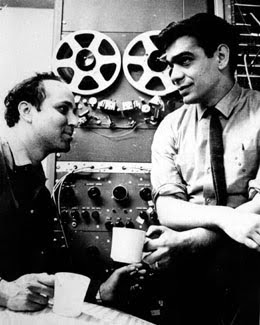
One of the founders of the SFTMC was Ramon Sender.  As a student I remember reading how Sender had used a tape recorder to reduce all of Wagner's Ring to four short clicks.  I assumed he would have done this by recording at a very slow speed and playing the tape back very fast.  Unfortunately, I don't remember where I read this; it was just a short reference.  Clearly the idea stuck in my brain.  (Update: See note from Sept. 2012 below.)

Recently I discovered a fascinating book called The San Francisco Tape Music Center, 1960s Counterculture and the Avant-Garde edited by David W. Bernstein.  It includes interviews with the principals of SFTMC:  composers, performers, equipment designers, dancers and light show artists.  Here's part of the interview with Ramon Sender.  He is discussing a very early three-head Ampex tape recorder:
I discovered that there was a tension adjustment on the reels.  You could actually put it in "record" mode, not turn on the track to travel, but just put on the tension adjustment, and the tape would creep very slowly.  That was when I started doing things like putting all of a Wagner opera on an eighth of an inch of tape.  I thought, wow I could sell this to conservatory students to help them do their assignments.  You want to listen to the Ring of the Nibelung?  Here, you can do it in a quarter of a second.
Fascinating!  Of course it's not as simple as he makes it seem.    First of all, tape moving that slowly on an analog tape recorder, the equivalent of 1 inch per day, would have no usable signal recorded on it.  When playing it back there would be all noise, a signal to noise ratio of zero.

Given the limited frequency response of his equipment, Sender's comment about helping students is an obvious joke.  In my mind, however, it is an admirable goal.  The students probably didn't really want to listen to the Ring in the first place.  I say hooray for audio Cliff's notes. 

Sender is also careful to say he did this only with "a Wagner opera" not with the entire Ring.   My best guess is that reducing the Ring of the Nibelung to four clicks, as reported in that book I read, was always a concept.  Sender's conceptual piece is easy to imagine and very communicative artistically, but at that time it was probably not worth the energy to turn it into actual audio.

As you can well imagine, I really like Ramon Sender's idea of compressing the Ring until it simply evaporates into a whiff of meaningless noise.  The problem of Wagner's excessively long music is solved.


THE ENTIRE RING IN FOUR CLICKS

In the sixties creative forward-looking musicians worked with early analog tape recorders and even earlier analog synthesizers and dreamed of an entirely new type of music.  In nearly every respect the music they dreamed up was completely unlike Wagner.

They were inspired by the new electronic tools at their disposal.  Maybe in their wildest, wildest dreams they imagined analog equipment would someday be supplanted by digital devices.   Could they have imagined that digital technology would become so ubiquitous and so portable and so powerful that anyone could accomplish the most complex audio editing almost anywhere.  If they did imagine that, then they probably didn't believe they'd live to see the day.  Turns out, they did.

In 2010 speeding up the entire Ring until it becomes four quick clicks is a rather trivial exercise.  I did it - and so could you - using the free program Audacity (highly recommended).  I repeatedly doubled the speed of each opera.  Just as with an analog tape machine, each doubling halves the length of the music and doubles the frequency, raising the pitch by one octave.  After about six octaves all resemblance to the original music disappears and only noise created by the inherent limitations of the equipment remains. 

I repeated this process sixteen times.  The final length is 1/1024th of the original.  Each opera lasts about a quarter of a second.  You'll be able to hear all four clicks in one second.  Theoretically the notes are sixteen octaves higher than the original.  With perfect fidelity the lowest audible frequency would have been transformed to over a half million cycles per second.  That is in the range of AM radio.  In reality nothing of Wagner  remains.  Instead of a time-saving subliminal way listen to Wagner, this process has simply removed all the content from his music.  Another problem solved.

Click here once to hear the entire Ring cycle as four clicks.  It'll only take a second.


THE ENTIRE RING, AT PITCH, IN SEVEN MINUTES

Recreating the tricks of old analog tape equipment is far from the only use for digital audio.  You can also manipulate sounds in ways which were inconceivable with analog equipment.  For instance, with digital audio you can change the pitch of music without changing the duration.  A good example of this, from pop music, would be AutoTune.  You can also change speed without changing pitch.  Making music slower is the idea behind 9 Beet Stretch which turns a seemingly interminable piece into an unbearably interminable one.

And, by making music faster, you can compress all of Wagner's Ring into a few minutes leaving mere hints of the original content.   That's what I've done.  Naturally a tremendous amount of musical information has been lost but you can still hear Wagner in there somewhere. 

For this realization I did seven halvings of the length of the Ring, making it 1/128th the length, keeping the pitches unchanged.  The result remains well within the frequency response of modern technology.  You can identify the occasional tonality, distinguish voices and instruments, hear loud and soft sections and generally get a feel for the flow of the music.   But it remains gobbelty-gook.  No way to solve that problem.

Click here to listen to the entire Ring cycle in seven minutes.


THE PROBLEM OF WAGNER'S RING 

Wagner's Ring is not a "problem" for opera queens and ring nerds.  More power to them.  But it can be a huge issue for an avant garde composer trying to face the unknown future of music who resents being pursued from behind by the continuing popularity and influence of this massive and vicious Romantic era monster.  Not all composers acknowledge the problem; not all composers are interested in the future.  Many are happy to imitate Wagner as best they can in hopes of getting their own operas performed.  Or of getting work writing movie scores.

Actually, I suspect most composers are simply oblivious.  They don't care about Wagner at all.  Much more power to them.

I'd like to end with a quote about Wagner's excessive influence as expressed by a composer who lived much closer to Wagner's time and is now regarded as one of the all-time greatest creative musical minds.  It was a time when Wagner was at the peak of his musical importance and the problem of finding a new non-Wagnerian future was most acute. 
The thing, then, is to find what comes after Wagner's time but not after Wagner's manner. 
Claude Debussy said this in his letters.  I found it quoted in Peter Yates' 1967 book Twentieth Century Music.

=-=-=-=-

After Leslie listened to the four clicks she remarked that some people might find even this version too long.

The transformational idea behind multiple octave changes reminds me of Frank Zappa's Big Note.

My own deconstruction of Wagner - or at least his one and only real contribution to pop culture - is called Wagner and Schubert Have Intercourse

Read about Burlesque of Nibelung which apparently happened a little over a month ago in downtown L.A.  Billed as "a naughty night of mythology, opera and high-brow burlesque hi-jinks", I suspect it's another unauthorized Ring Festival L.A. celebration.

ADDENDUM: I confess, the "Four Clicks" are not so much clicks as bursts of white noise.  But I distinctly remember that early book reference called the sounds "clicks" and I have kept the term.


September, 2012 ADDENDUM:  Thanks to Tom Service of the Guardian for linking to this post.

My original encounter with the idea of reducing Wagner, including the word clicks, is now available online.  It was from an article by Pauline Oliveros entitled Some Sound Observations, published originally in issue 3 of Source: Music of the Avant-Garde, 1966-1973 (page 136 of a 2011 reprint by UC Press and readable on Google.)  Here's what she wrote:
One's ideas about music can change radically after listening to recorded works at fast forward or rewind on a tape recorder. Ramon Sender arranged Wagner's Ring Cycle by a series of re-recordings at fast forward to four successive clicks.

3-Head Tags: . . . . . . . . . . . . . . . . . .

Saturday, May 22, 2010

A Combination of Jingle Bells and The Internationale

Mixed Meters returns to the airwaves with my Jingle Bells-related musical offering for the 2009 holiday season. Listen to A Combination of Jingle Bells and The Internationale by clicking here.  Or keep reading.


It has become a yearly Mixed Meters holiday tradition to compose and post a piece of music based on Jingle Bells.  The previous pieces are

Why Jingle Bells?  Because it's simple, everyone can identify it instantly and it has an unassailable association with our greatest annual holiday of corporate marketing and excess consumption.


Why Christmas?  Because, as a non-Christian, every year Christmas music makes me feel isolated and this is my way of taking a bit of control over it.  If you like traditional Christmas music, seriously, you won't like these pieces.

Why am I posting this in May?  Because here at Mixed Meters time has no meaning and the new piece wasn't finished until the end of January anyway.  Things happen when they happen.


What's with the title? The title  A Combination of Jingle Bells and The Internationale directly reflects the structure of the music.  These two familiar themes are presented prominently (but not lovingly) within the texture of the music, in combination.

Why two themes?  By combining two famous themes, which I chose more for their cultural references  than for their musical content, I hope to create some sort of meaningful dialogue expressed through music.  It's an audacious attempt and not entirely successful except for the occasional listener who cares passionately about the themes themselves.   Most often a composer who wants to convey meaning just adds text or lyrics.

Anything else besides the two themes? Yep. There's plenty of my original material as well.  The most notable being a melodic fragment which reappears several times.  You'll hear that first at 2 minutes 19 seconds.

Previously I did a similarly two-themed piece called Wagner and Schubert Have Intercourse.


What's The Internationale? The Internationale is a musical anthem of socialist and communist movements.  At one time it was the national anthem of the Soviet Union.  It is not as universally recognizable as Jingle Bells unless you happened to grow up in a Communist country.  If you're not familiar with it, I suggest you listen to one or two of the mind-boggling number of recordings found at a website called Russian Anthems Museum.

The Internationale appears first in A Combination of Jingle Bells and The Internationale at one minute and 17 seconds.  All the music up to that point is my own.

Here are a few lines of lyrics, with which no real American could ever agree, from verse 3 of The Internationale:
The state oppresses and the law cheats
The tax bleeds the miserable
No duty is imposed on the rich
'Rights of the poor' is a hollow phrase

What other melody did The Internationale remind you of? As I was composing I couldn't help but notice similarity to a theme by Johannes Brahms.  The Brahms will be familiar to ex-clarinetists everywhere.  What the heck, I put that in too.  (No idea what I'm talking about?  Listen to the first 10 seconds of this and then listen to A Combination of Jingle Bells and The Internationale at 3'38".)

Why The Internationale?  Because, as an anthem of godless communism, it seems like a good opposite to the anthem of godly capitalism, Jingle Bells.  And having it be in the public domain helps me avoid any capitalist guilt.


What does Sergei Kuryokhin have to do with this piece?  Kuryokhin was a Soviet pianist, composer and avant-gardist who passed away in 1996.  Last December, when I was casting about for a theme to pair with Jingle Bells (and also planning to write my post Sergei Kuryokhin - Pianist of Anarchy) I heard The Internationale referenced in two of his large ensemble performances recorded in 1988.  "Perfect," I thought.  The words "A Combination..." in my title are a small homage to Kuryokhin's wonderful solo piano album Some Combinations of Fingers and Passion.


What does Che Guevara have to do with this piece?  Nothing.  But I needed pictures for this post and Che, an icon of communism, has become a potent icon of capitalism.  That duality seems to reflect the two themes in my piece.  I previously discussed Che-based marketing in my MM post Che's Brand.

The Rolex ad shows him wearing a watch that today would cost at least $5,000.  (Anyone want to contribute a translation of the German?)  It came from here.  The Peter Griffin/Che Guevara drawing came from here.  The Mad Magazine cover came from here.  The woman wearing only carrot bandoleros is apparently Che Guevara's granddaughter in an ad for PETA.  Read about it here.  The Photoshopped Che Visa card came from here and the Che Santa from here.


No more delays.  It's now time to listen.  A Combination of Jingle Bells and The Internationale  327 seconds  Copyright © 2010 David Ocker

As an encore here are two non-Jingle holiday related pieces of mine from the first Mixed Meters Christmas season.  They were written in the same Christmas spirit as the others.  (Yes, the first dozen seconds of these two pieces are identical.  The titles are both apocryphal lyrics from the song Winter Wonderland.)
  • And Pretend That It's A Circus Clown (read or listen) 2005, 36 sec.
  • Until The Alligators Knock Him Down (read or listen) 2005, 40 sec.
And then there's this solo bass clarinet arrangement of a piece often heard at Christmas.  The performance is from 20 years before Mixed Meters was born.


Wednesday, May 05, 2010

Zappa Symphonies

I doubt there is a stranger coincidence among musicians' names than that of Francesco Zappa and Frank Zappa.  Francesco was an 18th century Italian cellist and composer who gathered just enough mentions in history books and left behind just enough manuscripts to avoid being completely forgotten.  The dates of Francesco's birth and death were never recorded.  We only know that he "flourished" between 1763 and 1788 and lived for a long time in the Netherlands.  Frank Zappa was a 20th century guitarist and composer who flourished almost exactly two hundred years later - give or take a few.  According to Frank the two were not related.

I worked for Frank Zappa from 1977 to 1984.  Near the end of that time I was heavily involved in the creation of Frank's Synclavier album entitled Francesco Zappa.  That's the only reason a new commercial release by a period music ensemble of any of Francesco Zappa's music would be of the slightest interest to me. 

Frank Zappa's Francesco Zappa album claimed to have been Francesco's "first digital recording in over 200 years".  But the recent PentaTone album by the New Dutch Academy Orchestra conducted by Simon Murphy really is more deserving of the title "the first recording of the music of Francesco Zappa".  And it too is digital.


I am not certain what the exact album title is.  As you can see from the cover, the phrase Zappa Symphonies gets the most space, but Francesco is only one of five composers.  Francesco gets billing higher than Mozart whose music is also included.  Maybe the name "Zappa" is enough to get this album filed under Rock and Roll in any still-functioning record stores. Or maybe there's a Zappa fan somewhere dumb enough to purchase this disc thinking he was getting newly discovered outtakes from the '88 band.

Printed on the disc itself the album is entitled Symphonies from the 18th Century Court of Orange in The Hague - Zappa, Stamitz, Schwindl, Graaf and Mozart.  That's a pretty good description.  You should know that the Stamitz on this album is not the famous Stamitz, it's his son (who may have been named Dweezil for all I know.)

On the second page of the program book there is an even longer-winded album title:

Crowning Glory
The Musical Heritage of the Netherlands
Dutch Crown Jewels:
Symphonies from the 18th Century
Court of Orange in The Hague
Zappa, Stamitz, Schwindl, Graaf and Mozart

I think we should just call the album Zappa Symphonies.

Zappa Symphonies is a survey of music created at a particular time, roughly defined by Francesco's flourishing almost 250 years ago, and a particular place, the royal court in The Hague.  Clearly The Hague was an advanced center of arts and culture.

Compare that to, say, Los Angeles during the same period.  Around here the natives were just starting to reap the "benefits" of early Spanish missionaries.  The Indians were talked into giving up their earthly paradise in exchange for the promise of another in the next life.  And so the Europeanization of L.A. began.  A long time would pass before Los Angeles started to think it needed classical orchestra music.  And we've happily imported music from Europe ever since. 

As a resident of Los Angeles I can only marvel at what it must be like to live in a place with a such a long local musical tradition as Zappa Symphonies reveals.  It seems entirely reasonable that Dutch musicians would want to preserve their tradition and share it through concerts and recording.  


The New Dutch Academy, as revealed by their recordings and their pictures, is a dedicated group of talented, young, beautiful people.  They call their instruments "authentic", a strange choice of words.  I think I would call the instruments "original" or "period" or maybe just "old".  Listening to this album, however, you could easily miss this aspect.  They clearly have overcome the habitual limitations of authentic instruments and, measured by any contemporary standard, perform at an extremely high level.  You can hear their live recordings on their website.

My biggest disappointment about the album is that the music itself is pretty dull.  Of course I'm comparing these unknown pieces to the great Mozart and Haydn symphonies which appeared just a few decades later - there's no way for me not to make such a comparison.  Unless you are specifically interested in the development of the modern symphony, or music in 18th century Holland, or music by composers with namesakes who lived two centuries later, or in finding out how good performance on period instruments can be, this album falls rather unceremoniously into the category of generic classical instrumental music.  As such, it ought to be a great hit on many of America's remaining classical music stations - especially during drive time.

You might wonder how I could describe any album with music by Wolfgang Amadeus Mozart, one of my favorite composers, as dull.  That would be because the Mozart music in question, a soprano aria plus his Fifth Symphony, was written while he was visiting The Hague - at the age of three.  In a world where so many people have fallen over themselves to believe that playing Mozart to a fetus could make the child more intelligent, it's not so far-fetched that he was only 3 years old.  (Okay, he was actually nine.  Would you believe that he wrote his first piano sonata movement at the age of six weeks?)  In any case, Mozart was young when he wrote his Fifth Symphony and he still had a lot to learn.  (For comparison, Beethoven was 38 when he finished Beethoven's Fifth Symphony. When Mozart was 38 he'd been dead 3 years.)


In the up-coming events list at the NDA's website, they have programmed some of the cello trios by Francesco Zappa on May 29.  These are described as being for three cellos.  This means they are not the same pieces which I entered into Frank Zappa's Synclavier back in the 80s.  Those were scored for two violins and cello.  The sheet music above is the first violin part of one of them. 

The story of how Frank came to discover that Francesco ever existed and how he used his quarter-million dollar Synclavier to create an album, often considered his worst release ever, consisting of nothing but Francesco's string trios and what my part in all that was and what I think of the Francesco Zappa album personally, can be found in the Synclavier Section of the David Ocker Internet Interview.   Scroll down to the line:
A few years before I quit working for Frank a new edition of Groves Encyclopedia...
That's where the story really starts.

One thing I did do for that album was write the program notes - tongue in cheek, of course.  Those notes were edited by Frank and they survived from the LP era to the age of CDs.  But, alas, my album credits disappeared from the CD.  Because I am proud of those credits as Frank wrote them (tongue in cheek, of course), I have reproduced the back cover of the LP and the jacket sleeve.  On the cover it lists  "Synclavier Document Encryption DAVID OCKER" and at the end of the program notes it reads "David Ocker, Assistant Director, Barking Pumpkin Digital Gratification Consort."   (Heck, I wasn't just the Assistant Director.  I was the whole Consort.)  Click on either picture and the text will be just barely readable.  Here's a readable pdf of the program notes.

Obviously the BPDGC never found "a way of liberating some of Francesco Zappa's symphonies from the really dusty libraries in Europe".  We were beaten to the punch, 25 years later, by the New Dutch Academy.   My congratulations go to the victors.


Frank Zappa never wrote anything he called a symphony.  I have suggested in this article that his piece Bogus Pomp could be made more accessible to classical audiences by describing it a Symphony.  I give four possible programs which end with Bogus Pomp.

I write about Frank Zappa on Mixed Meters from time to time.  For example Varese, Zappa and Slonimsky or Paradise, Pomp and Puppets - Performing Zappa's Orchestra Music.   Want to read all my posts which are labeled "Zappa"?  Click here.

If you want to hear the music of Frank Zappa played on old, inappropriate instruments, I cannot recommend the album Ensemble Ambrosius: The Zappa Album too highly. 

Somewhere, out there in the Internet, is a person named Francesco Zappa Nardelli.  He doesn't have anything to do with the subject of this post.

An April, 2010, article in Psychology Today: What's the Size of the Mozart Effect? The Jury Is In.


ADDENDUM

I just discovered that Jacopo Franzoni has created a wonderful Francesco Zappa/Frank Zappa website.  Check it out.

Authentic Tags: . . . . . .