Showing posts with label museums. Show all posts

Friday, February 28, 2014

These Stones Beneath Our Feet

(Want to avoid words?  Want immediate video instead?  Go directly to These Stones Beneath Our Feet.)


The Getty Museum in Los Angeles, high on what Angelenos might call a mountain top, is visible for miles around.  The Getty is a wealthy institution.  Many priceless, historic and beautiful artifacts of human culture are there. The architecture is stunning, monumental.  The views are breathtaking. Anyone can enjoy it free of charge.

Yet, when I visited there last, my most memorable and meaningful moments involved sitting in the entry hall looking at the floor.  While waiting for my companions to do their business in the bookshop I passed the time staring at some utterly unremarkable flooring.

Gradually the stones became metaphor to me.  At first I equated them with the museum itself: "This floor is like the Getty."  Then they became a symbol of all the culture which the Getty holds: "This floor is like the history of human culture."  Finally I found myself comparing these solid, boring, gray tiles with the very history of humanity.  I began to ask myself questions; questions like:

  • How long would the floor last?  
  • How would it be destroyed?  
  • What events would cause these square tiles to break?

One thing for sure - it will take a long long time before those floor tiles are broken.  I'm assuming regular maintenance, of course.  I suppose it's possible that they would decide to remodel the Getty, although I'm sure the museum has better things to spend its fortune on.  A rich foreigner could, someday, buy the place, tear it down and move it, brick by brick, to some other country.


The Getty is like a castle or a church.  Grand residences and religious monuments tend to outlast the cultures which build them.  Think of the Pyramids or Stonehenge.  It's entirely reasonable to imagine that the Getty buildings will become a pile of rubble someday.  Within two or three thousand years, perhaps?  Ten thousand?  After the Big One?

Besides inert stone slabs, I was also watching shadows of people walking through the hall.  The afternoon sun was causing their shadows to move across the stones and through my field of vision.  I remembered the poor guy trapped in Plato's cave watching shadows - not that I understand what that's about.  Or care.

I wondered what the people of these shadows were thinking.  The end of our shared culture was the farthest thing from their minds, I'm sure.  After all, they were visiting an institution dedicated to preserving that very culture.  The people on their way out were considering the bookstore or the restrooms or catching the tram to the parking garage.  The ones still arriving were likely wondering which expensive, elegant artifacts of history they most wanted to catch a fleeting glimpse of before the place closed for the night.


The stones, I thought, were as permanent as anything humans have ever created while the shadows were as fleeting as light itself.  The shadows were, literally, light itself.  I suppose it was about this point when I pulled the old point'n'shoot out of my pocket and shot some video of the stones and the shadows.

Alas, people were not very co-operative.  Especially those on their way to the restrooms kept walking through my field of vision.  Later I edited the video, removing any legs and shoes.  I combined just the bits with only stones and shadows.  I separated these with a matte gray background.


Meanwhile, in my mind, all these convoluted, convulsive thoughts about stones and shadows began forming into short word patterns.  Eventually these became what can only be called a "poem": two short sentences expressing more or less the same vacuous ideas I've been spewing at you here.

I added a hint of politics, also a touch of anarchy - sentiments probably stemming from having visited such an august, respected institution only to discover that I had found more to think about in the waiting room floor than on any of the gallery walls.  That tells you more about me than it does about the Getty.

The Getty is a museum of gorgeous art and cultural memory.  It should not be faulted for the artifacts it choses to display.  After all, it is a work of an early 1%-er, J. Paul Getty, who lived during the "ancient" times when our country still had strongly progressive income tax rates that made it harder to become filthy rich.  That was back before men with more money than sense took over our country.  Getty was someone who used wealth beyond the dreams of avarice to hoard many exquisite rare objects, the best anywhere.  Then, after his death he allowed his stash to be shared with poor schlubs like me.

All Getty's money was used to build an overwhelmingly grand shrine, the very grandeur of which gives all the small, fragile items inside more significance, just because they are there.  The objects are like shadows on the stones, I guess.  The shadows need to be preserved.  They must be important.  Why else would they have been placed in such a grand mausoleum of culture?


Anyway, back to the plot.   You'll remember that I had created a video and defined a subject matter and had written a "poem".  The missing element was music.  I like writing music.  I would rather spend my time creating music than looking at superb stuff in a museum.  Writing music is much better than looking at boring stuff.  Certainly better than staring at a floor no matter how solid and stable.  If you have spent any time reading Mixed Meters, none of this will be news to you.

I started the music with some tuned gong sounds, a gamelan-like feel.  After a minute I added a very ominous trumpet theme, four notes.  This motif derives its menace in large part from excess reverberation.  I kept adding to it and actually liked the music I was writing.  I composed music for about half the video.  Then ... for some reason ... I stopped.  I put this project on hold for over a year.  I didn't think about it at all, except for the occasional vague self-deprecating self-flagellating thought.  "You idiot.  You never finish anything."

I have two other large unfinished projects which have been sitting around much more than one year.  Both of these pieces have texts.  One is based on Schubert's Unfinished Symphony.  Not finishing that one makes a kind of sense, huh?  The other is a very intensely self-referent work: a piece of music which describes itself as it goes along.  Hopefully These Stones Beneath Our Feet will encourage me to finish those as well.


Last December, I started work on These Stones again.  I was pleased that I could pick up the musical ideas where I left them.  It's hard to tell when listening where the long break in my work habits actually happened.  That's good, right?

The "poem" is not part of the audio.  It appears only on-screen, very tightly synchronized with the music.  Words flash quickly.  Take your eyes off the video and you might miss something.  And there can be long periods of waiting between words.  The only way to connect the words will be in your mind.

I thought about posting the entire "poem" online.  I immediately rejected this idea.  You'll need to pay attention if you want to read the whole thing.  (This is really just a silly trick to get you to pay more attention to the music.)

You can listen to the music without watching the video and, therefore, without seeing the words.  I hope the music will still be interesting that way but I fear that it won't mean as much.  Without the video the music strikes me as being like a movie soundtrack without the movie.  The reappearance of themes and textures makes more sense when you can see what is happening.

Whew.  That's it.  I'm all worded out.  So there's nothing left for you to do here but watch the video.

These Stones Beneath Our Feet by David Ocker © 2014, 666 seconds


Other Mixed Meters posts of somewhat dubious relevance:

Floor Shows (with a reference to the Shoe Event Horizon)

Tile Patterns (pictures of colorful stone tiles in a supermarket)

Elie Broad: Masterpieces, Money and Monuments (just another rich Angeleno with his own art museum)

The Preserving Machine by Philip K. Dick (not really relevant to this post except for one sentence: "Bombs fell, bursting the museum to fragments, bringing the walls down in a roar of rubble and plaster.")

Cool and Warm, Dylan and Waldo at SFMoma (my visit to a different museum where, unlike the Getty, the exhibits overwhelmed me with things to think about. Here's the final paragraph: "Outside, I felt relieved by the simplicity of a bustling city street with a stiff breeze and clear blue sky. I felt no desire to visit an art museum again any time soon")

Going Coastal by David Ocker (another video with my music about a day with friends doing things at the beach including visiting the Getty Villa in Malibu.  To be fair, I like that place better than the Getty Castle.)


Sunday, March 11, 2012

Floating Rocks

Los Angeles has been witnessing the movements of a large rock.  A boulder which is supposed to weigh 340 tons.  I wonder how they weighed it, not that it matters.


At a reported cost of $10,000,000 (I calculate that's roughly $1 per ounce, considerably more than first class postage) the boulder just finished a very slow, very public journey through urban Los Angeles, picking up not moss but publicity as it moved towards the Los Angeles County Museum of Art.  Public relations-wise the museum must figure the ten mil is money well spent.  We are told this is one of the largest objects ever moved.  A feat of engineering to be sure.  Lots of good pictures of the moving rock here.

Once at its destination, the boulder will be suspended in mid-air.

No, not really.  It will be installed above a trench through which people can walk.  The rock will only seem to be float.  Giving it the appearance of floating is, I guess, what makes this project art.  It will be called Levitated Mass and it is the concept of artist Michael Heizer.

Here's some real art in which a large rock actually does float high in the air.  It's the painting by Rene Magritte entitled The Castle in the Pyrenees.  (click it for an enlargement)


I saw this painting in the Israel Museum in Jerusalem.  I was there in 1987 with my Aunt Marion and Uncle Ben.  In spite of rules against doing just that, they photographed me standing next to it.   I would love to post that picture here but, alas, I can't find it.  It is lost in the decades of my accumulated crap.  Maybe the snapshot will turn up someday.

Here is another floating rock in the Middle East.  It seems that some people in that part of the world believe that large boulders can float in midair.  It's probably a Photoshop trick, don't you know.  Still, the mother and child speaking in this video seem pretty much convinced.


The best example of gravity defying stonework, however, comes from the Hitchhiker's Guide to the Galaxy - the original 1980 BBC radio version.

This happens in the fourth episode of the "secondary" phase of programs.  Arthur Dent and his companions Ford Prefect, Zaphod Beeblebrox and Marvin the Paranoid Android land their probability-propelled spaceship in a mysterious white cave with smooth walls.  The cave turns out to be the Nutramatic cup.

Arthur falls from the cave and finds out about its origin from a bird-person on whose back he very improbably falls.  Here's the passage:
Arthur: "It looks like … like … just like a plastic cup hanging in the sky.  It's about a mile long."
Bird: "Looks like plastic.  Carved from solid marble there."
Arthur: "But the weight of it.  What's supporting it?  What keeps it there?"
Bird: "Art."
Arthur: "Art?"
Bird: "It's only part of the main statue.  Fifteen miles high. It's directly behind us but I'll circle round in a moment."
Arthur: "Fifteen miles high?"
Bird: "Very impressive from up here with the morning sun gleaming on it."
Arthur: "But what is it.  What's worth a statue 15 miles high?"
Bird: "It was of great symbolic importance to our ancestors.  It's called Arthur Dent Throwing the Nutramatic Cup."
Arthur: "Sorry, what did you say?"
Bird: "There.  What do you think of it?"
Not enough space or time in this post to explain the entire origin story of the statue of Arthur throwing the cup.  It's quality Douglas Adams.  There's the "Shoe Event Horizon", the Lintilla clones and the Dolmansaxlil Galactic Shoe Corporation publicity film.  Great stuff.

Meanwhile, back here in Los Angeles we will soon have our own floating rock, Levitated Mass.  As mentioned, the rock will be held up by a contraption of concrete and steel. Here's a video showing the trench in its early stages:


The Los Angeles rock will, clearly, not be held up by "art" as Magritte's castle or the Nutramatic cup are. Nor will it float because of any sort of religious faith. It will appear to float by virtue of some sort of optical illusion.  Shortly Los Angeles will discover just how good that illusion is.

It is fair to wonder what the illusion will mean.  I assume that like most art this piece is supposed to have some sort of meaning.  The word monumental is used quite a lot.  Levitated Mass is a monument, I guess.  Monuments are supposed to memorialize things.  And Levitated Mass does.  Here's a quote from a LACMA press release:
It is dedicated to the memory of Nancy Daly, former chair of LACMA’s board of trustees and an influential advocate for children and the arts in Los Angeles.
Nancy died in 2010 and Levitated Mass was conceived of in 1968.  So Nancy Daly is not an intrinsic part of the artistic experience.  She's someone important to the funding.  That's arts reality.

The press release also informs us:
Taken whole, Levitated Mass speaks to the expanse of art history—from ancient traditions of creating artworks from monolithic stones, to modern forms of abstract geometries and cutting-edge feats of engineering.
Ah! So maybe Levitated Mass is a modern day Stonehenge or  Chichen Itza - but one without any astronomical relationship.  That's because you can't see many stars from the Wilshire district.

Maybe it's an abstract geometric work - one which will inspire onlookers to consider its aesthetic form and artistic composition.  Probably not.  It's mostly just a found object - a random, if very large, rock that the artist convinced certain powerful people would look good from underneath.

If nothing else, Levitated Mass will cause us to wonder what we might have done with an extra $10,000,000.

Mostly it will become a conundrum for passers-by who will ask "What's that rock doing there?"  Maybe rock climbers will use it for practice.  It will also be a great target for taggers.

Maybe someday, hundred of years from now, when the steel and concrete under the rock have crumbled, and the people of LA have forgotten the spectacle of moving it through the streets and no one even remembers that LACMA ever existed, and if it hasn't sunk into the tar pits, someone will rediscover the art of stone sculpture and carve faces in the rock.

Those faces could be recognizable ones from late 20th and early 21st century Los Angeles:  faces most likely to survive in popular culture for generation after generation.  I suggest Mickey Mouse, Michael Jackson, Kim Kardashian and O.J. Simpson.


Here's Eagle Rock, an inspiring natural fixture quite near to Pasadena.  The rock doesn't float in the air - but it reminds us of animals who do.  It would cost much more than $10 mil to move.


The picture came from here.

Rolling Rock Tags: . . . . . . . . . . . . . . . . . .

Friday, April 08, 2011

Eli Broad: Masterpieces, Money and Monuments

Here's a quote I read a long time ago in a musician's union newspaper.  To me it seemed obviously true.
Play for the masses, eat with the classes.  Play for the classes, eat with the masses.
In other words, a musician who creates for an elite audience (the classes) should not expect to get rich.  But a musician with millions of listeners (the masses) could earn a lot of money.  Here's a list of the 10 richest musicians.  (Number one was a Beatle once, number two is a Country and Western star.)

These days even the richest musician doesn't have a Billion Dollars.  Few creative types accumulate that much wealth - J.K. Rowling just barely makes the billionaire list.  George Lucas and Steven Spielberg qualify.  (Here's a list of ALL the world's billionaires.)


A fundamental tenant of capitalism is that the people with the talent and passion for making money are allowed to gather as much of it as they can.  Once they have it, they're free to do anything they want with it.  Some choose to support arts institutions.  Museums (a category which includes orchestras and opera companies), even the ones nominally supported by public money, would perish without big chunks of private cash from people with money to burn.  Nothing new here.  This has been going on since the invention of rich people.  Top down funding of the arts is a fact of life.

Here in Los Angeles, one name dominates art philanthropy - Eli Broad.  In his career he has made not one but two piles of money, first in real estate and then in finance.  He's number 173 on that list of the world's richest humans.  These days Eli spends his time giving his money away in the realms of science and education as well as art.


Many Los Angeles arts institutions have gratefully endured the sting of Eli Broad's money.  Here's a New York Times interactive map showing locations of his munificence in L.A.
Last year the New York Times described Eli Broad:
Every American city has its power brokers, but only Los Angeles has an Eli Broad. Mr. Broad dominates the arts here with a force that has no parallel in any major city. Los Angeles would literally not look the same had Mr. Broad not chosen it as his home 40 years ago, and his business-focused method of managing his giving has earned him a reputation as both a genius and a despot.
Recently the Los Angeles Times published an interview with Eli Broad in which he discussed his art patronage.  Here's the opening paragraph:
Eli Broad is not known for being effusive, not even when talking about one of his greatest passions: collecting contemporary art. The billionaire philanthropist generally seems more comfortable talking about museum buildings than about the artworks that go inside them.

Since the arts community in Los Angeles will undoubtedly feel the effect of Eli Broad's money for generations to come, I feel like it's a good idea to pay some heed to what he talks about.  (Remember, at Mixed Meters quotes are always in purple.  All the following quotes in this post are directly from Eli Broad.) 

His stated motivations for collecting art and building museums surprise me.  I guess I expected him to mouth nostrums about the transformative power of art or pablum about making great art accessible to everyone.  I couldn't find anything like that, although it's doubtful he would actually disagree with such common wisdom.  Instead he talks a lot about hanging out with artists. Here's a quote from an interview with Charlie Rose:
I enjoy contemporary art because it's the art of our times.  I love the artists.  I find it invigorating to spend time with artists.  They have a different view of society than most business people do.
The next three quotes are from the Times article.  
My first career was in public accounting, ... so if I look at a spreadsheet I understand it quickly.  Numbers are hard and fast.  But it's a very different process looking at a work of art or visiting with an artist.  It's hard to explain your emotions when you see a work of art.
The reliance on numbers makes me wonder why Eli doesn't seem to have much interest in contemporary music - which, of course, is also "the art of our times".  Music is constructed largely out of numbers - rhythms, intervals, scales are all reducible to numbers.  But understanding a spreadsheet (i.e. money) and understanding a symphony (i.e. art) require different forms of perception.   I also wonder whether he finds it invigorating to hang out with composers.

He's clearly a practical man.  When asked how much he has spent on his art collection, he replied:
I don't know the exact number, whether it's $200 or $400 million, but it's probably closer to the latter.  If you ask me what it's worth, I've heard numbers that approach $2 billion, which blows my mind because I'm seeing all that happens then is that our insurance costs go up.
By any measure, he's a great success.  Here's how he described what it means to be a "successful" collector:
If I had to do it over again, I would buy some of the great work that I saw people like David Geffen buy several years ago for what I thought was an awful lot of money - like the Johns 'Target' he had.  I was too disciplined then.  I didn't have the money. ... Well, I had the money, but I wasn't prepared to spend $10 million for a great painting. ... To be a successful bidder means you're willing to pay more than anyone else in the world.  I don't know if I would call that a success.
This L.A. Times article gave impressions of what Eli Broad's vision for art in Los Angeles really is.  Clearly it involves two things: the actual monetary value of the objects which he has acquired combined with placing those objects on display for others to envy and enjoy.  The fact that these valuable objects of art might be culturally meaningful in some non-monetary sense, if indeed they are, doesn't seem terribly important to him. 

Eli Broad has used his money to serve the community of Los Angeles according to this vision.  Los Angeles ought to honor him in some way for that service.  In olden days great men, generally war heroes, were honored with statues astride a horse.  These days government doesn't have money to commission statues - even if there were artists who could recognizably execute such a piece.  Instead of art, governments have resorted to renaming streets or intersections after deserving gentlemen.  Los Angeles could honor Eli Broad by renaming Broadway, all twenty-some miles of it, after him.  It wouldn't cost a penny.  We would just start pronouncing the street name differently.


But great men of contemporary Los Angeles, those with sinful quantities of money, want more than a street name.  They want art museums with their names attached.  These days hardly anyone would remember Norton Simon, Armand Hammer, J. Paul Getty or Henry Huntington were it not for their eponymous galleries.  Decades hence who will remember Eli Broad except as just another one of those old rich guys who could afford to buy himself an art museum?


Here's an article listing other living billionaires who own their own art museums.

Here's an L.A.Times article about similarities between Norton Simon and Eli Broad.

Here's a timeline of art history - mostly museums - in Los Angeles, 1927-1999.  It contains this fascinating tidbit:  
1951 The Los Angeles City Council decrees that modern art is Communist propaganda and bans its public display, but the ordinance has little effect.
A related MM post about art collecting: Our Culture Overvalues the Wrong Things

Related MM posts about rich people:
The one previous MM reference to Eli Broad which also mentions monuments.


Here's a tribute to Eli Broad which I found on YouTube.  It's a music video which features a singing Eli Broad lookalike.  There are no credits or any indication of exactly what the reasons for this particular encomium for Mr. Broad might be.  The tune is hackneyed and repetitive but still somewhat Randy Newman-esque.  Watch for yourself.


Here's a Flickr page with still shots from this production.

There are other related videos: an invite to Eli's birthday party and a behind the scenes video from same:


Enjoy.


Broad Tags: . . . . . . . . .

Friday, April 11, 2008

You Can Pet Dinosaurs

This is the front entrance of the original 1913 building of the Natural History Museum of Los Angeles County. Leslie's job is managing one of the world's largest worm libraries in the basement of this building which is now being refurbished to its former glory. This entrance looks out on the rose garden at Exposition Park.

NHMLAC - Natural History Museum Exposition Park 1913 building
Last Saturday, in the nearly impenetrable bowels of another part of the museum, she gave a public talk on the subject of marine garbage. Knowing attendance might be slim she accepted my offer to attend. Great talk. She's giving another one on April 19th.

Afterwards we were standing in the museum's rotunda - a noisy impressive domed stone-walled space filled with little screaming children and skeletons of the iconic T-Rex/Triceratops prize fight. There's a sculpture of a similar scene outside the museum.

T-Rex and Triceratops fight it out sculpture Natural History Museum of Los Angeles County
At one point, standing there in the tumult, I turned around to see what appeared to be an actual breathing, moving dinosaur coming straight for me. And then another one. I did the obvious thing - I whipped the point-and-shoot out of my pocket, pointed it and shot some video.

I've cobbled the video bits into this 2 minute, 16 second piece. There's no music, so if you hate my compositions watch without fear.


Leslie couldn't tell me too much about these critters. She did know that they came from Australia at great expense. (Here's a YouTube television interview about the capture of a dryosaur in New Zealand.)

I was very impressed with them. I can't find anything on the NHMLAC website about the dinos but it does have this section about Leslie's marine worm collection.

Click the pictures, they get bigger. Hey.

UPDATE: Read about the origin of these creatures HERE!!! (I've corrected this post based on information there. Thanks for this to Steve Howarth who left a comment.)

Dino Tags: . . . . . . . . . . . .

Thursday, November 01, 2007

Creatures of La Jolla

Chameleon Birch Aquarium La Jolla California (c)David Ocker
In celebration of our fifteenth anniversary, Leslie and I drove to La Jolla for lunch at The Crab Catcher, a walk around La Jolla Cove and a quick tour of the Birch Aquarium at Scripps Institute of Oceanography, among other things. And we wondered why Jahja Ling appears to be wearing a black glove while conducting.


Fish Birch Aquarium La Jolla California (c)David Ocker

Submarine Birch Aquarium La Jolla California (c)David Ocker

Sea Dragon Birch Aquarium La Jolla California (c)David Ocker

The Crab Catcher La Jolla California (c)David Ocker

The Three Claws La Jolla California (c)David Ocker

Claw and Coffee La Jolla California (c)David Ocker

La Jolla Cove Seals (c)David Ocker

La Jolla Cove erosion (c)David Ocker

La Jolla Cove Cliff Cormorants and a Seagull (c)David Ocker

Does Jahja Ling wear the glove - La Jolla California (c)David OckerClick on any picture for a closer view.

Crystal Anniversary Tags: . . . . . . . . . . . .

Friday, August 31, 2007

Dog's Balls and Elizabethan Collars

We're not quite sure what make of dog Chowderhead is. Obviously he's got a lot of Chow in him. But he also must have inherited the retriever gene. He seems to really enjoy running after thrown balls and bringing them back after slobbering on them. He produces lots of slobber.

Here's a filmstrip of Chowderhead and his ball in our backyard. The pictures enlarge if you click on them. Especially the last one with his purple tongue and dirty ball.

Chowderhead's ball 1 'Where'd it go?' - (c) David OckerChowderhead's ball 2 'I'm getting close' - (c) David OckerChowderhead's ball 3 'I got it!!' - (c) David OckerChowderhead's ball 4 'Here I come' - (c) David OckerChowderhead slobbers on the ball 5 'That's good dirt' - (c) David Ocker
You'll notice Chowderhead is wearing a fetching plastic collar. This is to prevent him from trying to lick his balls and I don't mean his rubber ones.

Of course if he didn't have the collar he couldn't lick them anyway - because they've been removed by our vet. The operation is called an orchidectomy and the collar is called an Elizabethan Collar (not a "lampshade collar" as I might have guessed.) I suppose it reminds people of the collars worn by people when an Elizabeth was Queen of England. Like this woman, who would have called it a "Ruff" (which is what Chowderhead calls it.)


Poor Chowderhead. I felt his pain. Well. I imagined the pain he would have felt if he had the slightest notion of what had happened to him.

Strangely I couldn't find a single woman who would agree with me when I expressed my empathy for Chowderhead's loss. Men and women seem to view the issue differently.

This man started a successful business (and won a prize) by allowing male dogs to keep up appearances. I bet a huge percentage of his clients' owners are male and most of the Ignoble judges are not.

Anyway, the last picture is of Chowderhead's little head -- which we aren't likely to be seeing quite as often in the future. (This was taken in his indoor cage. You can click to ... oh forget it.)

Chowderhead's Penis (c) David Ocker
Want to see more penis shots? Here's the website of the Phallological Museum in Iceland. (Just go straight to the Images section.) Here's a link to a tourist's photo of some specimens from that museum. (Leslie sent this to me.)

Read previous Mixed Meters mentions of the word penis here (several have a little bit to do with music.) Here's a post entitled Gender Marketing (it's about driveways.)

Here's a good page for pictures of Elizabethan ruffs.

And here are pictures of contemporary Elizabethan ruffs by artist Jesse Mathes

The Neuticles website.

The picture of Countess Frances Howard, born 1590 who managed to divorce her husband on the basis of his impotence, comes from Sex in Elizabethan England by Alan Haynes

Ball Tags: . . . . . . . . . . . . . . . . . . . . .

Thursday, June 01, 2006

In which David Enjoys a Rite

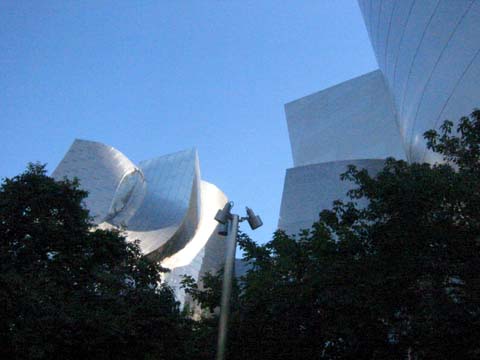
Disney Hall preview concertWednesday night, sitting in the fourth row of Disney Hall, I heard the Los Angeles Philharmonic, conducted by Esa-Pekka Salonen, perform Stravinsky's Rite of Spring. In 3 seasons in the new hall I've heard them do it about half a dozen times. I'll happily hear it a half dozen more.

I won't play the critical game of comparing performances or interpretations, but this has become one of my peak audio experiences - like playing a favorite CD as loud as I want. If you get the chance to hear this group play this music in this hall, take it. It'll make your hair whizz back. (I suppose you ought to regard whizzed hair as a positive thing. I know I do.)


Disney Hall Mountains in the distanceIt's more than just the wonderful acoustics - it's how the orchestra has learned to use those acoustics. While the loud passage make it exciting - the soft places make it magical. (A muted trumpet duet being the most magical of all.)

When I told Leslie I was going to hear yet another Rite of Spring, she reminded me how I diss the people who want to hear Beethoven's Ninth over and over. (I've had to sit through TWO performances of that in 4 years - which is two too many. Neither was in WDCH.) Whatever floats their boat.

The L.A. Phil Rite of Spring performances are an inspiration to me - of how well a composer can use a full orchestra - and of how well an orchestra can take that and run with it. Beethoven's Ninth, unfortunately, just reminds me of things a composer should avoid.

Another Mixed Meters post which deals with uses for the Rite of Spring.

If you think Beethoven's Ninth should be 24 hours long, this Mixed Meters post has a link you'll love.

The Video Corner

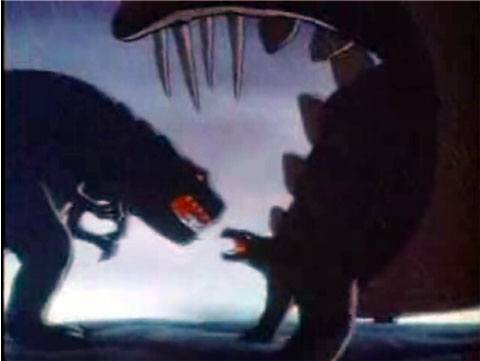
Thirsty Dinosaurs on paradeI can never hear Rite of Spring without seeing in my mind a line of exhausted dinosaurs crossing a desert. This is probably because my first exposure to the RoS, decades ago, was through the movie Fantasia.


Dinosaurs Duke it OutBut hey - some of the profits from Fantasia probably made their way into the Disney family donations for the WDCH acoustics. You can implant those same visions into your brain right this minute if you're not too worried about crimping Disney's future profits.

Click here (part one, in space)
or here (part two, volcanoes & pterodactyls)
or here (part three, dinosaurs trekking)


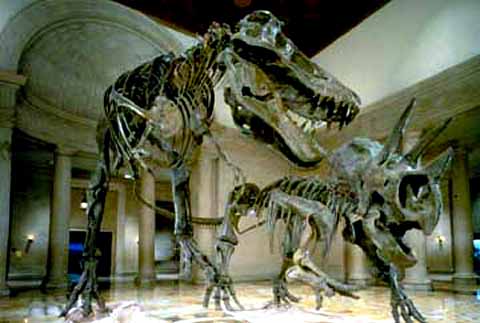
(Here are similarly posed dinosaurs in fossil format at the Los Angeles County Museum of Natural History where Leslie works in the worm department. This particular picture came from HERE.)


And three short clips that are no longer part of Fantasia's Beethoven Pastoral sequence - was the depiction of this little character racist? Is it racist now? One Two Three


Music Reviews
Music Video

Tuesday, January 24, 2006

In which Musical Dots Get Double-Clicked

Here's a bit of fun. It's an interactive musical mixer at the San Francisco Exploritorium web site.. You move colored dots around on a musical field. Once you grasp concepts like "left/right" or "up/down" you can click on the dots, changing their color and their musical style. Clever. Combining and changing the styles fascinates me. (Thanks to Janet Davis for the link.)

Music Reviews