Showing posts with label Iowa. Show all posts

Thursday, March 31, 2016

The Toy Drum (Summer 1953)

Few people remember that I began my musical career as a percussionist.  In fact, even I had forgotten this fact until just recently.

I was reminded of this when I had a pile of old family home movies converted to video.  These date from the late 40s, when my father must have purchased a 16mm camera, to the early 60s, when - given my absence in the action - I must have been old enough to be entrusted with the role of cameraman.

If these videos prove anything, it's that I am descended from a long line of cinematographically challenged ancestors.  Exposure is random and framing is laughable.  There are countless shots of people without heads.  Also occasionally heads without bodies.  No sound of course.  Lots of classic home-movie embarrassed movement.

Here's a photo of one of thsee film reels and the box it came in - this one is labeled only "Summer 1953".    It says Kodachrome Daylight Type Double 8mm Magazine - which held a whopping 25 feet of film.


The transferred video has 3 minutes and 48 seconds of nostalgic action.  I appear the most often - making me the nearly 2-year old star.  Well, I was cute, wasn't I?  There are also shots of my parents, my Grandmother and Great Aunt Kate, my uncles Ben and Carl and Carl's wife, my Aunt Esther.  (I had two Aunt Esthers.  How many did you have?)

Fear not, brave Mixed Meters reader.  I am not posting the entire video for you to endure.  I have excerpted a few scenes.  The first is an unusually high quality shot of  me with my parents outside their apartment in Sioux City Iowa.   Here's a still.


(The brick apartment building and the wooden one behind it are still visible in Google maps.  Pan the street view shot to the left and you can see my eventual high school - complete with stone turrets - up the slight hill.)

The other shots in this following video show me with what was apparently my first musical instrument - a cute little toy drum and cymbal combo supported by a neck strap.  And I appear to be having a great time banging away at it.  Yes, I was the center of attention when I was hitting that drum.  Ah, lost youth.  Cute and talented!

In the last scene you'll notice a huge drop in video quality.  It was very underexposed, almost solid black.  I adjusted it as best I could because I wanted to include the final frame of the film - my father, looking plaintively at the camera and covering his ear with his hand, as if to say "Take the drum away from the boy, please."   Or maybe he was unhappy being pigeonholed in conversation by my Uncle Carl, whose suit-coated wrist can just barely be seen.

Oh.  I also added some music and titles to the video in a futile attempt to enhance the home movie experience.  You should prepare yourself in coming blog posts for more blasts like this one from my early history and even pre-history.


Here's an early MM post about my Mother and Ronald Reagan - and her last pack of cigarettes.
Here's an MM post called My Mother, My Worm.
Music in Sioux City, Iowa?  Here's a post called Me and Mahler, Me and Iowa (there's a picture of me and my Dad)
You could also read Forty Years in California - there's another pic of me with my Father.

Thursday, September 11, 2014

Forty Years In California

Here are two pictures of me taken by my mother in 1974.  The date is September 8, 1974, one month to the day since Richard M. Nixon resigned the presidency.  The location is my hometown of Sioux City Iowa outside our family home (although our house is not shown in either picture).  I had just turned 23 years old.  The car is an infamous 1974 Chevy Vega purchased used earlier that summer.


My father is standing behind me in the first shot.  In the second you can clearly see bags hanging in the back of the car.  I was about to leave on a long trip.

I was going to California to attend graduate school in music.  At the moment these pictures were taken I thought that I would be attending the University of California at San Diego, although my first choice was the more exciting but less practical California Institute of the Arts.

If you figure three days driving from Iowa to Southern California, today is exactly the 40th anniversary of my arrival in Los Angeles.  Or maybe yesterday.   Anyway, I've been here ever since.  The longest I can remember leaving California is three weeks - and that only happened once.

During my undergraduate years in Minnesota, I remember telling my clarinet teacher that I would be continuing my education in California.  His response was that he had noticed musicians who go to California were never heard from again.  I thought that a little strange.  Turns out that he was right, because he never did hear from me again.

I still have two copies of the Cal Arts Admission Bulletin from that year.  In it composer Mel Powell, then the Provost, began his message so:
A scholar of the bizarre, having read the bulletin of several hundred American universities, colleges and conservatories, proclaimed the discovery of a curious new language of garniture.  He found that bulletin prose tends to vibrate with fervor as the distances that separate description from reality extend themselves and promote euphoric envisionings by students, parents, teachers, administrators and trustees.


Despite this oblique warning (written in a curiously common double talk I had never encountered before), I was strongly, yes, euphorically attracted to the California Institute of the Arts, especially to studies in electronic music.  I was also seduced by their lack of Eurocentrism which I understood at the time only with relief that foreign language proficiency was not required for graduation.

On my first day in California I drove directly to Valencia - home of CalArts - intending to retrieve my admissions deposit.  They had not offered me enough financial aid and I needed that deposit money back.  The original plan was to drive on to my second choice school the next day.  Apparently being present in the flesh makes bureaucracy move more quickly because a couple days later, with offers of sufficient money, I found myself enrolled at CalArts.

All my major career opportunities during four decades in California can be traced directly back to people I met at CalArts.  My time there was, for all its faults, a life-changing experience for me.


If you had asked me in 1974 where I would be in 2014, I don't know what I might have said. I'd probably first wonder whether I'd even still be alive.

If you had told me that I would still be a musician whose only tool is a computer and who works exclusively with people I never see - some of whom I've never even met - using something called the Internet, you would of course have been correct.  I expect that I would have laughed at the absurdity of such a notion.  "Not likely.  That's science fiction."

Here's a video of Arthur C. Clarke being interviewed in that same year 1974 about the future of computers.  He was not far off in his predictions, although he suggests that only businessmen and executives will be able to live wherever they please thanks to computers.  Thankfully I've become neither of those things.


Arthur C. Clarke might have said some really dumb things in the rest of that interview.  This clip makes him sound prescient.

By attempting a career in music I was aware, even in 1974, that I wasn't likely to earn piles of money.  I admit that I had faint hopes of getting famous.  Getting rich seemed especially unlikely.  I do feel extremely lucky that 40 years later I'm able to spend my life involved in music and even still make some money at it.

Do you notice that money keeps coming up in this post.  My parents and I shared the uncertainty over whether I would be able to make a living as a musician.  There was no way to know whether graduate education in music, especially at such a strange institution, would just be a waste of resources.

Financially the United States has changed a lot since 1974 and it hasn't been getting better for most people.  In fact, according to this article, The 40-Year Slump by Harold Myerson, 1974 was a watershed year for the American economy:
        But no one could deny that Americans in 1974 lived lives of greater comfort and security than they had a quarter-century earlier. During that time, median family income more than doubled.
        Then, it all stopped. In 1974, wages fell by 2.1 percent and median household income shrunk by $1,500. To be sure, it was a year of mild recession, but the nation had experienced five previous downturns during its 25-year run of prosperity without seeing wages come down.
        What no one grasped at the time was that this wasn’t a one-year anomaly, that 1974 would mark a fundamental breakpoint in American economic history. In the years since, the tide has continued to rise, but a growing number of boats have been chained to the bottom. Productivity has increased by 80 percent, but median compensation (that’s wages plus benefits) has risen by just 11 percent during that time.
Driving off to start my adult life in 1974, I was really quite optimistic.  I was taking a big chance on my dream of being a musician.   Back then there was no way I could have predicted the details of what would happen to me.  Or to the people around me.

I graduated from CalArts two years later and within a year I was working for Frank Zappa - starting salary was $410 per week.  (Adjusted for inflation, that would be about $1600 today.)  After putting over 100,000 miles on the Vega I traded it for a new Toyota.  In September 1984 I quit working for Frank and started freelancing.  I'm still a freelancer 30 years later.   It was a few years more before I shaved off my beard.  In 1991 I met Leslie Harris and we were married the next year.  She has done far more for the positive quality of my life than being a musician ever has.  We're living happily ever after as best we can.  Life is good for us.  I can only wish that were more universally true these days.


In 1974 I was driving off into an unknown future and I had no idea of what would happen.  It's fair to ask what useful advice I would give my hopeful young self based on my 40 years of the California experience? A few things that come to mind:
  • 1) When your father told you to save your money, listen to him.  
  • 2) Be honest with yourself about what you really want.
  • 3) No matter how much you weigh, you will always feel fat.
And where, I wonder, will I be forty years from now.   The odds are good that I will be merged one way or another with the ecosystem by then, well separated from consciousness, remembered only faintly by a few, mentioned infrequently in biographies of Frank Zappa.  Hopefully, if my life means anything, I will have proved that life really is too short to spend it listening to ugly music.


Here are Mixed Meters posts about Cal Arts.
Here are Mixed Meters posts about Iowa.
Here are Mixed Meters posts about California.
Here are my expectations of what death is like.
My essay on the tenth anniversary of 9/11.

Saturday, June 15, 2013

My Mother, My Worm

Don't be fooled. This post is really about Mexican food.  I have two reasons for writing it.  These will be revealed.

Here's a picture of my Mother on the day in November 1948 when she married my Father.


Next is a headshot of "my worm" - Flabelliderma Ockeri.  Well, it's an example of the species of worm which is named after me.  Cute, huh?  It even has its own Wikipedia listing (which is more than you can say about the human me.)  Curiously, the listing is in Dutch.


As some of you may know I come by my scant biological knowledge solely through my marriage to a marine biologist Leslie Harris.  To be more specific, Leslie is an invertebrate taxonomist.  To be downright precise, she's a polychaetologist - a worm expert.  She doesn't deal with just any worms - certainly not with earth worms.  She only deals with worms found in the ocean.  (Personally I had no idea that worms even lived in the ocean until I met Leslie.)

And there are, it seems, an awful lot of worms in the sea.  Leslie works at one of the world's largest collections of polychaetes, housed at the Natural History Museum of Los Angeles County.  People come from all over the world to study these worms and Leslie and I have offered our guest room to many of these worm people while they're in LA.

One such visitor has been Dr. Sergio Salazar-Vallejo, a polychaete expert and professor at Ecosur, an institute of biological studies in Chetumal, Mexico.   He visited us enough that not only did he become our friend but we made him a member of our family.  (We even gave him a certificate to prove it.)  Sergio arranged for many of his worm students at Ecosur to study worms at NHMLAC.  All of them stayed in our guest room.  Not all at once of course.

Sergio apparently believed that I should be rewarded for allowing this steady stream of biologists into my home.  That is where the idea of naming a worm after me got its start.  In his scholarly paper cleverly entitled Revision of Flabelliderma Hartman, 1969 (Polychaeta: Flabelligeridae) published in the Journal of Natural History, he described Flabelliderma Ockeri.  In that paper he explained why I deserved this honor
Etymology: This species is named after Mr. David Ocker, in recognition of his long-standing generous support to polychaete workers, most having come from Chetumal. Thanks to his support, many extremely productive research visits have been made to Los Angeles.
This happened over six years ago.  You'd think I would have blogged about this long before now.  One of the purposes of this post is to belatedly thank Sergio for this signal honor.  Thanks, Sergio.

Here's another picture of "my worm".


If you have no idea what you're looking at in these pictures, don't feel bad.  Neither do I.  At my request Sergio provided an explanation.  I felt it was too complex for Mixed Meters.  He obligingly provided a second, simpler paragraph.  I felt that was still too complicated.  Here's his third revision.
Living specimen of Flabelliderma ockeri, anterior end, dorsal view. The thin filaments are branchiae and the thick ones are palps. The dark brown central area is the group of eyes.  The family name, flabelligerids, indicates that their members carry a fan (L. flabellum). The fan is made up with fine chaetae, often included in a thin layer of a fibrous matrix, which can also include some sediment. The genus Flabelliderma was proposed because the body wall or skin (Gr. derm, skin) differs from other species belonging to Flabelligera.
I needed to look up some of the words:
  • anterior - front
  • dorsal - top
  • branchiae - organ of respiration (kind of like a gill on a fish)
  • palp - organ of sensation or feeding
  • chaetae - bristles, organ of locomotion  ("polychaete" means "many bristles")
By the way, F. Ockeri is a Southern Californian.  It has been discovered only in the area roughly from San Diego to Santa Barbara.  Here are more pictures - including a full body shot - which were included with Sergio's paper:


This Spring Sergio and his wife, Emilia Gonzalez-Salazar (she studies molluscs) visited us again for several months.


In this picture you can see Dr. Luis Carerra-Parra (another polychaete person and one of Sergio's students), Emilia Gonzalez, Sergio Salazar and Alejandro Salazar (he's an offspring of Emilia and Sergio.)  Notice that they are sitting at a dinner table.

When Emilia and Sergio stay with us they take over our kitchen.  Leslie and I don't mind.  We are not particularly familiar with their strange idea of preparing an evening meal and then gathering the entire family around the table to eat it together.  Very curious.

Naturally, when gathered around the table in the presence of a freshly prepared meal, the discussion often turns to food.  That's how it happened at one meal that I told a story about my Mother's Midwestern encounter with Mexican food sometime in the early '80s.  (Remember my Mother?  Check back to the beginning of this post.)

Here's a picture of me with her in Sioux City Iowa in June 1986.  Sioux City is where I grew up and where she still lived.  We're standing in front of the Green Gables Restaurant on the corner of Pierce and 18th Street.  I wonder if they still serve kreplach soup one night per week.


Here's that story about my Mother and Mexican food that I told at dinner:
At that time I was living in California and periodically she came out from Iowa to visit me.  Although Sioux City has an airport of its own, flying to California was cheaper if you first drove to Omaha Nebraska, about 100 miles south.  
When I grew up there weren't many ethnicities in the Midwest.  Beyond a few Jews (that was us), a few black people and a very few Native Americans (who mostly kept to themselves on reservations), there were only seemingly countless varieties of Northern Europeans.  
Sometime after I moved to California apparently things began to diversify.  Latinos began moving to the Midwest, many of them to take the difficult, dangerous jobs in meat processing plants.  As their population increased, services geared to Latino customs followed.  I remember the surprise while visiting of seeing not one but two Latino grocery stores in Sioux City.
And that's why my Mother could have the experience of eating at a Mexican restaurant in Omaha Nebraska before she flew to California: because there were Mexicans running restaurants there.  Later I asked her what she had eaten.  Her answer - she pronounced the unfamiliar polysyllabic word very carefully - she had eaten an entomatada.
I told her that she must have gotten the name wrong.  I had been living in Southern California for nearly 10 years and thought I knew all about Mexican food.  I rattled off a list of the possibilities for her.  Could she have had an "Enchilada" or even a "Burrito" perhaps?  "It had to be one of those other things," I told her.  "Entomatadas don't exist."
Now, cut back to the present, a few weeks ago.  Twenty-five years or so have gone by.  Leslie, Sergio, Emilia and I are having dinner.  I tell them this story.

Imagine my surprise, my astonishment, when Sergio replies that my Mother had indeed gotten the name correct, and that entomatadas are not some mythical culinary chupacabra.   Entomatadas are a Mexican speciality made by dipping lightly-fried tortillas into tomato sauce and then filling them with cheese or meat or something.  The word tomato is easy to find in "entomatada".

I asked Emilia and Sergio if they could make entomatadas for us some night.  And they did.


Here's a plate of entomatadas ready for consumption in our kitchen.  They were very good.


And so the second purpose of this blog post is to apologize to my Mother.  Sorry, Mom.  I should have believed what you told me.


For Further Reading:

My Mother, were she still alive, would turn 101 next month.  Click here to see a genealogy which lists her.  (It also lists Leslie and myself.)

Sevens, a MM post, has one story about my Mother's pregnancy with me and another about the massive pile of manure in Sioux City.

Reagan Says Give Chesterfields for Christmas, a post about my Mother's cigarette habit.

An obituary of Ben Shuman, my Mother's brother.

Yelp lists 19 Mexican restaurants in or near Sioux City Iowa right now.

About growing up in Sioux City and listening to Mahler.

About Oscar Littlefield, an artist I knew in Sioux City.

Google search for entomatada.  (lots of recipes)


Mother and Worm Tags: . . . . . .

Saturday, October 02, 2010

Drawings by Oscar Littlefield

My last post, Pointing at my iMac, included a 20-year old Everex computer advertisement.  I kept it so long just to use on Mixed Meters.  Yup. In my search for it I came upon a manila envelope I've been saving for even longer.  Dating the envelope is easy - here's the return address:


Inside are four pen and ink drawings.  I intended to have them framed.  As my Mother always said, "The road to hell is paved with good intentions."  Words to live by.

The framing and hanging might still happen someday.  Until that day comes I've scanned them for display here.  (Click on any of the drawings for an enlargement.)


The artist is Oscar Littlefield. He was a resident of Sioux City, Iowa, during the period when I was a child growing up there.  He earned his living as the director of the Sioux City Jewish Federation.  Art was his hobby.  I didn't know Oscar until the mid-80s, the last few years of his life, when he, a widower, had married my Mother's best friend, a widow like my Mom.

There had never been artist role models for me while growing up in Sioux City.  One very minor exception was a visiting composer who wasn't even close to being an inspiration. (Read a little about that guy in Drummer Replaced by a Machine.)


Oscar, however, was different.  When I met him I had finished my education.  My music had been inspired by a number of abstract modern artists.  He and I fell easily into talking about the creative process - and he quickly became a reason to look forward to my visits to Iowa.

Oscar's principal medium was woodcarving.  Some of his sculptures are visible now on the Sioux City Art Center's website.  Check them out.

His drawings made a big impact on me.  I saw them, framed, hanging on the wall in his home.  Even more impressive was a hand-written letter from Albert Einstein, displayed nearby.  Einstein was saying (in German) how hard it was then (in the '30s) to find a job for a young physicist - because he was Jewish. 


These four drawings, like most pen-and-ink drawings, are about lines.  Oscar generally makes his lines of even thickness.  Darker shadows are represented by carefully placed parallel lines.  The lines swoop and curve.  They go places.  Oscar uses them to suggest three dimensions, especially in the last one.  The skull-like silhouette is the only real bit of representation.  I may not have picked his intended orientation - especially in the first two. (Feel free to swivel your monitor around to check out other possibilities.)

This page at the Sioux City Art Center website discusses Oscar's working method as a woodcarver.  It says:
The approach is very simple: an artist looks for inspiration in random patterns and pays attention to their own personal, subjective responses and imaginings
These drawings seem to have resulted from exactly that method as well.


Oscar's drawings were comparable to my own pen-and-ink "doodles" - little drawings I've done my entire life.    I think that the abstraction, the process, the long curved lines and the medium itself reveal many similarities between us.

Examples of my own "doodle" drawings are viewable in one, two, three, four, five, six different Mixed Meters post.  (If you time for only one I suggest #3.)  Also, you could see some doodles done in the medium of refrigerator magnets (along with a good story about cat piss.)

Here's a post, not about drawing, but about growing up musical in Iowa: Me and Mahler, Me and Iowa.

Finally, here's a post called Sevens, in which I discuss the large pile of manure Sioux City, Iowa, is famous for.

Pen-and-ink Tags: . . . . . .

Thursday, October 09, 2008

Drummer Replaced By A Machine

Recognize this tune?.

Of course you do; even though this midi sequence is just the chord progression. But it represents my first encounter with a venerable, senior composer.

Back in my high school years I performed in my home town summer concert band, the Sioux City Municipal Band, Leo Kucinski, bandmaster. We played two Sunday concerts - one in Riverside Park (actually near a river) and the other in Grandview Park Bandshell (a tiny Hollywood Bowl clone).

Every year this guest artist would come and conduct his most famous work. His name was David Bennett (I can't find any web link about him personally). His was my first image of how a composer looked and acted. Can you say "stereotype"? Of course you can.

Much more recently - like last week - my friend Wildman (yes, that's what we call him) sent me a wonderful YouTube link of Sweet Georgia Brown.

Wildman is a drummer. We went to graduate school together and were housemates. He used to drive many miles every day through Los Angeles traffic to play in a Top 40 band at a hotel in the City of Industry. Or was it in Commerce?

Wildman knows that drummers can be replaced by machines. But usually not machines like this one. It even does some basic drum breaks.

What does this have to do with composer David Bennett and his hit tune Bye Bye Blues? Just watch the whole video.


Previous Mixed Meters Mentions of My Home Town.

This MM article about growing up listening to Mahler has a picture of the Grandview Park Bandshell and another of my father and me in our band uniforms holding our horns.

Update: Wildman confirms that his Top 40 Band gig was in City of Commerce. He wrote:
I still have the silvery white jumpsuit with rhinestones and matching jacket but lost the white patent leather shoes.
Remember, that was in 1976. Just imagine!

Bye Bye Tags: . . . . . . . . . . . . . . .

Friday, July 06, 2007

Me and Mahler; Me and Iowa

Forward: This is a long, completed essay about my relationship to the music of Gustav Mahler over 40 years. Go back to this post Buying a Guitar in Pasadena (Mahler's Seventh) to see how this topic first came up. Then go to In Which David Is Caught In The Act to see why it's coming up again now. What I wrote here is just as I left it last February but it feels vastly incomplete to me.
Here's what I think are the main points to be gleaned from all the upcoming verbiage:

Personally I have always sought out newer music to listen to (new pieces, new composers, new styles, genres etc etc). This has been a kind of innate search throughout my life.

As I develop interest in new audible things my interest in old things wanes. (There are lots of exceptions to this, however.)

This process feels completely natural to me; it feels like growth. It feels like aging. I believe it is an essential element in why I'm a composer.

It also appears to be very unusual attitude among classical music listeners who, I sense, do not like to admit that their relationships with "masterpieces" change over time, except to decide which interpretation is now the best ever.

With these points said, it's probably not necessary for you to read the rest of what I wrote.


The Story Starts Here

a vintage Standard Oil Iowa roadmap
In a previous post I mentioned anecdotally that I no longer listened to Mahler because I "grew up".

Part-time Mixed Meters Reader Addison (who is the anonymous part-time blogger behind Me And Yobo and a full-time New Yorker with whom I attended college years ago somewhere near cow pastures and who is also a fellow adherent of the Church of The Goon Show) responded succinctly to my terseness "That's Harsh".

And if Addison missed my admittedly elliptical point, I suspect my other two readers did as well.

So, allow me to go on at length about Gustav Mahler and my relationship to his music - because it represents a vast influence on my growth over the years - even though I no longer care to listen.
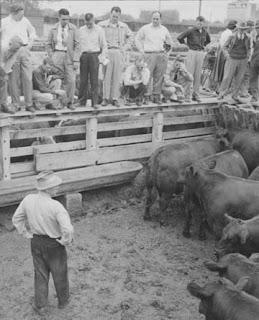
Students at the Sioux City Stockyards about the year I was born
Sioux City Iowa


Okay, the story starts in Iowa where I grew up in a city famous for the world's largest popcorn and honey processing plants. Back then there was a several story high pile of cow manure near the Interstate Highway representing the bedrock principles of the local economy. Not a place for serious, challenging music.

My own musical tastes were initially influenced by my parents. Their record collection ran the gamut from late Mozart to Dvorak - plus the occasional Broadway musical.

Plus anything that might be played at a summer band concert - which I heard not on recording but at actual summer band concerts. In Sioux City these were held in a miniature reproduction of the Hollywood bowl. (The Grandview Park Bandshell - big enough to hold a 50-piece band.)
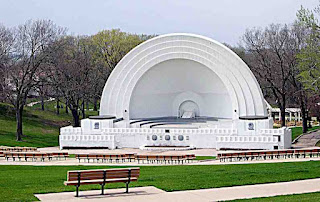
Grandview Park Bandshell, Sioux City Iowa
My Father played clarinet in that band - and as a toddler I'd be in the audience with my mother waving my arms like the conductor, a man named Leo Kucincski. Once, running backstage after the concert to see my Father, I tripped over a dachshund with disastrous effect (on me, the dog was fine).
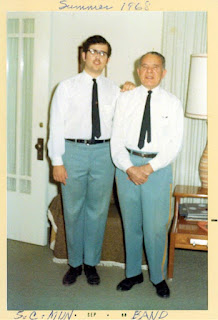
David and Albert Ocker in 1968 wearing Sioux City Municipal Band evening uniforms
Hmmm - oh yeah - Mahler. Hang on, we're getting there.

As I reached my teen-age years, had I been the slightest bit a normal Iowa youth, I would have decided that this music was boring and succumbed to peer pressure, listening only to Herman's Hermits or the Dave Clark Five.


In the Library

Instead, having absorbed my parents entire collection, I searched on my own for more classical music. I discovered the modest record collection of the Sioux City Public Library - stone letters above the main entrance said "a gift from Andrew Carnegie". Let's blame him.

In the library I first encountered composers like Richard Strauss and Sergei Prokofief. Here I discovered a monaural copy of Leonard Bernstein conducting Mahler's Seventh. I'd never heard of Mahler, but the piece required two LP discs and it came in a thick black box instead of a simple record sleeve. How cool was that! I checked it out.

This was the mid-sixties. Mahler was having a revival. Not that his symphonies were readily available everywhere, let alone on the frontier between Nebraska and Iowa. In the important centers of Art and Intelligence (places like Chicago) he must have been performed and discussed. But all I knew about Gustav Mahler is what I could read in the liner notes to this album.
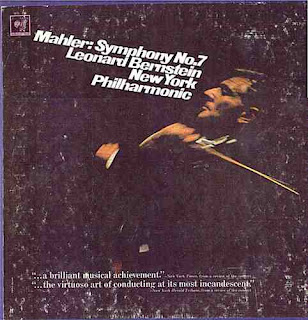
Columbia M2L 339 Bernstein conducts Mahler 7 New York Phil
This is where the story really starts. Although I was trapped in Sioux City, I would come home after school and listen to music before my parents returned from work. In this environment I was captivated by Mahler's Seventh Symphony. Can you say "Bolt From the Blue". This piece is generally regarded as his most enigmatic. That's because it really is his most enigmatic. Not your recommended introduction to Mahler.

As a late-middle-age know-it-all with the advantage of hind-sight, I can tell you that in Mahler's music I encountered a person who didn't have all the answers and wasn't afraid to say so. I didn't know it then, but this was important.

Mahler's musical space encompassed conflict, irresolvable influences, indecision, uncertainty and finally inconclusive resolutions. Eventually I discovered that other creative artists dealt with such issues, but back then Mahler, for me, was a first faint glimpse into a universe I wanted to experience.

Not long after this I went away to college. That's where I met interesting people with similar interests for the first time. People like Addison whose offhand "That's Harsh" comment is responsible for this self-indulgent run-on essay. Let's blame him for this, okay?
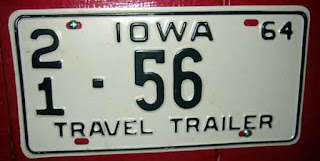
an Iowa licence plate, but not from my county

Going Away to College

Back then I put very great emphasis on the notion of "going away" to college. The Rabbi of our congregation had told me "Sioux City is a place you come from". I already knew that but I was simply flabbergasted that any adult would say it out loud. I wanted out. Going to college meant getting out.

Although the physical distance from Sioux City to Carleton College was only a few hundred miles, I found myself on a totally different planet (er, Planet Carleton?). There were still cows nearby, but no huge pile of shit. Plenty of other changes happened to me during this time period, of course, but for now I'm trying to stick with Mahler.
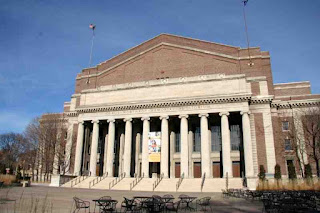
Northrop Auditorium at the University of Minnesota where I attended Minnesota Orchestra concerts
(And this is where the story really starts.) At Carleton I finally met other people who were interested in Mahler. We finally experienced all the symphonies. It was a really big deal when someone scored the first copy of a Mahler's Eighth recording - Solti conducting Chicago. We listened to each piece over and over. We traveled to the Cities to hear the Minnesota orchestra perform Mahler live listening raptly from the nosebleed seats of Northrop Auditorium. We were greatly offended by a tired principal trumpet player cracking too many high notes.

Each of our interests in Mahler certainly stemmed from different sources. Most meaningful to me were Mahler's Jewish/Christian and performer/composer conflicts. My friend had their own reasons although we didn't really know how to discuss them.

As a college senior I remember my roommate Mark Lindenbaum (now a doctor who still plays his tuba quite a lot) saying "The amazing thing about Mahler is that I feel like I really know him as a person." I couldn't disagree. Today knowing a composer's personality only through his music (accurately or not) still seems like a huge, remarkable accomplishment.
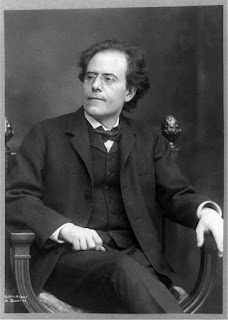
Gustav Mahler himself picture from Wikipedia
I'm not saying Gustav would have been an easy man to talk to, only that I would have some idea of what to expect when I met him. At the moment I can't think of another composer I could make that claim that about. I know a lot of music that just makes me wonder what kind of weirdo nebbish wrote it. (Yep, I do agree that my own music would fall into that hole.)

There were a number of Mahler highlights for me during my after school years. A broadcast by Leonard Bernstein explaining Mahler's Ninth as a different kind of farewell symphony. Ken Russell's film Mahler - okay, WAY over the top, but the soundtrack was a wild ride of bits and pieces of symphonic Mahler combined creatively. An early proto-mashup of Mahler.
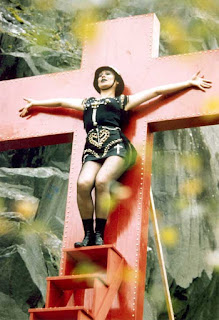
from Ken Russell's film Mahler - Nazi Helmet Girl on Cross
But over all of this, I never lost my original fascination for the Seventh Symphony. I attended every Seventh performance that I could - including extending my stay in London in 1984 to hear the LSO.

The Enigmatic Ending

Something strange happened (and this, of course, is where the story really starts). It happened slowly mind you, but imagine the mid-90s. I lost my patience for all of Mahler's music. The comfort I used to find from his music was replaced by annoyance and discomfort. "Okay, I get it," I thought "What else is there to listen to?"

It seems rare to me for any fan of classical music to admit to changing tastes. I still respect and honor Mahler, but I don't care any longer for the experience itself. Much of the music in my parents collection, back in the 60s, is like that. I would never have a reason to ask to hear it. If life gives me Mahler I won't avoid the experience, I just won't seek it out.

Alas, the immediate cause of the "I grew up" anecdote was the upcoming LA Philharmonic performances of Mahler's Seventh in Disney Hall. I was speaking with the wife of the conductor of those concerts. Had I thought about it, I might have gone to hear the music in the Disney acoustic as the reviews were glowing. But I doubt I would have gotten caught up in the music itself.

So, Addison, babe - that's where I stand on the subject of Gustav Mahler's music. It was a flippant remark but grounded in truth. I hope you appreciate how much work your "That's Harsh" caused me in preparing this essay. Heck, I hope you read even half of it. Let's squeat lunch at Goodhue when you get the chance.

Goodhue Dormitory Carleton College Northfield MN

Postlude

And that's where the manuscript breaks off. I stopped work on this essay on February 22, 2007. I'm not going to try to expand on it now (July 8, 2007) although I made a few small edits. You get it pretty much just the way I left it.

There are a few errors. For example I have it on good authority they no longer serve meals at Goodhue. Mostly it brings up, in my mind, all sorts of avenues and alleys about who I am, where I came from, why I do what I do, like what I like, and create what I create.

Sometimes it's useful to strip off the clothing of nowness, dive into the pool of back-thenness, and search around for anything in need of rescuing. I did listen to several Mahler symphonies to make sure I haven't grown even more of late to the point that I need Mahler again. I don't appear to have done that. Maybe someday. I hope I live long enough to find out. Sigh.

Mahler and Me and Iowa Tags: . . . . . . . . . . . . . . . . . . . . .
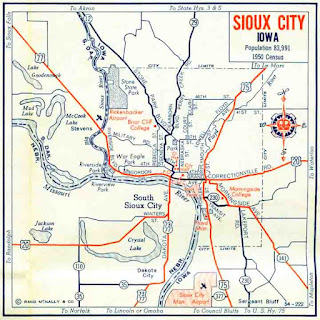
map of Sioux City Iowa from 1960s
Most of the pictures will enlarge if you click them.

The Sioux City Stockyards Photo comes from here.

The Grandview Park Bandshell picture came from here. There used to be many, many more benches.

The picture of Goodhue (plus other Carleton campus pictures) came from here. You must imagine this during a Minnesota winter.

The still shot of the Nazi Girl on the Cross from Ken Russell's Mahler was found here.

Here's a fascinating article Mahler and the Crisis of Jewish Identity by Francesca Knapp and Raymond Draughon


back cover of Iowa Road Map

Sunday, November 19, 2006

Follow the Bouncing Balls

This is a very cool music video on YouTube. The accompanying description says this instrument was made of John Deere farm implement parts at the University of Iowa. It also says over 13,000 hours was required to calibrate the performance and that the machine will be donated to the Smithsonian.

As someone who grew up in Iowa, I'm so proud!


No, wait! It's an animation (duh!) - and it came from here. It's included on a DVD of animated music from Animusic. The company is located in Texas. (doh!)

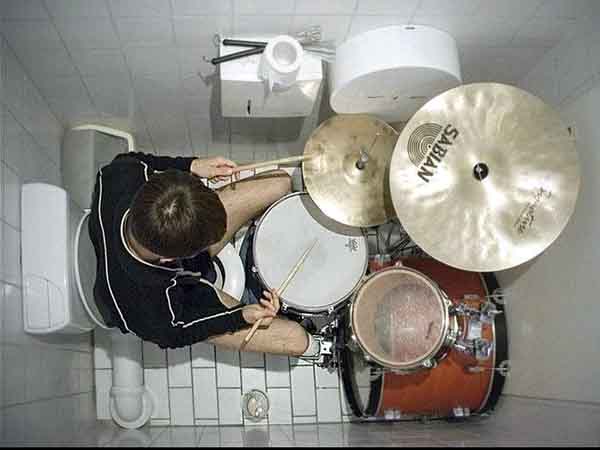
Not fooled? Here's a picture of a typical college practice room instead. Never enough space, right?

A Drummer in a John

I found this picture at Bits & Pieces but apparently it was imported from Belgium.

Speaking of Iowa - here's a high-number Iowa license plate on display in Robins, my local Pasadena barbecue restaurant where the food is good and the menus uninformative.

Iowa license plate #56
The number 64 is the year; 21 is the county which issued the plate. Click here for the complete county list. I grew up in 97.

Here's a prior Mixed Meters post concerning both music and toilets. (Also rich people and prison riots and Ojai and Attica.)

Barbecue Tags: . . . . . . . . . . . . . . .. . . . . . . . .