Showing posts with label ICA. Show all posts

Wednesday, September 12, 2012

John Cage's Second Century

The day on which John Cage would have turned 100 years old was last week.  In certain circles it was a big deal.  (Here's a list of events.)

I am offering two recordings of the music of John Cage.  Both were performed in Los Angeles in the early 1980s on concerts produced by the Independent Composers Association.  I no longer remember exactly why I saved these cassette recordings.  Subconciously, I guess, I knew that I would need material for my blog one day, once my hair turned gray.

Both concerts were apparently reviewed by the L.A. Times although I don't have access to either article nor to concert programs.  I do remember that the reviewer remarked how Atlas Eclipticalis felt like the 'classical' work on a program of modern music.  Imaginary Landscape was part of a tape music concert which also included pieces by Scott Fraser, Luc Ferrari and Jonathan Harvey.

listen to John Cage Atlas Eclipticalis with Winter Music - 1756 seconds - November 16, 1982 - The House, Santa Monica, California - The Independent Composers Assn. Ensemble, Delores Stevens, pianist, Stephen Mitchell, conductor

listen to John Cage Imaginary Landscape #4 with Radio Music - 497 seconds - May 21, 1983 - Stella-Polaris Gallery, Los Angeles, California - The Independent Composers Assn. Radio Ensemble
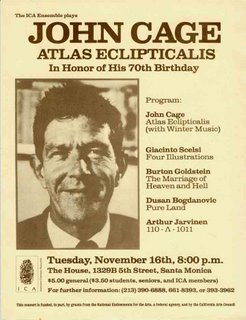

(Read about: why I have this flyer and how I know the other composers on the tape concert.  At some point I made a copy of the Atlas Eclipticalis tape at half speed.  I much preferred listening to it that way.)


As someone whose musical thinking was greatly influenced by Cage's work and ideas, I would be remiss to let this occasion pass without comment. On the other hand, these days I'm really more interested in observing how Cage is being remembered by the classical music establishment than I am in the man or his music.

I see Cage as the ultimate 20th century iconoclastic artist, someone who smashed the sacred ideas of the music world. In their place he brilliantly offered indeterminacy, new performance techniques, electronics, wildly inventive compositional systems and a sense of calm, unflappable, detached theatricality.  He leavened this mixture with a galaxy of personal anecdotes, ideas from Zen teachings, mycology and the force of his own personality.

Indeed, I believe that the man himself sets Cage apart from the other composers of his time.  He injected himself uniquely into his music by performing, lecturing or just being charming.   In his second hundred years how essential will his persona be to the continued acceptance of his music?  Eventually everyone who directly knew and revered Cage will be gone.  Time will tell us if his music alone will continue to inspire new listeners.  Or maybe his writings and ideas will motivate future generations to become fans.  

In the coming decades the ears of the audience will, no doubt, continue to blend the music of the entire post-World War II avant-garde into a more homogenous musical experience.  Although there will be plenty of academic types to make plenty of fine distinctions, it will be harder and harder for more casual listeners to choose sides in those ancient artistic conflicts.  Total control via serialism or total randomness using chance operations?  As it turned out, the aesthetics were much the same either way.

The centennial celebrations are heavy with the idea that Cage was a strong artistic wind that will blow through the ages.  I suppose it is possible that Cage, by the year 2112, could land a spot in the pantheon of the greatest dead white male composers.  Even so "Bach, Mozart, Beethoven, Wagner and Cage" would be quite a stretch.  I wouldn't be surprised if he comes to be regarded as the essential 20th century serial composer, eclipsing all those famous Europeans and academic Americans of the last fifty years.

Cage made a big deal out of studying with Schoenberg - and spent much of his later career trying to curry the approval of his long-dead teacher.  Here's an excerpt from a fascinating L.A. Times article by Mark Swed about Cage's early life in Los Angeles:
Still the young composer continued to, as he put it, worship Schoenberg like a god. He took away from Schoenberg the idea that a composer always needed some kind of system. And Cage always came up with one.
Schoenberg would likely have said that music needs more than a system of rules.  I'm pretty sure he would have insisted that music also requires meaning and expression.

Recently, in a BBC interview with Norman Lebrecht, John Adams talked about John Cage (This is from the 9/3/12 podcast, starting about 15'48")
Actually there was a four or five year period when I was not that cognizant of minimalism.  I was a real acolyte of John Cage. . . . I knew all my John Cage very well and I was very deeply imbued in John's orthodoxy.  I do think that Cage is a very orthodox composer.  That surprises people because they think of him as an iconoclast but he actually is a strangely intolerant composer in a certain way, when it comes to anything which doesn't fit into his very precise world.  That means most of western music whether it's Miles Davis or Beethoven.  Eventually I just had to throw that out.  Because I had fun doing John Cage and you could talk about it forever but my background and my musical breeding had brought me up to love great music.  Also I keep going back to this experience about music is essentially the art of feeling and Cage had no place in that.  
(Here's a fun anecdote about Cage's intolerance.)

We can argue later about what Cage is and what Cage is not.  After that we can take a swing at what is great music and what is not.  Or we can just agree to disagree.

Right now the question I am more interested in is 'How will perceptions of Cage change over time?'  The best way to find out is to simply wait and see.  It's more fun to guess.

I expect that the great iconoclast will gradually be transformed by his remaining acolytes into a great icon.  He will be revered, Zen-like, in concerts and concert halls.  Cage, I'm sure, would have liked nothing better.  I also expect that the manner in which his music is performed will become increasingly conventional and prescribed.  That's sad, but it is the way of what we call classical music.

Personally, the harder it becomes to experience the music of John Cage on a street corner, the more we will lose what I think is the real value of his work and life.
As John Cage has said, music is all around us if only we had ears. There would be no need for concert halls if man could only learn to enjoy the sounds which envelop him, for example at Seventh and Broadway at four p.m. on a rainy day.
(That quote comes from the spoken introduction to the 1970 Everest recording of Variations IV by John Cage.)

(Seventh and Broadway: 1 2 3 4 5 6)

Random Tags: . . . . . . . . . . . . . . .

Monday, June 09, 2008

Second Second Story Series - Portraits By Robert Jacobs

A few of Robert Jacobs' polaroids from the Second Second Story Series remain to be posted. These are all head shots of a few Independent Composers Association members. Later you'll see how Robert transformed a couple of them into actual portraits.

These were all taken in 1978. In order of appearance are:
  • Robert Jacobs
  • Lois Vierk
  • Scott Fraser
  • Susan D. Palmer
  • Richard Amromin
  • David Ocker

Robert Jacobs 1978Lois Vierk 1978Scott Fraser 1978Susan D. Palmer 1978Richard Amromin 1978David Ocker 1978The last two Polaroids, of Richard Amromin and myself, are the basis for the next two portraits as recently transformed by Robert.

Richard Amromin portrait (c) by Robert JacobsDavid Ocker portrait (c) by Robert Jacobs
Rob entitled my portrait "Blood, Sweat and Tones". Behind my hair-covered face there is musical notation while blood and sweat stream down from above over the picture and the frame itself. (The sweat is clear and hard to see; click it for a slightly better view.)

This picture hangs in our home. A young son of a friend saw it and asked "Why do you have a picture of a terrorist?" Why, indeed.

Here are more recent pictures of Richard, myself and Robert.

Richard Amromin 2008Find out what Richard Amromin is up to these days at New Town Arts.

David Ocker 2008Robert Jacobs 2008
Back in the days of ICA we called Robert Jacobs "Bob". Now, for some reason, he's known as "Rob". I still think of him as "Bob".

Back in those days he made his living as a photo retoucher. This was before Photoshop of course. His work was done with razor blades, sheets of plastic, paint and an airbrush which I thought was very cool.

Here is an advertising poster for his business. It's entitled "Unwanted Hair Removed". Like the Second Second Story Series poster at the beginning of this series, this was designed by Rob's brother, Ray. I've saved it all these years because I thought it was hysterical.

Unwanted Hair Removed - Robert Jacobs photo retoucher
Click on it for an enlargement. At the bottom of the picture it says:
Robert Jacobs retouches dye transfers and Type "C" prints. Also, black and white. His new studio is located at 7000 Beverly Boulevard. Telephone (213) 931-3751.
The credits are: Photography: Steve Berman, Model: Candy Brown, Design: Jacobs & Gerber, Partners, Lithography: Porter & Griffin.

These days Robert Jacobs no longer does photo retouching. But he uses those talents as a fine artist. His recent work can be found at Rob Jacobs Art and Angels of Protection.

These days anyone with Photoshop can do photo retouching. Here's my original, un-retouched, photo of Rob in 2008. I was the person who retouched the picture above - but Rob gave me some good pointers. I'd really like to thank him profusely for providing all the pictures of those concerts so long ago.

Robert Jacobs 2008
Retouched Tags: . . . . . . . . . . . . . . . . . . . . . . . . . . . . . .

Wednesday, May 28, 2008

The Second Second Story Series - Concert Four

(This is the 5th article in a series. Skip back to the first article here.)

As a society we decide what pieces of music will become "classics". Most so-called Classical Music was chosen by people long dead but we living humans get to sneak new pieces into the canon occasionally.

These days one of the pieces we the people are making "classical" is Terry Riley's In C - an orchestra piece of utter simplicity and massive power. It speaks to us of musical patterns and formal structures, it hints at changes in social relationships and organizational hierarchies. There ought to be no podia in In C. Every performer in In C has to be creative. It marks the passage of time (about the only thing every single piece of music does one way or another) in a way no other piece ever had before. Written in 1964, it is clearly one of the most talented children of the sixties.

On May 28, 1978, (30 years ago today) In C was the centerpiece of the final concert of the Second Second Story Series. Without it the entire series would have merited little attention back then - and even less now. But the energy generated by this one performance became a kind of landmark for the ICA, an inspiration in seasons to come. It was the sort of success every beginning arts organization needs.

Here is a portrait of Terry Riley taken by Robert Jacobs back in 1978. At the end of this post is a picture of Terry today and some links to information about him and his music.

ICA Second Second Story Series 1978 - Terry Riley Portrait by Rob Jacobs
SECOND SECOND STORY SERIES PROMOTION ARTICLE

In C was already well known by 1978. It had been released on a Columbia album - which had been a personal inspiration and refuge for me in my graduate student years at the Herb Alpert School of Music, a musical relief that I might listen to twice or three times after many a hard day studying ugly comtemporary music. But In C had had few performances in Los Angeles (actually none that I'm aware of).

We tried to get as much publicity for our concert as we could. I ran across a promotional article that I had saved from a magazine called Neworld (about which I remember nothing). This article ran prior to the entire series. It was written by Jo Ann Smith. Here's a quote describing the plight of independent composers:
...it is difficult for composers to get their work performed. Especially if they are young and unknown. (Perhaps if they were very young - twelve or thirteen - it would be different. Audiences tend to put up with a lot of nonsense from pre-pubescent musicians.) The ways around this are not legion. You can have your parents buy you an orchestra; you can stay in school forever, being performed on the obligatory student composer concerts and heard by practically nobody; you can threaten to hold your breath until Zubin Mehta agrees to perform your piece; or you can organize and try for a frontal assault.
Click here to read the entire article about the Independent Composers Association written by Jo Ann Smith in Neworld 1978, No.2

ICA Second Second Story Series 1978 - David Ocker in a panic
SECOND SECOND STORY SERIES RADIO INTERVIEW

I also discovered an aircheck of a regular Saturday night KPFK radio show called Zymurgy. It was hosted by Carl Stone and Leni Isaacs (now Leni Boorstin, an important honcho of the Los Angeles Philharmonic). The night before the In C concert the guests on Zymurgy were Anna Rubin, Robert Jacobs and myself, "Dave" Ocker. We sounded very young and earnest. I've extracted a few quotes from the interview down below somewhere.

I've uploaded the show as an MP3. I probably made this tape myself using some sort of automatic timer to record off the air onto two crappy cassettes. I've cut all the music selections down to one minute or less. The recording quality was not good enough for music. The two hour show lasts about 50 minutes, including a commercial for a strident Helen Caldicott in a futile effort to speak truth to power at the end.

The musical snippets will give you a vague idea of the diversity of music on this series - with the emphasis on "vague". As this is the only Second Second Story Series audio document which I'll be posting to Mixed Meters you'll just have to make do with vagueness.

Click here to listen to Leni Isaacs Boorstin interview Anna Rubin, Robert Jacobs and David Ocker on KPFK radio Zymurgy program, May 27, 1978.


ICA Second Second Story Series 1978 - empty chairs
SECOND SECOND STORY SERIES PRINT REVIEWS

The final concert received four separate print reviews. The most amazing was by the late Daniel Cariaga of the Los Angeles Times. I once heard Ara Guzelimian (who now rules much of the music world somewhere in New York City) express amazement at Danny's "revelation" at this concert. Recently Mark Swed recalled watching Danny sitting Buddha-like under a statue of the Buddha during In C. Wish I had a picture of that.

Danny wrote:
Under half-dimmed lights in a second-story yoga classroom, between a Safeway and a Baskin Robbins, this extraordinay event took place. To one observer, the impressive closing of a second series cosponsored by the Independent Composers Assn. and Larchmont Center (the yogic connection) cause regret that earlier visits to an obviously enterprising impressarial entity had not been made. Clearly, ICA is making some things happen.
Read the entire review by Daniel Cariaga "ICA Series Ends with Riley's 'In C'", Los Angeles Times, May 31, 1978

Read Mixed Meters obituary of Danny Cariaga here (including the story about the second ICA concert Danny attended.)

ICA Second Second Story Series 1978 - Robert Jacobs Kathryn Ando
Mark Swed, the current Martin Bernheimer of the Los Angeles Times' music criticism department, also covered the concert for the Los Angeles Herald Examiner, now the perfect example of a second newspaper in a large city. Mark is a long-time Terry Riley fan. Here's part of what he wrote:
For the first time in recent memory, there was a real sense of occasion at a new music concert. The Independent Composers' Association pulled off this minor coup in the unlikely but pleasant Larchmont Center for Yoga at the final concert of their second season Sunday night. The uncommonly large and excited crowd came for a rare local appearance by Terry Riley, who led a performance of his "In C."
Read the entire review by Mark Swed "A rare taste of Terry Riley 'In C'", Los Angeles Herald Examiner, May 30, 1978

ICA Second Second Story Series 1978 empty chairs & Susan Palmer
Even more amazing to a an old new-musician with a bad attitude (such as myself) 30 years afterwards, this concert was reviewed by a newspaper from Long Beach, California, a large suburb of Los Angeles. Someone named Bill Arthur wrote:

I saw that the '60s never ended, and in fact began a creative musical tradition, at a concert put on by a group of young musicians called the Independent Composers Association in Los Angeles Sunday night. That the program took place in the Larchmont Center for Yoga suggest how the avant-garde (this part, at least) has matured beyond the need to be outrageous. Despite the outrageous heat, the young, hip listeners (some with infants in arm) displayed as serious musical concerns as the very committed musicians.

Read the entire article by Bill Arthur, "Independent Composers performs in Los Angeles", May 30, 1978, in the Long Beach Independent and Press-Telegram (a newspaper with both morning and evening editions).

ICA Second Second Story Series 1978 - Scott Fraser Lois Vierk
Months later a magazine called Synapse published this review by Colin Gardner. It was entitled "Terry Riley, In C".
This particular performance was something of a revelation. The excellence of the musicianship was aided by the receptive condition of the audience, our sensual perception having been heightened by the incredibly hot evening and the absense of air conditioning in the hall. Most people were beginning to feel groggy by the beginning of In C and the perpetual pounding rhythm of the pulse and repetitive overlays of the 53 figures produced an intense experience as if being pounded into submission all the more effectively to appreciate the nuances of the orchestration. One's mind drifted into a dreamlike state for long periods, overwhelmed by the totality of the piece while at other times on could concentrate on the rhythm or on each indivicual instrument. In C is not an electronic piece, yet it somehow seems electronic, conjuring up the electronic pulses of the German sequencer-dominated music of Hoenig Schulze and Tangerine Dream.
As you can tell, Colin was writing for a different type of reader than the three newspaper critics. You can read Synapse back issues here.

ICA Second Second Story Series 1978 Anna Rubin resting
SOME QUOTES AND THOUGHTS ABOUT THE ICA

Being exposed to my 30-years-ago self is a bit of a shock. But a few things said in the KPFK interview got me thinking.

Leni asks us several times whether the members of the ICA have any artistic discussions among ourselves or musical influences on one another. I suppose she was thinking that a group of composers might have some artistic commonality or requirement, possibly even a specific manifesto.

Question: "Do you find that you have to have any common agreements of new music?". Anna replies:
My experience of the group is that what seems to bind us together is the desire to produce our music, to put our music out. And we have endless informal discussions on aesthetics and whatever, but it hasn't had to be a part of our formal process. We haven't had to battle out a lot around new music.
Leni asked each of us "What has been the biggest change in your compositions?" Here's my answer:
I learned to be dissonant, I think. I started off with a fairly melodic, harmonic idea, conventional thoughts about music. Gradually learned that there were really no rules.
At another point I said:
It's in the nature of independent composers to be obscure.
Now, 30 years on, many of us have found ways to continue composing somehow or at least we've found ways to wish we had more time to start composing again. A few have become composition teachers - thereby, to my mind, losing their "independent composer" status.

We are all still really good at being obscure. And we now live in a musical world where "no rules" is even more "the rule" than it seemed to be in 1978. In other words, things haven't changed much.

And I gather that, these days, composers 30 years younger than I am are still thinking they might form ICA-like groups. The purpose now, as then, would be "to produce our music, to put our music out" (as Anna said.) My advice - "Guys, don't expect to lose your obscurity. That will just make you frustrated and unhappy." (Read an earlier Mixed Meters rant on this subject.) (Be sure to read the wonderful comments.)

I'm not sure I can remember any more why we expended all that energy to create concerts of new music. There must have been lots of hopes and dreams and ego and a sort of criminal naivete about the place of modern music in society. But in spite of all that I am completely sure that I'm glad I did it.

By the way, these quotes from the radio show have a large number of "uhs" and "ums" edited out. You're welcome.

TERRY RILEY LINKS

Terry Riley recent picture
Terry's Homepage terryriley.com

Terry Riley entry on Wikipedia (source of the recent photo)

In C entry on Wikipedia

Download the score and instructions to In C from Other Minds
(there were no written instructions in 1978, just one page of music and a performance tradition passed verbally.)

Read about In C, Chinese Version

You can download a free long version of In C here (recommended, but there's no info on who's performing. after a few minutes research I can tell you that bad performances of In C are easy to find on the Internet)

Buy a copy of the original In C LP

Terry recently gave a solo organ recital in Walt Disney Hall. For a few days you can read Mark Swed's review here for free. Predictably, Mark liked it.

Read all Mixed Meters posts about The Second Second Story Series here.

Read all Mixed Meters posts about the Independent Composers Association (including the S.S.S.S) here.

Only the first picture (Robert Jacob's picture of Terry Riley) was taken the day of the In C concert. Click on any picture for an enlargement. The other pictures were taken by "we don't remember who". Special thanks to that person.

In C Tags: . . . . . . . . . . . . . . . . . . . . . . . . . . . . . . . . . . . . . . . . . . . . .

Thursday, May 15, 2008

The Second Second Story Series - Concert One Pictures

Here are more pictures from the first concert of the Second Second Story Series on April 16, 1978. Well, this first picture of Carl Stone looking up to Jan Greenwald's Mobile 4 John Cage was posted before. It's still kinda cute.

Second Second Story Series - Carl Stone and Jan Greenwald's Mobile 4 John Cage 1978N ext are two shots of a rehearsal of Song for Three Clarinets by Lois Vierk (now known internationally as Lois V Vierk). Lois is conducting in the first shot. The clarinetists, left to right, are Laurel Hall, "Dave" Ocker and Alan Solomon.

Lois is listed in Wikipedia. Follow the links to more interesting reading.

Second Second Story Series - Song for Three Clarinets by Lois V Vierk 1978
In this shot you can see the screen for the film in Carey Lovelace's Crotchets and Contrivances performed by Stuart Fox, guitar and James Hildebradt, percussion - but there are no pictures of them.

Second Second Story Series - Song for Three Clarinets by Lois V Vierk 1978
Two shots of Songs to Death by Anna Rubin with Joan Collopy, soprano, Erika Duke, cello and Lori Alexander, piano.

Second Second Story Series - Songs to Death by Anna Rubin 1978Second Second Story Series - Songs to Death by Anna Rubin 1978


(Mandala) by Pauline Oliveros was the final piece on the concert. Here's Pauline's website.

The title drawing was a map of the players' locations. Four percussionists positioned around the bass drum. Four clarinetists positioned towards the four directions and eight glass players, two in each quadrant. Apparently the soprano started on the outside and spiraled in towards the center during the piece. That's how I interpret it now with my very foggy memory. If your memory unit is better please leave a comment. Judging by these pictures everyone wore white.

Anyway, the next picture is of me, "Dave" the clarinetist, at my location on the far side of the white bass drum. White was never my color.

Second Second Story Series - (Mandala) by Pauline Oliveros 1978Here are a few other performers in the Oliveros piece milling around. With one hand on his hip the other holding a glass is Tom Recchion, well-known these days for his membership back then in the LA Free Music Society .

Second Second Story Series - Tom Recchion and (Mandala) performers 1978
All these Polaroid pictures were taken by Robert Jacobs - find him online here and here.

There will be at least two more posts in the Second Second Story Series Series. The next will include more pictures - polaroid headshots taken by Rob Jacobs and the story of how a few of them have become portraits one of which hangs in my home. And then, on May 30, the final concert - featuring Terry Riley's In C - with its three press reviews.

Click this link to see all the Second Second Story Series series posts.
Click this link to see all posts about the Independent Composers Association.
You can download the entire series program book as a 17 meg. pdf file by clicking this sentence. It has more information about every piece, composer and many of the performers.
Clink any picture to see it get bigger.

Second Story Tags: . . . . . . . . . . . . . . . . . . . . . . . .

Wednesday, May 07, 2008

The Second Second Story Series - Part Three

Today we continue Mixed Meters' exciting series on the 30th anniversary of The Second Second Story Series, four concerts in April & May 1978 produced by the Independent Composers Association (ICA) in Los Angeles. You can read the second Second Second Story Series post here. Read the first one there.

Here is a picture of composer Carl Stone looking up at Mobile 4 John Cage by Jan Greenwald, performed on concert one. The mobile is the score for her piece. At first I thought Carl was holding a drum - but what he's really doing is trying to shine light on the mobile using a lampshade. Lighting was a problem in the venue. This was before Carl started his website Sukathai.com.

Carl Stone with Jan Greenwald's Mobile 4 John Cage Second Second Story Series
Today, May 7, is the anniversary of the third concert. Music by Anna Rubin, Carl Stone, Richard Amromin, Stephen Mitchell, Robert Jacobs, Scott Fraser and someone named DAVE Ocker. (Soon after these concerts I stopped calling myself "Dave" - but I don't object if others choose to call me that. The reason I stopped will require a separate blog post. )

Credit for the pictures in this and the other Second Second Story Series posts goes to Robert Jacobs who is currently living the life of the creative visual artist. He took the color photos with his Polaroid camera. And he saved the black and white ones (photographer unknown) all these years. Please visit Rob's websites at Robert Jacobs Art and Angels of Protection.

There are SO many pictures that I've decided to add at least one extra Second Second posting - probably between now and the last concert (the highly successful series finale) on May 30. Click any picture for an enlarging experience.

Here are composers Scott Fraser (wearing his summery Koss Pro-4AA headphones) and Stephen Mitchell.

Scott Fraser and Stephen Mitchell at Second Second Story Series
PROGRAM THREE - May 7, 1978

TRIX OCARINAS for three ocarinas and percussion (1978) -- Anna Rubin
(world premiere)
ocarinas by Susan Rawcliffe

LIM for magnetic tape (1972) -- Carl Stone

FAIRWEATHER, BELLWETHER, AND AIRMAIL
for magnetic tape (1974) -- Dave Ocker

RHEA
for piano (1967-1978) -- Richard Amromin
(world premiere)

INTERMISSION

LAZULI for magnetic tape (1977) -- Stephen Mitchell

EL DIA for two clarinets and piano (1977) -- Robert Jacobs
(World Premiere)

RECITATION for magnetic tape (1978) -- Scott Fraser

TRIX OCARINAS for three ocarinas and percussion (1978) -- Anna Rubin


The program book for the entire series (which you can download as a pdf here) contains the full program with performers' names, program notes for every piece, composer biographies and other exciting stuff.

Here are composers Anna Rubin (at left) and Susan Palmer and bassoonist Carolyn Beck. Carolyn belonged to the CSUN Contemporary Ensemble which performed on the second concert. Below is a picture of conductor and CSUN professor Daniel Kessner (now retired, I believe).

Anna Rubin, Susan Palmer, Carolyn Beck - Second Second Story Seriesconductor Daniel Kessner - Second Second Story Series
Next is a group shot of seven ICA members on the "stage" of the Center for Yoga. Left to Right: Richard Amromin, Anna Rubin, Dave Ocker, Robert Jacobs, Susan Palmer, Lois Vierk (with improvised eyeglasses) and Stephen Mitchell (on a folding chair separated slightly from the others for reasons unknown.)

ICA members at Center for Yoga - Amromin Rubin Ocker Jacobs Palmer Vierk Mitchell
The next two pictures seem to have been taken at ICA meetings in someone's home or apartment. Going to meetings was the primary activity of an ICA member. We had countless meetings. The first shot shows Stephen Mitchell and Jan Greenwald; the second Lois Vierk and myself.

ICA Members at meeting - Steve Mitchell and Jan GreenwaldICA members at meeting - Lois Vierk and David Ocker


Second Story Tags: . . . . . . . . . . . . . . . . . . . . . . . .

Wednesday, April 30, 2008

The Second Second Story Series - Part Two

Click here to read the first post in my series about the ICA's Second Second Story Series. Click here to skip to the first program later in this post. Click here to skip to the second.

There were four concerts total. Today, April 30, 2008 is the 30th anniversary of the second one. Here is the cover of the program book:

Second Second Story Series 1978 - Program Booklet Cover
You can download the entire program book as a 17 meg. pdf file by clicking this sentence. The booklet is 28 pages. It includs all four programs with complete performer listings, program notes and biographies of each composer and many performers, plus other things common to all program books like advertisements and the full score to Terry Riley's In C on the back cover.

The Center for Yoga was (as I remember) an old lodge hall of some sort. Here are pictures showing the performing area. The first (scanned from a proof sheet) was taken from the balcony. This is a rehearsal of The Scream of a Night-Heron by Susan Palmer - with the violist missing.

Second Second Story Series at Center for Yoga April May 1978
This picture shows the hall from the opposite direction. Composer Scott Fraser is well-posed while listening to playback of a magnetic tape piece. Above him you can see part of the balcony. Behind him are three large leather chairs.

Second Second Story Series 1978 - Scott Fraser
Here's a better view of those chairs - being used by Ganga White of the Center for Yoga and composers Richard Amromin and Scott Fraser again.

Second Second Story Series 1978 - Ganga White, Richard Amromin, Scott Fraser

Here is a polaroid shot (taken by Rob Jacobs) of composers Pauline Oliveros and Anna Rubin. For information about Pauline Oliveros start here. Here's a link for Anna Rubin.

Second Second Story Series 1978 - Pauline Oliveros and Anna Rubin

PROGRAM ONE - APRIL 16, 1978
MUSIC BY WOMEN COMPOSERS

MOBILE 4 JOHN CAGE for 5 radios (1978) -- Jan Greenwald
(world premiere)

SONG FOR THREE CLARINETS (1978) -- Lois Vierk
(world premiere)

CROTCHETS AND CONTRIVANCES for guitar and percussion (1977) -- Carey Lovelace
film by Roberta Friedman

INTERMISSION

SONGS TO DEATH for soprano, cello and piano (1976) -- Anna Rubin
poems by Sylvia Plath


for soprano, 4 clarinets, 4 percussion and glass players (1978) -- Pauline Oliveros


Rob Jacobs kept these pictures in this post safe since 1978. We do not remember the photographer of the black and white shots. More of Rob's own color Polaroid photos will be included in the remaining posts about this series. Rob's recent work as an artist can be found here and here.

Here are composers Susan Palmer and Rob Jacobs. Notice the person reading the program book in the upper right corner. (Click to enlarge any picture.)

Second Second Story Series 1978 - Susan Palmer and Rob Jacobs
PROGRAM TWO - APRIL 30, 1978

PHIELDS for magnetic tape (1977) -- Scott Fraser

THE SCREAM OF A NIGHT-HERON for soprano, fl, cl, bn, vln, vla, vcl (1978) -- Susan Palmer
(world premiere)
Lynn Griebling, soprano
CSUN Contemporary Ensemble, Daniel Kessner, conductor

THINGS IN THE NIGHT
for magnetic tape (1978) -- Stephen Mitchell
(world premiere)

FOUR MINUTES A YEAR
for clarinet/recorder and piano (1978) -- Robert Jacobs
(world premiere)

INTERMISSION

DURATION II for magnetic tape (1976) -- Jan Greenwald

CHAIN-REACTION I (pianos) (1973) -- Drew Lesso
(U.S. Premiere)
Three Time Zones & Resultants
Music Theatre

NONET
for fl, cl, bn, hn, tp, tn, vln, vla, vcl (1975) -- Richard Amromin
the CSUN Contemporary Ensemble, Daniel Kessner, conductor


Here is composer Drew Lesso, on the left looking down at the 1978 video camera, with two other people, preparing for his piece Chain-Reaction I

Second Second Story Series 1978 - Drew Lesso with video camera and others
Here is Chain-Reaction I in performance. For more pictures and information about Chain-Reaction I please click here.


Please tune in to Mixed Meters on May 7 and May 30 for the exciting continuation and conclusion of this series about the Independent Composers Association and The Second Second Story Series.


Second Story Tags: . . . . . . . . . . . . . . . . . . . . . . . .

Wednesday, April 16, 2008

The Second Second Story Series

Recently I found this concert poster for The Second Second Story Series floating in a box of old paper. (Click on the picture for full size viewing and reading.)


I was struck by the dates. The first of the four concerts, on April 16, 1978, was presented exactly thirty ago today. "Ah," I thought "Perfect blog material."

There were four concerts in all. Hopefully I will post more about them as each 30-year anniversary passes. Maybe a pdf of the entire 20-page program book?

The Independent Composers Association or I.C.A. produced the concerts jointly with the venue, a large room on the second floor of an old building where yoga is still taught.

It was our second year of producing concerts. The first year we did a three concert series in Santa Monica in a dance studio above a Radio Shack.

This was the second series of concerts by the ICA and both of them were held on the second floor. Hence the title: The Second Second-Story Series

The poster design was by Ray Jacobs brother of an ICA member, Rob Jacobs. I remember that it won a California design award later that year.

Finally, for the sake of Mr. Google's creepy crawly robots, here's the entire text written out in machine readable ASCII.
The I.C.A. and Larchmont Center present

THE SECOND SECOND STORY SERIES

Sunday, April 16, 1978 ALL WOMEN COMPOSERS Special Guest Composer
PAULINE OLIVEROS

Sunday, April 30, 1978 ELECTRONIC, ACOUSTIC, CHAMBER & SOLO WORKS OF THE 70's
Guest Conductor
DANIEL KESSNER

Sunday, May 7, 1978
ELECTRONIC TAPE & LIVE MUSIC
Sunday, May 28, 1978 CAMBER ORCHESTRA CONCERT Special Guest Composer
TERRY RILEY leading In C

All concerts at
LARCHMONT CENTER
230 1/2 N. Larchmont Blvd. L.A. Second Story. Free Parking.

Located 1/2 block south of Beverly Blvd. Between Gower and Rossmore (Vine St.). ALL CONCERTS BEGIN PROMPTLY AT 8 PM

GENERAL ADMISSION $3.50 STUDENTS $2.50
SERIES SUBSCRIPTION 4 tickets - $12.00 Students -$8.00 Tickets available at Larchmont Center (213) 464-1276

REFRESHMENTS AVAILABLE

The SECOND SECOND STORY SERIES is sponsored jointly by the Independent Composers' Association, Inc. and Larchmont Center for Yoga. The I.C.A. is a non-profit, cultural and educational organization dedicated to the furtherance of contemporary musical art. For further information contact the I.C.A., 7000 Beverly Blvd., LA 90036. Phone 559-7807

Design: Jacobs & Gerber, Partners
Photography: Steve Berman


Second Story Tags: . . . . . . . . . . . . . . . . . . . . . . . .

Monday, March 12, 2007

Two Marks of Good Music Criticism

I have two confessions. One -- I used to play the bass clarinet. Two -- I occasionally ego surf (er, I search the web for my own name.)

My mind was completely blown last year when I surfed upon this July 2006 article by music critic Mark Saleski, someone I had never heard of. Obviously Mark is a very good critic. He opens his review of an album by bass clarinetist Bennie Maupin (another person with whom I'm not familiar) talking about me. There are several positive paragraphs reminiscing about an otherwise completely forgotten solo bass clarinet composition of mine. He lamented misplacing his recording of it. Saleski writes:
"My cassette recording of that performance has a lot of miles on it—the bass clarinet (so full of character!) being put through those winding passages was something that just made my ears light up."

David Ocker circa 1985 playing the bass clarinet
This particular piece (I'll tell you the title in a minute) was written for a recital I gave in 1985 at New Music America. It may be hard to believe now, but for more than a decade mostly in the 80s there was a major festival of composers and performers of contemporary music, established and wannabes alike. It was held in a different US city every year. It was actually a big deal.

In 1985 NMA happened in Los Angeles, actively supported by the city's Cultural Affairs Department. LA had had a vast international arts festival the year before, in the shadow of the Olympic Games, and festivals became all the vogue for a while.

My NMA recital was one of four held at the Arnold Schoenberg Institute (then located at USC in a building I think is designed to look like a piano). The other three new musicians were David Burge, piano, Bert Turetzky, bass, and William Winant, percussion.

New Music America 1985 - Los Angeles - brochure cover
Recorded excerpts from these concerts (and other NMA LA events) were made available to a national public radio network. I seem to remember that the number of stations which actually broadcast these programs was firmly in the single digits. But obviously Mark Saleski listened to one of them. More than 20 years later his comments mark the first time I was aware of anyone who had actually listened.

If you do a web search for "New Music America" you'll find that it lives on mostly as entries in the biographies of countless composers and performers - myself included. I found only this one small Wikipedia entry describing the whole endeavor.

Anyway, after reading Mark Saleski's review, I resolved to provide him with a replacement recording. And also, naturally, to blog about the whole thing for my two regular readers. I've uploaded three audio excerpts from that recital, all are of me playing bass clarinet.

David Ocker with a bass clarinet against his nose circa 1985
The piece Mark Saleski wrote about is titled "The Allegro Fourth Movement from the Symphony Number 3 in F Opus 90 by Johannes Brahms by David Ocker." (yes, I put my own name right at the end of the title.) Fully describing the history and the process and the point of the piece would triple the length of this post - so I'll just say that I made a lead sheet of a Brahms symphonic movement and then changed the notes so I could claim it as my own.

click here to hear The Allegro Fourth Movement from the Symphony Number 3 in F Opus 90 by Johannes Brahms by David Ocker

Copyright (c) (p) 1985 and 2007 by David Ocker - 8 minutes 51 seconds

I opened the recital with a solo improvisation. Although I often improvised in public back then (as part of a trio with Vinny Golia and Anne La Berge) it was rare for me to improvise alone. This piece, my only named, marginally repeatable improv, is entitled "At Sixes and Sevens". The title refers to a rhythmic element that's difficult to hear. Mostly it was an opportunity to show off some of the strange bass clarinet noises I could make.

click here to hear At Sixes and Sevens

Copyright (c) (p) 1985 and 2007 by David Ocker - 4 minutes 22 seconds

I played an encore which was Non-new and Non-American: my arrangement for solo bass clarinet of the Dance of the Sugar Plum Fairies from Tchaikovsky's Nutcracker. Surreal, huh? I suppose I imagined back then that I could do just about anything on the bass clarinet. Even imitate a celesta.

click here to hear Dance of the Sugar Plum Fairies by Pyotr Ilyich Tchaikovsky, arranged and performed by David Ocker, bass clarinet

Copyright (c) (p) 1985 and 2007 by David Ocker - 2 minutes 26 seconds


This Sugar Plum Fairy picture came from here. The two shots of me with my bass clarinet are from the 80s, taken by John Livzey in Frank Zappa's UMRK studio. If you look at my beard carefully you can see my very first gray hairs. I've always particularly liked the picture with the clarinet pushing my nose out of joint.

I'm including the full program, the blurb text (also in the picture) and Mark Swed's complete LA Herald Examiner review. In a prior review Mark Swed had referred to me as a "super-clarinetist" and I, of course, used that term in my promotional materials as often as I could. Obviously Mark is a very good music critic. In this particular review he tries to define more precisely exactly what he meant by "super-clarinetist."

David Ocker - super-clarinetist - Benny Goodman never sounded like this

In 1985 Mark Swed and I didn't yet know that we were distant cousins by marriage. And I most certainly did not know that in 1992 I would marry Leslie Harris, Mark Swed's first cousin once removed. It's entirely possible that I'm related to Mark Saleski somehow as well. I just don't know quite how yet.

THE PROMOTIONAL BLURB

In Recital:
DAVID OCKER

Benny Goodman Never Sounded Like This! The composer/clarinetist performs music by Dolphy, Jarvinen, Martino, Ocker, Smith, Steinmetz, and Tenney.

"Super clarinetist" - Mark Swed, L.A. Herald Examiner

Sponsored by the ICA.

Arnold Schoenberg Institute, USC Campus Tickets: $5 advance, $7 after 10/15 and at the door ($4 students with ID, seniors and ICA members). For tickets after 10/15 call (213) 741-7111.

Info call: (213) 743-5362


THE PROGRAM

David Ocker At Sixes and Sevens solo bass clarinet   [listen]

Arthur Jarvinen Carbon solo bass clarinet  [listen]

Donald Martino B,a,b,b,it,t clarinet with extensions  [listen]

James Tenney Monody solo clarinet

William O. Smith Variants solo clarinet

Eric Dolphy, transcribed Ocker God Bless the Child solo bass clarinet [listen]

John Steinmetz DATACOMP Atari 800 computer and bass clarinet

David Ocker The Allegro Fourth Movement from Symphony Number 3 in F opus 90 by Johannes Brahms by David Ocker solo bass clarinet  [listen]

Pyotr Illich Tchaikovsky arr. Ocker Dance of the Sugar Plum Fairies solo bass clarinet  [listen]

Sheet music to Carbon and Allegro Fourth Movement etc etc can no longer be purchased from Leisure Planet music.

THE REVIEW

Los Angeles Herald Examiner Saturday November 9, 1985

New Music America

by Mark Swed
Herald music critic
David Ocker's solo clarinet recital at the Schoenberg Institute at USC on Wednesday afternoon represented the finest aspects of the Los Angeles new-music spirit. Ocker is an original, both as clarinetist and composer. I've called him a superclarinetist before -- not because he is the top virtuoso in the business, but for his inspired way of transcending limitations.
Technically, Ocker is good enough: he can finger and tongue his way through difficult, abtuse music. Better yet, he is musical. He made Donald Martino's too rationally disjointed "B,a,b,b,it,t" sound like music; and he did the same with Arthur Jarvinen's irrationally disjointed "Carbon." But that isn't what makes Ocker special.
Ocker, as both a performer and composer, brings to music the kind of personal quality that most professional musicians have had trained out of them. Ocker introduced each work, mostly by telling what it meant to him, and did so with dry humor and without the slightest pretense. He is ever-so-slightly awkward on stage, in his playing and composing, but he turns that awkwardness into something playful and curiously touching
All of this was found in Ocker's own version, for solo clarinet, of the Finale to Brahms' Third Symphony, where he follows Brahms' form and rhythms, but to his own melodies. Ocker said the work was meant to show the epiphany he felt upon first hearing it. It conveys the feeling of singing along with a record, loudly and exuberantly, just for oneself. It turns the art of transcription into modern performance art in an entirely new way that dramatically and spiritually confronts the notion of performing in public.
Ocker is also a funny, self effacing performer, and another highlight of his program was a hilarious spoof on modern music done up as a computer game by John Steinmetz.

Solo Clarinet Recital Tags: . . . . . . . . . . . . . . . . . . . . . . . .